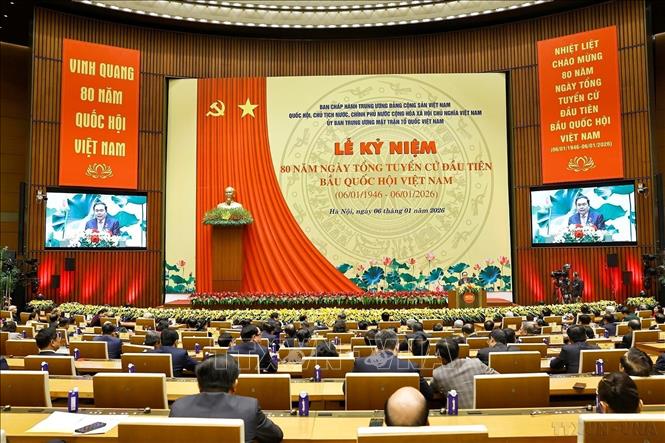
Commemoration of the 80th anniversary of the first general election to elect the National Assembly of Vietnam. Photo: Doan Tan/TTXVN
Over 80 years of formation and development, the Vietnamese National Assembly has consistently affirmed its position as the highest representative body of the people and the highest state power organ of the country. The election of deputies to the 16th National Assembly and deputies to People's Councils at all levels for the 2026-2031 term continues to be an opportunity for the people to elect worthy individuals, contributing to building a National Assembly of the people, for the people.
The National Assembly - an institution of power originating from the people.
In our country's political system, the National Assembly holds a particularly important position: it is the highest representative body of the people, the highest state power organ of the Socialist Republic of Vietnam. The National Assembly exercises constitutional and legislative powers, decides on important national issues, and exercises supreme oversight over the activities of the State.
The essence of the "People's National Assembly" is first and foremost reflected in the way this body is formed. The National Assembly is directly elected by voters nationwide according to the principles of universal, equal, direct, and secret ballot. Each National Assembly representative is a representative of the will and aspirations of the people, entrusted by the people with the power to decide on important national issues on their behalf.
Looking back at history, that democratic spirit has been affirmed since the early days of the nation's founding. On January 6, 1946, the first general election in the nation's history took place nationwide, electing the first National Assembly of independent Vietnam. The fact that over 89% of voters participated in the election demonstrated the people's faith and aspiration to control their own destiny. This was not only a momentous political event but also a milestone affirming a fundamental principle of our State: all state power belongs to the people.
The essence of the "People's National Assembly" is also clearly demonstrated through its structure and composition of representatives. The National Assembly brings together representatives from many social strata, ethnic groups, and sectors of national life. This diversity not only reflects the vibrant picture of national unity but also ensures the broad representation of the highest state power organ, where the voices and legitimate interests of all strata of the people are reflected and considered in the process of deciding on important national issues.
Throughout its 15 terms, the National Assembly, the highest organ of state power, has always been closely linked to the destiny of the nation. During the arduous years of resistance, the National Assembly made many historic decisions, mobilizing the entire nation to rise up and defend national independence and unity. In the period of reform, the National Assembly continues to improve the legal system, creating a legal foundation for the country's development.
It can be said that, throughout its more than eight decades, the Vietnamese National Assembly has always been the embodiment of the wisdom and will of the entire nation, and a crucial institution ensuring the people's right to self-governance in the country's political life.

Tam Lu commune, a mountainous border area in Thanh Hoa province, is ready for election day. Photo: Khieu Tu/TTXVN
The National Assembly acts in the interests of the people.
By its very nature, the National Assembly is elected by the people and represents their will and aspirations. It is responsible for acting in the best interests of the people through the performance of its important functions such as legislation, supreme oversight, and making decisions on major national issues.
First and foremost, in the legislative field, the National Assembly plays a crucial role in building and perfecting the legal system – the foundation of a socialist rule of law state. Laws are enacted to regulate social relations, ensure human rights and civil rights, and create a favorable legal environment for socio-economic development.
In recent years, the legislative activities of the National Assembly have been increasingly reformed in a democratic, scientific, and practical direction. Many draft laws are subject to extensive consultation with the people, experts, and scientists before being passed. This shows that each law is not only a product of the state power organ but also the culmination of the wisdom of the entire society.
Along with legislation, the National Assembly's supreme oversight function also plays a particularly important role. According to the Constitution, the National Assembly oversees compliance with the Constitution, laws, and resolutions of the National Assembly; reviews the work reports of important state agencies such as the Government, the Supreme People's Court, and the Supreme People's Procuracy… Through its oversight activities, the National Assembly, on behalf of the people, checks the exercise of state power, ensuring that state agencies operate in accordance with the law and serve the common interests of the people.
In recent parliamentary questioning sessions, the National Assembly has become a democratic forum where members frankly question government officials on issues of public concern. From economic development, resource management, and environmental protection to administrative reform and anti-corruption efforts, many pressing social issues have been openly discussed in parliament.
Through this process, the responsibilities of regulatory agencies are clarified, and many practical solutions are proposed to address the problems arising in practice. This contributes to affirming the role of the National Assembly not only as a law-making body but also as a body that supervises power, ensuring that the state apparatus operates in the interests of the people.

The polling station in Dai Thang block, Luong Van Tri ward, Lang Son province, inspects the ballot box. Photo: Van Dat/TTXVN
Members of Parliament – a bridge between the people and the State.
One of the key elements that constitutes the nature of a "People's Parliament" is the role of its members.
Members of the National Assembly are outstanding citizens, representing all strata of the people and ethnic groups throughout the country. They not only participate in deciding major national issues but also have the responsibility to listen to and reflect the thoughts and aspirations of their constituents.
Through interactions with constituents before and after each session, National Assembly representatives gather the opinions of the people to convey them to the parliament. Many important issues of social life discussed in the National Assembly originate from very specific suggestions from constituents at the grassroots level.
The National Assembly's activities are also becoming increasingly open, transparent, and closer to the people. National Assembly sessions are broadcast live; meetings with constituents are held regularly; and many channels for receiving public feedback have been expanded. This helps strengthen the bond between the National Assembly and the people, while also enhancing the accountability of representatives to their constituents.
Entering the 2026-2031 term, our country is facing new development demands. The process of industrialization, modernization, and deep international integration places increasingly high demands on perfecting the legal system, enhancing the effectiveness and efficiency of the state apparatus, and ensuring that major national decisions are carefully considered, scientifically sound, and in line with the requirements of rapid and sustainable development.
In this process, the role of the National Assembly becomes increasingly important. Practical experience shows that the quality of the National Assembly's work depends greatly on the quality of its representatives. A strong National Assembly must first and foremost be built upon representatives with firm political convictions, high intelligence and a strong sense of responsibility, who dare to speak up for the people, dare to fight for the common good, and have the capacity to participate in deciding on crucial national issues.
Therefore, selecting truly outstanding National Assembly deputies is of paramount importance. Each deputy needs not only impeccable moral character and strong political resolve, but also the necessary qualifications, capabilities, and social prestige to be worthy representatives of the people's will and aspirations, contributing to the building of an increasingly high-quality, effective, and efficient National Assembly.
The quality of the National Assembly stems from the quality of its representatives, and the quality of the representatives is determined by each vote of the elector. When voters carefully and wisely choose truly outstanding individuals with sufficient virtue and talent, the National Assembly will truly be a place where the intellect, courage, and aspirations for national development converge, thereby further affirming its nature: the National Assembly of the People, for the People.
Source: https://baotintuc.vn/thoi-su/quoc-hoi-cua-nhan-dan-vi-nhan-dan-20260315052956842.htm


![[Image] Hanoi's urban life under the challenge of a "scorching hot" environment](https://vphoto.vietnam.vn/thumb/1200x675/vietnam/resource/IMAGE/2026/05/25/1779706979265_nang-nong-t5-2026-minh-duy-7-4636-jpg.webp)
![[Image] Close-up view of the interchange connecting the two expressways and Long Thanh Airport.](https://vphoto.vietnam.vn/thumb/1200x675/vietnam/resource/IMAGE/2026/05/25/1779703378210_ndo_br_z7863716673926-224453a31600126cce10622af6290afd-4549-jpg.webp)











































































Comment (0)