

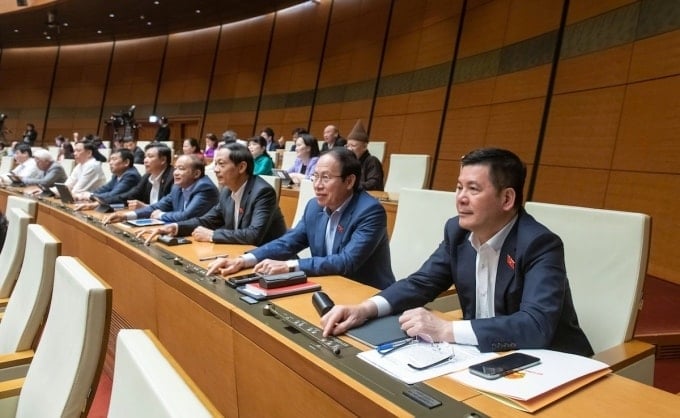
On the afternoon of November 30th, with over 91.6% of delegates voting in favor, the National Assembly passed the amended Electricity Law.
The draft Law on Electricity (amended) comprises 9 chapters with 130 articles, regulating electricity development planning and investment in electricity projects; development of renewable and new energy sources; electricity operating licenses; competitive electricity market, electricity prices, and electricity trading; responsibilities, rights, and obligations of organizations and individuals operating in the electricity sector and using electricity; operation and dispatch of the national power system, and management of electricity market transactions; protection of electricity infrastructure and safety in the electricity sector; and state management of electricity.
The amendment of the Electricity Law is considered very necessary and urgent in order to promptly institutionalize the Party's new guidelines and policies, creating a basis for breakthrough and decisive actions to develop the electricity sector.
At the same time, address the shortcomings and inadequacies of the current law and existing limitations such as: lack of clear and specific regulations for investing in emergency power projects; lack of comprehensive regulations on mechanisms to promote investment, construction, and exploitation of new and renewable energy sources; lack of regulations on specific mechanisms for developing offshore wind power, suitable to Vietnam's conditions in each period, to attract domestic and foreign investment; lack of policies for rooftop solar power and small-scale wind power serving the needs of households, government offices, and public works, ensuring compatibility with development goals and the conditions of the power system in each period...
Presenting a summary report explaining, receiving feedback, and revising the draft Law on Electricity (amended), the Chairman of the Committee on Science , Technology and Environment, Le Quang Huy, stated that to ensure the consistency of the legal system, the Standing Committee of the National Assembly has directed relevant agencies to review and unify the relevant contents, ensuring synchronization and consistency with the legal system, especially with the laws that the National Assembly considered and passed at the 8th Session on planning, investment, and bidding.
Regarding the development of electricity in rural areas, ethnic minority regions, mountainous areas, border areas, islands, and areas with particularly difficult socio -economic conditions, incorporating the opinions of National Assembly deputies, the draft Law has been revised and reflected in Clauses 3 and 13 of Article 5 and Article 17, clarifying the mobilization of investment capital for electricity development in rural areas, ethnic minority regions, mountainous areas, border areas, islands, and areas with particularly difficult socio-economic conditions, as well as the State's support for electricity costs for household use by poor households and social policy beneficiaries. In addition, the development of renewable energy depends on renewable energy sources, natural conditions, and technical infrastructure; in cases where rural, mountainous, and island areas meet the necessary conditions, preferential mechanisms will be applied to invest in the construction of renewable energy power plants as stipulated in this Law.
Regarding the elimination of cross-subsidization of electricity prices, the Standing Committee of the National Assembly believes that gradually reducing and eventually eliminating cross-subsidization between customer groups and regions is necessary in accordance with the spirit of Resolution No. 55-NQ/TW. Currently, retail electricity prices are applied uniformly nationwide, with cross-subsidization between regions. Cross-subsidization between customer groups needs to be gradually reduced and eventually eliminated through the development of a retail electricity pricing structure that reflects the costs incurred by the electricity system based on consumption characteristics.
The implementation of cross-subsidization in electricity prices depends on many factors (such as the progress and extent of restructuring the electricity sector, feasible financial policies/tools for implementing cross-subsidization reduction, etc.), requiring careful and thorough research and consideration to develop a specific roadmap; regulating the immediate elimination of cross-subsidization in electricity prices is not feasible. Therefore, the draft Law only stipulates a roadmap for eliminating cross-subsidization in electricity prices and assigns the Ministry of Industry and Trade to submit it to the Prime Minister for approval, with the roadmap to be implemented synchronously with the levels of electricity market development as shown in point d, clause 2, Article 39 and point c, clause 3, Article 50.
In response to the opinions of National Assembly deputies, the draft Law stipulates that the winning bid price is the maximum price for electricity buyers to negotiate with the winning bidder. It assigns the Government the responsibility to regulate the details of negotiating and concluding investment project contracts and power purchase agreements with winning bidders, ensuring the rights of all parties, as stipulated in Clause 2, Point c, Clause 3, Article 19. Regarding the forward electricity market, which is a new issue with no prior practical experience in Vietnam, a thorough impact assessment is needed before its inclusion in the draft Law. Therefore, the draft Law only stipulates general principles and assigns the Government the responsibility for detailed regulations, as shown in Clause 6, Article 45.
The draft Law on Electricity (amended), once passed, will contribute to accelerating the implementation of electricity projects and ensuring electricity supply security, especially in the context of very high and rapidly increasing electricity demand in the coming period. This also provides the legal basis for the Government to direct ministries and agencies to urgently and actively develop and finalize draft guiding documents for the implementation of the Law.
Source: https://baohaiduong.vn/quoc-hoi-thong-qua-luat-dien-luc-399286.html
![[Photo] General Secretary and President To Lam meets with National Assembly delegates from ethnic minorities.](https://vphoto.vietnam.vn/thumb/1200x675/vietnam/resource/IMAGE/2026/04/20/1776696701056_a1-bnd-8331-3342-jpg.webp)




![[Image] National Assembly discusses the implementation of the socio-economic development plan.](https://vphoto.vietnam.vn/thumb/1200x675/vietnam/resource/IMAGE/2026/04/20/1776696707422_ndo_br_img-20260420-185419-jpg.webp)




















































































Comment (0)