

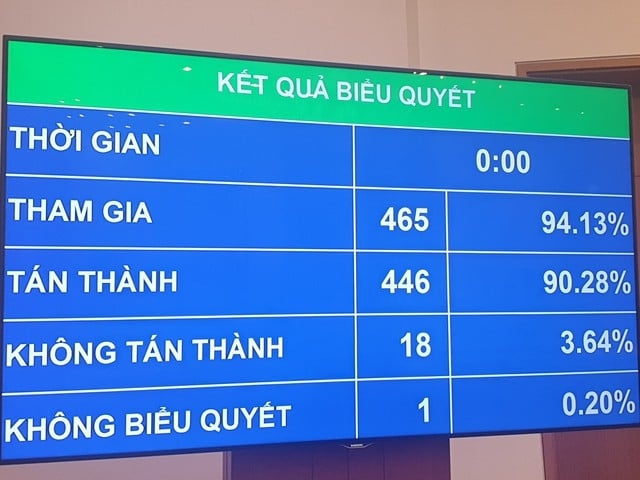
The National Assembly voted to approve the Resolution on the Program for drafting laws and ordinances in 2024, adjusting the Program for drafting laws and ordinances in 2023.
The resolution states that, from the beginning of the 15th National Assembly term to the present, despite facing many difficulties due to the impact of the COVID-19 pandemic and the complex and unpredictable developments in the world and region, and many new issues arising, the National Assembly, the Standing Committee of the National Assembly, the Government, and relevant agencies and organizations have made efforts to overcome difficulties and challenges, seriously implementing Conclusion No. 19-KL/TW of the Politburo on the orientation of the legislative program for the 15th National Assembly term and the legislative tasks according to Plan No. 81/KH-UBTVQH15 of the Standing Committee of the National Assembly, achieving many positive results.
The legislative process continues to be innovative, practical, and effective, promoting democracy, strengthening the rule of law, and emphasizing responsibility with a proactive legislative spirit, engaging early and from afar. A large number of laws, ordinances, and resolutions have been submitted to the National Assembly and the Standing Committee of the National Assembly for consideration and approval, completing the entire legislative program as planned, ensuring that the requirements for progress and quality are met.
The positive results achieved in legislative work have made a significant contribution to the comprehensive improvement of the development institution, strengthening the guarantee of human rights and civil rights, effectively serving the requirements of socio-economic development, ensuring national defense and security, international integration, and continuing to build and perfect the socialist rule of law state of Vietnam.
However, in the process of formulating and implementing the legislative program, there are still some shortcomings and limitations that need to be urgently addressed in order to further improve the quality and effectiveness of lawmaking in the future.
Regarding adjustments to the 2023 Law and Ordinance Drafting Program, the Resolution adds the following to the 2023 Law and Ordinance Drafting Program: Submit to the National Assembly for comments at the 5th session (May 2023) and adoption at the 6th session (October 2023) the draft Law on Forces Participating in Protecting Security and Order at the Grassroots Level.
The following draft laws will be submitted to the National Assembly for consideration at its 6th session (October 2023): Law on National Defense, Security and Industrial Mobilization; Law on Roads; Law on Road Traffic Order and Safety; Law on the Capital City (amended); Law on the Organization of People's Courts (amended); and the Law amending and supplementing a number of articles of the Law on Auctioning Assets.
Submitting the draft Ordinance on Litigation Costs to the Standing Committee of the National Assembly for comments and approval.
Regarding the legislative program for 2024, the Resolution stipulates that at the 7th Session (May 2024), the National Assembly will submit to approval 9 laws and 1 resolution, including: the Law on Social Insurance (amended); the Law on Archives (amended); the Law on National Defense, Security and Industrial Mobilization; the Law on Roads; the Law on Road Traffic Order and Safety; the Law on the Capital City (amended); the Law on the Organization of People's Courts (amended); the Law amending and supplementing a number of articles of the Law on Guarding (according to the procedure at one session); the Law amending and supplementing a number of articles of the Law on Auctioning Assets; and the National Assembly Resolution on the legislative program for 2025, adjusting the legislative program for 2024.
At the same time, nine draft laws were submitted to the National Assembly for consideration, including: the Law on Notarization (amended); the Law on Trade Unions (amended); the Law on Cultural Heritage (amended); the Law on Geology and Minerals; the Law on People's Air Defense; the Law on Urban and Rural Planning; the Law on Juvenile Justice; the Law amending and supplementing a number of articles of the Law on Pharmaceuticals; and the Law amending and supplementing a number of articles of the Law on Standards and Technical Regulations.
At the 8th session (October 2024), the National Assembly will approve 9 laws: the Law on Notarization (amended); the Law on Trade Unions (amended); the Law on Cultural Heritage (amended); the Law on Geology and Minerals; the Law on People's Air Defense; the Law on Urban and Rural Planning; the Law on Juvenile Justice; the Law amending and supplementing a number of articles of the Law on Pharmaceuticals; and the Law amending and supplementing a number of articles of the Law on Standards and Technical Regulations.
At the same time, two draft laws were submitted to the National Assembly for consideration: the Law on Gender Transition and the Law on Employment (amended).
The resolution requires the Standing Committee of the National Assembly, the Government, and all agencies, organizations, and individuals involved in the law-making process to uphold responsibility, strengthen discipline and order; ensure strict implementation of the legislative and ordinance drafting program; not propose adding projects to the program close to the National Assembly session, except in cases of genuine necessity and urgency, requiring timely implementation of the Party's guidelines and policies, conclusions and directives of the Politburo and the Secretariat; and thoroughly address the situation of submitting project and draft documents outside the prescribed deadlines.
If necessary, the Standing Committee of the National Assembly shall report to the National Assembly for consideration of holding additional sessions or extending the regular session time of the National Assembly, dividing the session into phases to consider, comment on, and pass more laws and resolutions that meet practical requirements.
Agencies, organizations, and individuals assigned to lead the drafting process must strictly and effectively summarize the implementation of laws, assess the impact of policies, solicit and incorporate feedback from agencies, organizations, individuals, and those affected, ensuring practicality and effectiveness.
The drafting process must adhere to high quality standards, closely follow and promptly institutionalize the Party's guidelines and policies, and meet the demands of reality; comply with the requirements in Conclusion No. 19-KL/TW of the Politburo and the principles for drafting and promulgating legal documents. A thorough review of relevant documents is necessary to identify and address inconsistencies; ensuring that conflicts, overlaps, and loopholes that could lead to corruption, negative practices, or the insertion of "group interests" or "local interests" in the proposal, development, and promulgation of policies and laws are avoided.
Source link

![[Photo] Prime Minister Pham Minh Chinh presides over a meeting on private sector economic development.](/_next/image?url=https%3A%2F%2Fvphoto.vietnam.vn%2Fthumb%2F1200x675%2Fvietnam%2Fresource%2FIMAGE%2F2025%2F12%2F20%2F1766237501876_thiet-ke-chua-co-ten-40-png.webp&w=3840&q=75)













































































Comment (0)