

Recently, Mr. Vu Anh Kiet (residing in Hoa Hung Ward, Ho Chi Minh City) needed to book a hotel room in Da Lat. He immediately came across numerous advertising pages on Facebook. These pages often posted videos and images of attractive hotels and had a high number of followers.
Mr. Kiet contacted a fan page called Park Hotel Dalat because it had a well-designed interface, polished images, and over 31,000 followers. This fan page advertised a hotel located at 115 Phan Boi Chau (Da Lat), and offered rooms from 700,000 to 900,000 VND per night, which was considered quite reasonable compared to the general market.
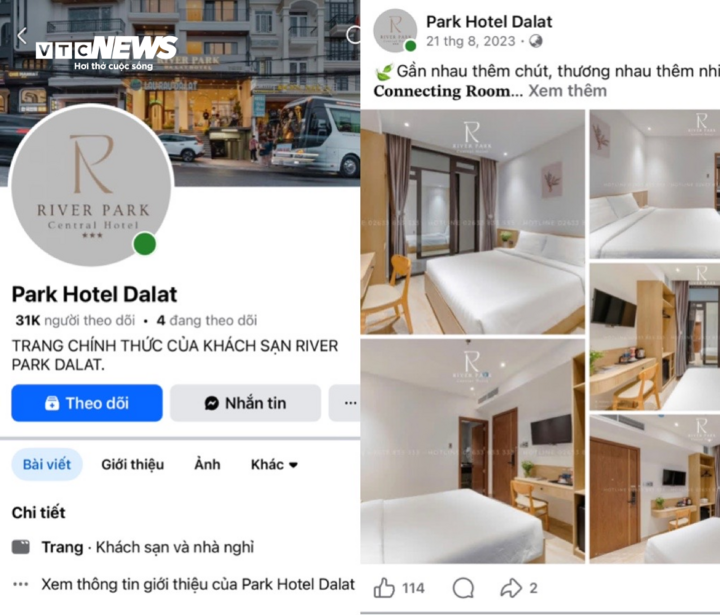
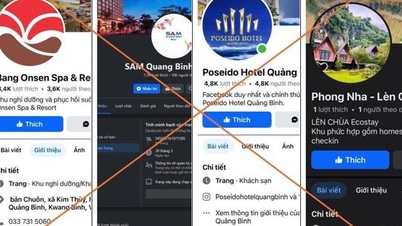
The advertising pages have a large following and eye-catching images. (Photo: Dai Viet)
After agreeing on a one-day stay, the fanpage requested Mr. Kiet to transfer 700,000 VND in advance to account number 230977467203 opened at VPBank to reserve the room.
However, shortly after receiving the money, the fanpage continued to inform him that his transaction was invalid due to incorrect transfer details, and requested that he correctly enter the code "TCLOO487U8". At this point, Mr. Kiet began to suspect something was wrong, as he believed that businesses are generally not very strict about the details of bank transfers when customers pay for rooms.
Furthermore, the fan page instructed him to contact a Facebook account named Duong Nhu Quynh, who was introduced as the hotel's accountant, to process the refund. This person then sent him a strange link under the pretext of assisting with the refund of the transferred money.
Noticing something unusual, Mr. Kiet did not access the link. According to him, if he followed the instructions and provided personal information or bank account details, the risk of having money stolen from his account would be very high.
Mr. Kiet requested a refund, but the website immediately blocked his communication.
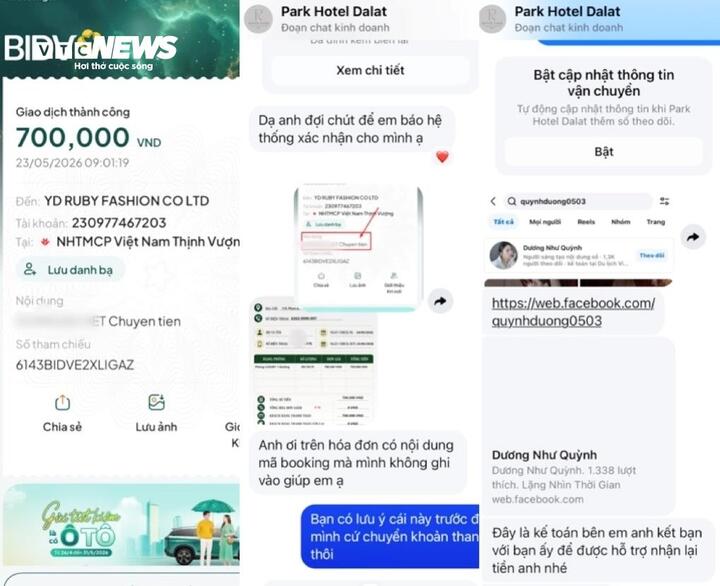
The advertisement instructed Mr. Kiet to contact a "fake" accountant to get a refund, but it was actually a ploy to carry out further fraudulent activities. If the victim is careless, they could lose all the money in their account if they click on the suspicious link. (Photo: Dai Viet)
According to an investigation by VTC News online reporters, the address 115 Phan Boi Chau is actually the business location of the River Park Central Hotel.
A representative from the hotel stated that recently, numerous fake fan pages have been impersonating the hotel to scam people out of their booking money. This summer, the number of people reporting being tricked into transferring deposit money has been on the rise.
"Some people were scammed out of up to 90 million VND, and one person was scammed out of 27 million VND; this is a significant loss," a hotel representative stated.
River Park Central Hotel advises people not to make deposits or payments for rooms in advance through unofficial fan pages or accounts. When making a reservation, people should contact the hotel directly via hotline or video call the hotel reception before making payment to minimize the risks from fake pages.
"People should contact the hotel via its hotline. This is the official and secure number as it has the Lam Dong area code 02633. We also do not have any promotions, so people need to be vigilant. Everyone should absolutely avoid clicking on any suspicious links to prevent losing money," a hotel representative said.

Ms. Nguyen Ngoc Huyen (residing in Nhieu Loc ward, Ho Chi Minh City) shared that her family was also scammed out of 1.8 million VND by individuals who booked hotel rooms online, trusting advertisements on social media. Because the amount was not large, her family did not report it to the authorities. Many of her friends have also been scammed in a similar way.
Ms. Vo Dai Tuong Vy, representative of Kavy Travel Co., Ltd., stated that hotel booking scams in Da Lat, Nha Trang, Phu Quoc, etc., have been rampant recently, causing public outrage. Because the amounts involved are usually not large, victims often do not report the incidents to the authorities. However, the total amount of money these scammers have stolen from people is considerable.
According to Ms. Vy, scammers often create advertising pages on social media, running campaigns to gain likes and interactions to build user trust, and many pages even have blue verification ticks to increase credibility. As a result, countless people have fallen victim to these scammers, with many losing tens of millions of dong.
Ms. Vy advised that people should only book rooms through reputable travel companies or through popular online booking applications with a large user base.
Recommendations from authorities
Recently, the Criminal Police Department (PC02) of the Ho Chi Minh City Police issued a warning about the increasingly complex situation of online tourism scams as the peak summer tourist season of 2026 approaches.
Accordingly, recently, the Ho Chi Minh City Police have continuously received complaints from people about being scammed when booking hotel rooms, homestays, or buying airline tickets through social media. Many victims lost from several million to tens of millions of dong after transferring deposit money to individuals impersonating reputable travel companies and agencies.
In addition, a common tactic nowadays is to create Facebook fan pages, groups, or Zalo accounts with interfaces similar to those of large hotels, homestays, or travel brands.
To build trust, these scammers spend money on extensive advertising campaigns with "golden hour combo deals," "last-minute tickets," "50% off tours," cheap 5-star hotels, or super-affordable overseas tours.
Notably, many fake fan pages are verified with a "blue checkmark" and use names very similar to the real brand, making it very difficult for users to distinguish them. Many people are careless because they see high follower counts and many positive comments, so they quickly transfer deposit money.
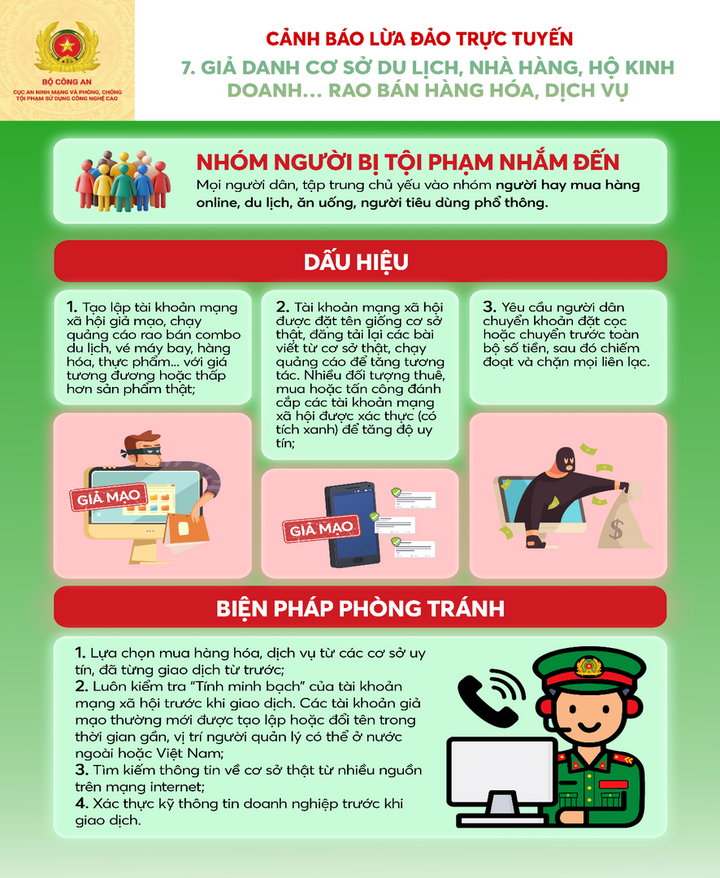
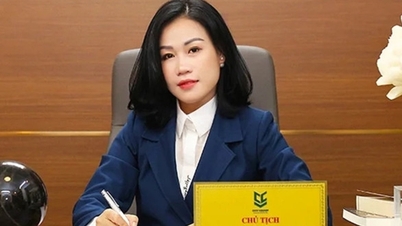
(Photo: Ministry of Public Security)
According to the Ho Chi Minh City Police, to gain absolute trust, the perpetrators also used hundreds of fake accounts to comment and praise the service, post photos of tourists as "feedback," and even forged bank transfer receipts, confirmations of successful flight and hotel bookings.
After the victims transfer the money (usually 50% to 100% of the service package value), the perpetrators immediately lock the account, block communication, or delete the fan page to erase all traces. Many families only discover they have been scammed when they arrive at the airport or their accommodation, only to find that the hotel has no booking information.
Besides cheap tour packages, PC02 reported a sharp increase in scams involving the rental of "fake" homestays and villas in popular tourist destinations such as Da Lat, Nha Trang, Da Nang, and Vung Tau.
Scammers often copy images and videos of luxury villas from the internet and repost them at unusually low prices to attract customers. When potential renters are still suspicious, the scammers send fake business licenses, rental contracts, or invoices with forged red stamps to build trust.

Many tourists are shocked to discover, after traveling hundreds of kilometers, that their homestay address doesn't exist or is just an ordinary house. Furthermore, with the surge in overseas travel during the summer, scams promising "100% visa approval," "super-fast processing," and "no financial proof required" are flourishing on social media.
According to PC02, the perpetrators exploited people's reluctance to deal with procedures and their desire for quick service to trick victims into paying tens of millions of VND in service fees along with their passports, citizen identification cards, and other important personal documents.
"Not only do people risk losing money, but they also risk having their personal data leaked. This information could be used by malicious actors to open fake bank accounts, borrow money through apps, or commit other illegal acts," a representative from PC02 warned.
To avoid becoming victims of travel scams, the Ho Chi Minh City Police Department advises people not to trust tours or packages that are unusually cheap compared to the market price.
People should carefully check the legal information of travel companies, prioritize transactions through official websites or apps, and call airlines, hotels, or resorts directly to confirm booking information before transferring money.
The police also advised citizens to be highly vigilant and limit money transfers to personal accounts, and to absolutely not provide photos of their citizen identification cards, bank account information, or OTP codes to strangers via social media.
In case of suspected fraud, people should save all messages and transfer receipts and promptly report it to the nearest police station for assistance.
Source: https://vtcnews.vn/ro-chieu-lua-dao-dat-phong-khach-san-ar1021608.html













































![[Video] Sunset at Lap An Lagoon – Where the sun sets over the fishing nets](https://vphoto.vietnam.vn/thumb/1200x675/vietnam/resource/IMAGE/2026/05/31/1780192137701_beach-landscape-sea-water-nature-grass-745871-pxhere-com.jpeg)




























Comment (0)