The ships did not return to the sea.
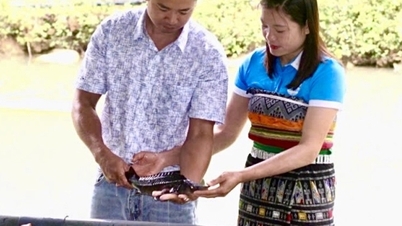
Bending over to change the water and feed his ornamental fish, the calloused hands of Mr. Truong Minh Chanh, from Dau Giong hamlet, Tran De commune, accustomed to pulling nets and steering large boats through rough seas, now meticulously pick each strand of seaweed for the small fish he keeps in a glass tank. This gentle task is not yet familiar to a seasoned net-pulling "fisherman" like him, but it is the truth.

Due to difficult fishing conditions, Mr. Truong Minh Chanh no longer relied on fishing for his livelihood and switched to selling ornamental fish.
After more than 20 years working in offshore fishing, Mr. Chanh decided to sell his fishing boat, once his greatest asset, his pride, and the source of his family's livelihood. "The fishing grounds are shrinking, fish and shrimp stocks are dwindling, and every trip is a loss-making venture. I can't bear it anymore, so I've decided to end my life at sea and switch to selling... ornamental fish," Mr. Chanh shared.
Tran De commune has over 320 offshore fishing vessels. But as marine resources are depleted and fishing efficiency plummets, everyone understands that change is necessary. Mr. Pham Thanh Huy, a fisherman from Tran De commune who has been working at sea for many years, expressed his concerns: “I’m worried about not having a stable job when I ‘move ashore.’ I could start a small business, but the biggest obstacle right now is capital. Fishermen have been at sea for years, accumulating very little, and now if they want to change professions, they need capital to invest. I hope the government will have policies to support people in obtaining the necessary capital for a suitable career transition.”



Many other fishing families share the same concerns. Mr. Nguyen Quoc Hao, Deputy Head of the Economic Department of Tran De Commune, said: "The local authorities have recognized the difficulties faced by fishermen and are actively proposing to higher levels the need for mechanisms and policies to support capital for boat owners who wish to switch professions."
Restructuring the marine industry
Currently, the city has approximately 785 fishing vessels, with over 300,000 workers involved in the fishing industry; nearly 5,700 people are directly engaged in small-scale coastal fishing activities...
In response to this situation, the city is implementing a project to transform the marine fishing industry, taking into account its impact on the environment and aquatic resources. The goal is to reduce the number of fishing vessels by at least 70 by 2030, develop 3-5 effective livelihood models, and provide vocational training for over 600 workers. The transformation is not limited to reducing the number of fishing vessels. Further ahead, it involves restructuring the entire marine industry, shifting a portion of the workforce to aquaculture, fisheries logistics services, ship repair, seafood processing, and coastal ecotourism .
According to Ms. Quach Thi Thanh Binh, Deputy Director of the City's Department of Agriculture and Environment, the unit will advise on the development of comprehensive support programs to help people stabilize their livelihoods while contributing to the protection of aquatic resources and limiting illegal fishing. In addition, the city is assessing the needs to implement policies supporting the transition to new occupations for fishing vessels that are no longer in operation.
These actions by the city are seen as a necessary step, because focusing on protecting aquatic resources without addressing the livelihoods of fishermen makes the policy difficult to implement. The fishing industry, already arduous and demanding, is now facing a turning point of change. The adaptability of individuals like Mr. Chánh and Mr. Huy, along with decisive and coordinated steps from the government, hopefully will create an effective direction for Can Tho's marine economy.



Text and photos: SONG LE
Source: https://baocantho.com.vn/roi-bien-and-noi-lo-sinh-ke-moi-a207366.html
![[Photo] "Hanoi Lotus Festival" honors the lotus flower that has been associated with Vietnam for thousands of years.](https://vphoto.vietnam.vn/thumb/1200x675/vietnam/resource/IMAGE/2026/06/27/1782516943048_sen-ha-noi-2026-minh-duy-1-jpg.webp)