

Recently, the stage has seen a surge in the emergence of seriously staged political dramas that not only possess high ideological value but also provide entertainment.
A beautiful impression from the staging techniques.
A clear example is the play "Comrade" (written by Le Thu Hanh, directed by People's Artist Tran Ngoc Giau and Quoc Thinh), which evoked many emotions in the audience thanks to its unique staging techniques, creating a powerful story about comrades who once fought bravely on the battlefield but now face harsh realities in peacetime when money corrupts their conscience.
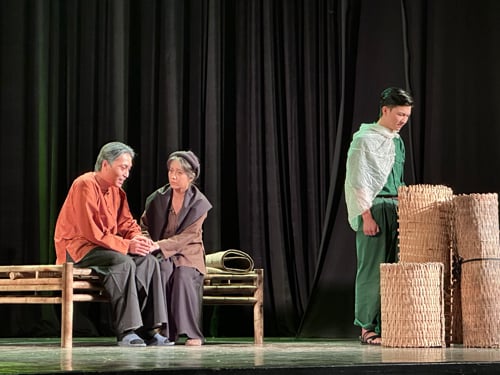
A scene from the play "If I Were Still Alive" by the Hong Hac Theatre. (Photo: HOANG THUAN)
Many audience members were moved to tears by the unwavering loyalty of the party members who maintained their political stance and served as role models for their descendants. Although this was a theme of revolutionary ideals, under the skillful hands of author Le Thu Hanh and directors People's Artist Tran Ngoc Giau and Quoc Thinh, the play was not dry but became very realistic and overflowing with emotion in an extraordinary way.
Mr. Lee Jung Nam, President of the Busan Theatre Association in South Korea, watched the play "Comrade" twice and decided to invite it to perform at the Busan Theatre Festival in 2025.
Similarly, the Trinh Kim Chi Theatre has two plays, "Two Mothers" (written by Le Thu Hanh, directed by People's Artist Trinh Kim Chi) and "That Day at the Gate of Heaven" (written by Nguyen Khang Chien, directed by People's Artist Trinh Kim Chi), which have brought a new dimension to this stage, following the premiere of "Aspiration for Tomorrow" (written by Tran Van Hung, directed by People's Artist Tran Minh Ngoc) - a script that won the A prize in the "Forever One Love" themed writing competition launched by Ho Chi Minh City. All three plays have created a strong appeal, partly demonstrating the powerful influence of dramatic works on the stage life in Ho Chi Minh City.
Experts acknowledge that all three plays offer a fresh perspective on how people today view the past, transforming pride and revolutionary spirit into a driving force contributing to the nation's progress. All three plays not only contain powerful propaganda but also skillfully incorporate relatable details, offering genuine and heartfelt humor, allowing audiences to easily empathize and follow the characters throughout the performance.
"Above all, it's the innovative approach to staging techniques that makes political plays more engaging, transforming them from dry, propagandistic performances into something vibrant and flourishing on today's stage," commented Meritorious Artist Ca Lê Hồng, a member of the Arts Council of the Ho Chi Minh City Department of Culture and Sports .
The Ho Chi Minh City Drama Theatre, with its play "Aspiration for Peace " (written by Ngoc Truc, directed by People's Artist Tran Ngoc Giau), also made a beautiful impression at the Ho Chi Minh City Theatre Festival, bringing to the stage another extremely simple yet meaningful political commentary. Previously, the Ho Chi Minh City Small Stage Drama Theatre, with its play "Ancient Traces" (written by Nguyen Thanh Binh, directed by People's Artist Tran Minh Ngoc), was awarded the Innovation prize and performed not only at the "5B" stage but also organized over 100 performances at cultural centers, agencies, enterprises, organizations, schools, etc., serving audiences of all ages. The Hong Hac Theatre's premiere of "If I Were Still Alive" (written by Viet Linh, directed by Viet Linh and Le Chi Na) at the Youth Cultural Center also created a sensation with the author's very new perspective on war.
Regarding the socialized cải lương (Vietnamese traditional opera) art units and the Trần Hữu Trang Theater, political themes have consistently attracted attention in recent times with plays such as: "Red Coral", "The Song of the Hau River", "People on the Suburbs"...
Soon, young director Tran Ngoc Nha Thy will stage "Tears of Deep Affection" by author Hoang Song Viet, also on a political theme, which will premiere at the Tran Huu Trang Theater after she completes her university directing program.
Elevating the art
People's Artist Tran Minh Ngoc commented: "Renewing political drama on stage, transforming seemingly dry scripts into plays with real life, is a challenge to elevate the artistic level of the Ho Chi Minh City stage today. Doing everything possible to ensure the stage can still find a different and attractive approach requires not only serious and meticulous investment in staging but also innovation in approach."
I am very pleased that plays and traditional Vietnamese operas, particularly those focusing on war, revolution, and the lives of city dwellers during the new urban development period, such as "Aspiration for Tomorrow," which revolves around the city's newly operational metro line, have received enthusiastic reception from audiences of all ages.
"That's a positive sign and shows that the audience not only enjoys laughing at entertaining topics but also likes to reflect on the true, good, and beautiful perspectives on today's society in this civilized, modern, and compassionate city," analyzed People's Artist Tran Minh Ngoc.
In fact, according to People's Artist Nguyen Thi Thanh Thuy, Deputy Director of the Department of Culture and Sports of Ho Chi Minh City, communication and promotion are crucial factors in attracting public attention. Currently, both public and private art organizations have made efforts to build professional communication teams, helping works to spread widely. Following the success of the Ho Chi Minh City Theater Festival, the Department of Culture and Sports of Ho Chi Minh City will organize performances to promote award-winning works, bringing the stage with political themes closer to the public.
According to Meritorious Artist Le Thien, political and social themes in plays and Cai Luong (Vietnamese traditional opera) still hold an independent place in the hearts of the public. Younger audiences may not be familiar with them at first, but after watching plays/Cai Luong for a while, they will find them interesting. This demonstrates the responsibility and duty of artists towards the theater scene in Ho Chi Minh City.
People's Artist Thoại Miêu believes that political stories told through the staging of artistic units have captivated many audiences, even achieving high revenue, which is clear evidence. "More importantly, theaters and artistic units, both public and private, need to be commissioned by the state to continue creating and staging political works. In my opinion, sponsors and businesses should not only provide financial support, but they can also help spread the works widely to the public through sponsoring performances, supporting the organization of promotional tours... as the play 'Dấu xưa' (Ancient Traces) has done," People's Artist Thoại Miêu shared.
The current challenge is how to ensure that political drama theater doesn't just serve political purposes or only lights up for festivals and competitions, but also harmoniously combines artistic value with the entertainment needs of audiences of all ages?
According to People's Artist Thanh Dien, to address this issue, specific solutions are needed to attract and train young playwrights, creating opportunities for those with the ability to create theatrical works to participate in creative workshops organized by the Ho Chi Minh City Theater Association.
This approach simultaneously meets the requirement for scripts with profound literary content and provides an engaging experience from the perspective of today's youth, ensuring that political plays are sufficiently appealing to the public.
Source: https://nld.com.vn/san-khau-sang-den-with-nhieu-vo-chinh-luan-196250225210246148.htm







































Comment (0)