

 |
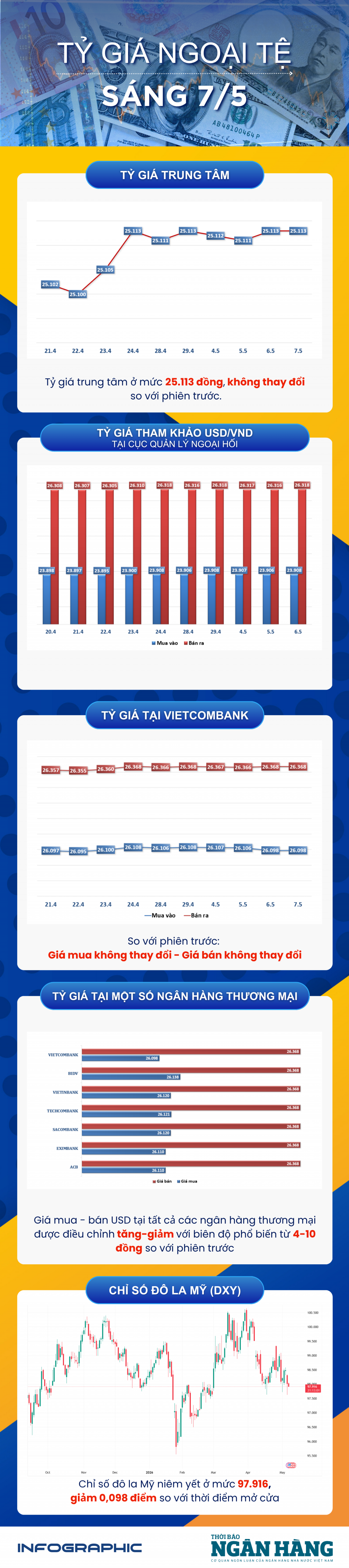
The US dollar continued to maintain its strength in today's trading session, as global investors prioritized safe-haven assets amid ongoing Middle East tensions that showed no signs of easing, while markets began adjusting expectations regarding the interest rate paths of major central banks.
The USD Index fluctuated around 97-98 points, remaining near its multi-week high. The euro traded around 1.17 USD/EUR, while the yen remained in weak territory near 157-158 JPY/USD, despite recent brief recoveries.
The latest developments show that the foreign exchange market remains heavily influenced by the conflict in the Middle East, particularly the uncertainties surrounding the Strait of Hormuz.
Despite some signals of dialogue between the US and Iran in recent days, investors remain cautious as the risk of energy supply disruptions has not been completely ruled out. The continued high oil prices are fueling concerns about a resurgence of inflation in many major economies .
Kyle Rodda, an analyst at Capital.com, commented that the market is in a state of "high alert," because although the risk of military escalation has somewhat subsided, the impact of the energy shock is still lingering and could continue to put pressure on global growth.
In this context, the USD continues to benefit from its role as a safe-haven asset and the advantage of the US as a net energy exporter. Conversely, energy-import-dependent economies such as Japan and the eurozone are under greater pressure.
According to OANDA's analysis, the yen is facing a difficult situation, being impacted by both rising oil prices and pressured by the large interest rate differential between the US and Japan. This significantly diminishes the yen's traditional role as a "safe haven" currency in the current period.
The market is also closely watching the reaction of the Bank of Japan (BOJ), especially as the USD/JPY exchange rate continues to approach the 160 level, a threshold that previously prompted Tokyo to intervene in the foreign exchange market.
Meanwhile, the euro continues to face pressure from weak growth prospects and the risk of stagflation, a situation where slow growth is accompanied by high inflation due to rising energy costs. Some experts believe the European Central Bank (ECB) may be forced to maintain its hawkish monetary policy for longer than expected if price pressures persist.
Commodity currencies like the AUD and NZD have tended to recover slightly in recent sessions thanks to more stable market sentiment, but remain highly volatile depending on oil price movements and geopolitical situations.
Investors are now shifting their attention to key US economic data, particularly the labor market and inflation, to assess whether the Fed will continue to maintain high interest rates for a longer period.
According to many international financial institutions, as long as tensions in the Middle East persist and energy prices do not significantly cool down, the USD is likely to maintain its superior position in the global currency market.
Source: https://thoibaonganhang.vn/sang-75-ty-gia-trung-tam-di-ngang-181590.html
![[Image] Close-up view of the interchange connecting the two expressways and Long Thanh Airport.](https://vphoto.vietnam.vn/thumb/1200x675/vietnam/resource/IMAGE/2026/05/25/1779703378210_ndo_br_z7863716673926-224453a31600126cce10622af6290afd-4549-jpg.webp)


![[Image] Hanoi's urban life under the challenge of a "scorching hot" environment](https://vphoto.vietnam.vn/thumb/1200x675/vietnam/resource/IMAGE/2026/05/25/1779706979265_nang-nong-t5-2026-minh-duy-7-4636-jpg.webp)





























































































Comment (0)