

On the morning of December 19th, the Ministry of Education and Training (MOET) held an online meeting with localities regarding the arrangement and organization of public preschool, primary, secondary, and continuing education institutions.
Most localities will retain the same schools in 2025.
Presenting the report on the implementation of the arrangement and organization of preschool, primary, and continuing education institutions according to the two-tiered local government model, the Director of the Department of General Education, Thai Van Tai, stated that the network of schools and classrooms has generally been completed, meeting the requirements of universal education. However, a clear disparity exists between different regions.

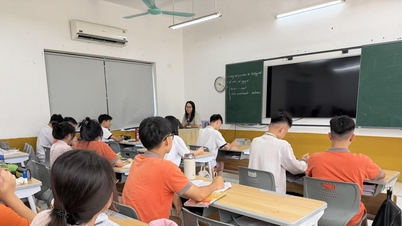
In large cities and industrial zones, the average student-to-class ratio is high, reaching 37.8 students per class in primary schools and 44.5 students per class in lower secondary schools; in Hanoi and Ho Chi Minh City alone, some classes have over 55 students. Conversely, in the mountainous regions of Northern Vietnam and the Central Highlands, many schools are small, with class sizes of only about 18 students per class, and some even have to organize combined classes.
School facilities continue to improve. According to Circular No. 23/2024/TT-BGDĐT, the maximum size of primary schools has been adjusted to 40 classes, an increase of 10 classes compared to the previous regulation.
The arrangement and organization of educational institutions are being implemented based on the conclusions, plans, and directives of the Politburo, the Secretariat, and the Central Steering Committee, emphasizing the principle of maintaining existing educational institutions, decentralizing management of preschool, primary, and secondary schools to the commune-level authorities, and completing the arrangement of public educational institutions at the commune level before December 31, 2025.
According to reports compiled from 23 out of 34 provinces and cities submitted to the Ministry of Education and Training as of 12 PM on December 18th, most localities will maintain the current structure of preschools, primary schools, junior high schools, and high schools in 2025 and develop a roadmap for reorganization after the end of the 2025-2026 school year.
The initial restructuring has contributed to streamlining administrative structures, reducing management staff, reassigning teachers and staff, and addressing localized shortages and surpluses. However, some localities have merged schools mechanically and on a large scale in a short period, potentially overloading facilities and affecting the model of ethnic boarding and semi-boarding schools, as well as the right to access education for students in disadvantaged areas.

A roadmap is needed to build consensus among the public and the teaching staff.
At the online conference, representatives from many localities agreed that the restructuring of the school network should be carried out cautiously, with a roadmap, without disrupting teaching and learning activities, ensuring students' learning rights and the stability of the teaching staff.
Mr. Nguyen Vinh Hung, Deputy Director of the Department of Education and Training of Hue City, said that the city has decided to maintain the stability of educational institutions under the Department's management, only considering restructuring at the commune and ward levels when absolutely necessary and ensuring safe travel conditions for students, especially in disadvantaged areas and border regions.
According to Mr. Hung, the restructuring of the school network must be linked to investment in boarding and semi-boarding schools to create stable and long-term learning conditions for students in special areas.
Sharing the same view, Mr. Phung Quoc Lap, Deputy Director of the Phu Tho Department of Education and Training, emphasized that rearranging the school network is a sensitive issue that requires a suitable roadmap, linked to communication efforts, and creating consensus among the people and the teaching staff.

In his concluding remarks at the conference, the Permanent Deputy Minister of Education and Training, Pham Ngoc Thuong, noted that the restructuring of the school network is not about mechanical reduction, nor is it about chasing after a reduction in the number of schools or school branches. The highest goal is to improve the quality of education, ensure students' right to education, and guarantee better teaching conditions for teachers.
The Deputy Minister of Education and Training emphasized three overarching requirements in reviewing and reorganizing the network of educational institutions: sufficient schools, sufficient classrooms, and sufficient teachers, but these must be sufficient in a reasonable manner, appropriate to the practical conditions of each locality.
On behalf of the Ministry of Education and Training, Deputy Minister Pham Ngoc Thuong requested that specialized units continue to research and review the completion of standards regarding schools, teaching staff, and student numbers according to new conditions; and at the same time, compile the infrastructure investment needs of localities as a basis for advising on the allocation of resources from the medium-term public investment plan and national target programs.
Source: https://daidoanket.vn/sap-xep-cac-truong-cong-lap-than-trong-co-lo-trinh.html
![[Photo] General Secretary and President To Lam presides over a meeting with the Central Organizing Committee.](https://vphoto.vietnam.vn/thumb/1200x675/vietnam/resource/IMAGE/2026/06/03/1780482764658_a1-bnd-4741-3342-jpg.webp)
![[Photo] Secretary of the National Assembly Party Committee, Chairman of the National Assembly presides over the meeting of the Standing Committee and Executive Committee of the National Assembly Party Committee.](https://vphoto.vietnam.vn/thumb/1200x675/vietnam/resource/IMAGE/2026/06/03/1780480353201_ndo_br_bnd-2585-jpg.webp)
![[Photo] First session of the 14th Congress of the Vietnam Trade Union](https://vphoto.vietnam.vn/thumb/1200x675/vietnam/resource/IMAGE/2026/06/03/1780465947883_ndo_br_img-3852-jpg.webp)


![[Image] Checking the security conditions at the exam site, ready for the 10th grade exam.](https://vphoto.vietnam.vn/thumb/402x226/vietnam/resource/IMAGE/2026/05/28/1779943458889_z7872507660648-d764421a26e8cd7b61d70d142a48a685-jpg.webp)








































![[Video] Sunset at Lap An Lagoon – Where the sun sets over the fishing nets](https://vphoto.vietnam.vn/thumb/1200x675/vietnam/resource/IMAGE/2026/05/31/1780192137701_beach-landscape-sea-water-nature-grass-745871-pxhere-com.jpeg)






























Comment (0)