

Flexible approach
Recognizing this as a new and challenging task that directly impacts the lives of the people and grassroots officials, the province established a Steering Committee to develop an implementation roadmap and required localities to implement it synchronously and closely from the survey and plan development stages to gathering public opinion.
Based on that guiding principle, many localities in the province have proactively found flexible approaches that suit their practical conditions, meeting the requirements of restructuring while also creating consensus among the people.
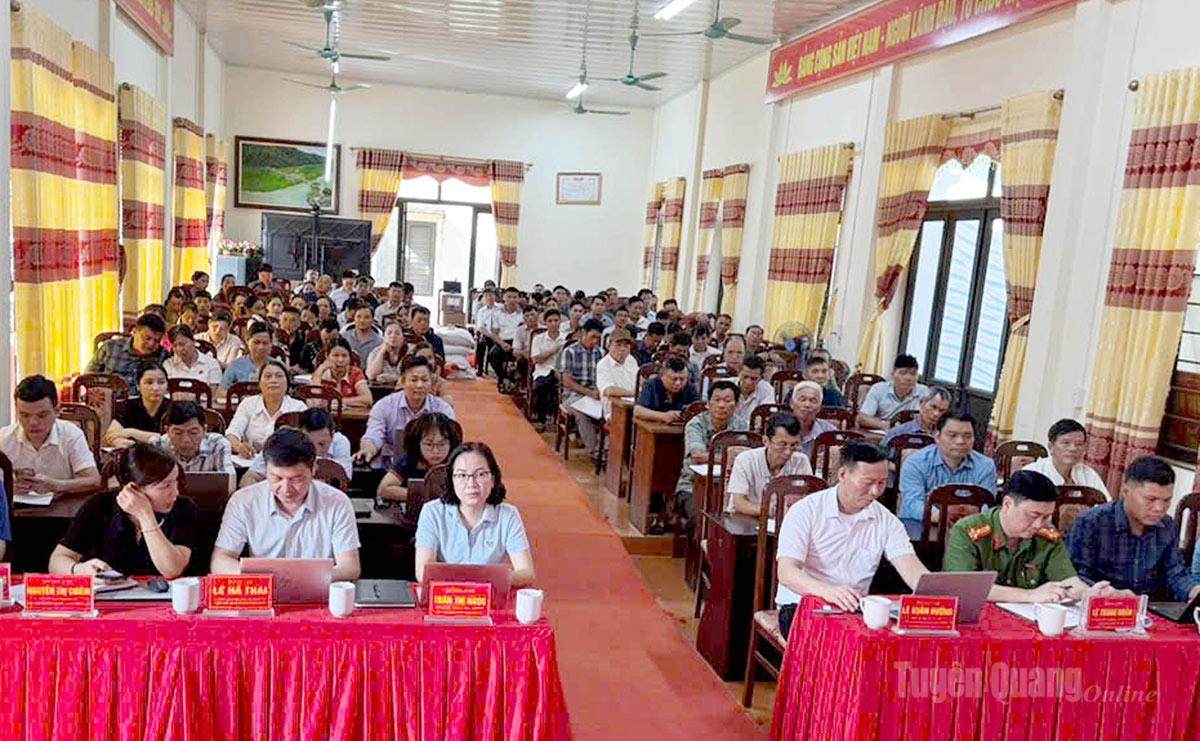 |
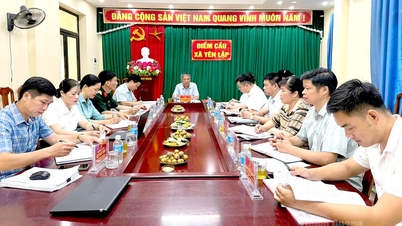
| Phu Linh commune organized a conference to gather public opinion on the reorganization of villages according to Directive No. 21 of the Prime Minister . |
After merging with Na Khuong commune, Xuan Giang commune has a large area, a fragmented hilly terrain, and an unevenly distributed population with many ethnic groups living together. The commune currently has 18 villages, and is expected to have 9 villages after reorganization.
According to Comrade Tran Trung Thanh, Secretary of the Party Committee of Xuan Giang commune, the locality did not implement the relocation in a mechanical way but prioritized practical factors. During the planning process, the commune paid special attention to geographical distance, transportation conditions, living habits, and cultural characteristics of each community.
"We believe that the reorganization is not only about reducing bureaucracy but, more importantly, about facilitating people's daily lives, meetings, and access to community activities; while preserving the cohesion and cultural identity of each locality," said Comrade Tran Trung Thanh.
Thanks to its practical approach, the commune's proposed reorganization plan received high levels of public support. Many believe that calculations based on geographical distance and demographic characteristics will make it easier for residents to participate in community activities after the merger.
In Phu Linh commune, the village reorganization process was also implemented in a democratic, transparent manner, with the opinions of the people at the center. The commune's Steering Committee organized meetings in each village to fully inform the people about the policy, listen to their thoughts and aspirations before finalizing the plan.
Comrade Luu Duc Hung, Secretary of the Phu Linh Commune Party Committee, shared: “After the merger, it is expected that representatives from each of the old villages will participate in the leadership and management of the new village. This will help reassure the people and at the same time leverage the experience and prestige of the grassroots officials. Regarding the old village cultural centers, the local authorities have agreed to use them on a rotational basis to serve community activities, avoiding waste of facilities.”
According to the report, as of May 28th, 109 out of 124 communes and wards in the province had submitted their plans to the Provincial People's Committee. After compilation and evaluation, most of the plans met the requirements of Prime Minister's Directive No. 21 and adhered to the principles and guidelines outlined in Resolution No. 96 of the Provincial Party Committee.
Arrangement and assignment of non-professional personnel.
Along with organizational restructuring, the arrangement, utilization, and resolution of policies and regulations for part-time officials is a matter of particular concern for the province. As of April 30, 2026, the province still has 1,159 cases of former part-time officials who were assigned to support advisory and support agencies of the Party Committee, the Fatherland Front Committee, and political and social organizations, as well as the government at the commune and ward levels.
Since the administrative unit reorganization, the province has resolved the entitlements and policies under Government Decree No. 154 for nearly 2,364 cases of redundant non-professional personnel. Payments have been made publicly, transparently, and to the correct recipients. However, there are still over 100 cases that have not completed the procedures to implement the downsizing scheme as prescribed. At the village level, after review, it is projected that after the reorganization is completed, approximately 4,000 to 5,000 non-professional personnel will receive entitlements and policies under Government Decree No. 154. This is a large number, requiring thorough preparation in terms of resources, funding, and implementation plans.
In reality, the majority of part-time community workers in villages and residential areas are dedicated individuals with prestige within their communities. Many have been involved in this work for decades, making positive contributions to mediation, mobilizing people to implement the Party's guidelines and the State's policies and laws, building a cultural life, and maintaining security and order in their localities.
Therefore, addressing the benefits and policies for this force is not only about implementing legal regulations but also about recognizing their contributions throughout their careers. In addition, many localities are encouraging those who have left the force to continue leveraging their prestige and experience, participating in community activities, mediation groups, self-governing groups, and emulation movements in residential areas.
As one of the part-time community workers who were laid off after the reorganization of residential areas, Mr. Nguyen Duc Hung, former official of the Fatherland Front in residential area 12, Ha Giang 1 ward, said that despite having many years of experience working at the grassroots level, he fully agrees with the policies of the Party and the State.
“The reorganization of villages and residential areas is necessary to streamline the administrative apparatus and improve the efficiency of operations at the grassroots level. I, like many other officials, believe that the common good must be prioritized. All levels and sectors have clearly explained and implemented policies and regulations, so we feel reassured, agreeable, and ready to comply. Even though I no longer hold this position, I will continue to participate in community activities whenever the locality needs me,” Mr. Hung shared.
When the grassroots apparatus is streamlined, the staff is more rationally organized, policies and regulations are fully and promptly implemented, and the rights of the people are guaranteed, the goal of building an efficient, effective, and effective grassroots political system will be increasingly realized, creating an important foundation for localities to improve the quality of governance and service to the people in the new development phase.
Text and photos: Van Nghi
Source: https://baotuyenquang.com.vn/xa-hoi/202606/sap-xep-hop-ly-dam-bao-quyen-loi-nhan-dan-c041107/
![[Photo] Secretary of the National Assembly Party Committee, Chairman of the National Assembly presides over the meeting of the Standing Committee and Executive Committee of the National Assembly Party Committee.](https://vphoto.vietnam.vn/thumb/1200x675/vietnam/resource/IMAGE/2026/06/03/1780480353201_ndo_br_bnd-2585-jpg.webp)



![[Photo] General Secretary and President To Lam presides over a meeting with the Central Organizing Committee.](https://vphoto.vietnam.vn/thumb/1200x675/vietnam/resource/IMAGE/2026/06/03/1780482764658_a1-bnd-4741-3342-jpg.webp)















![[Infographic] Over 1,400 intellectual property infringement cases processed after 3 weeks of implementing Directive 38](https://vphoto.vietnam.vn/thumb/402x226/vietnam/resource/IMAGE/2026/06/04/1780545194110_infographic-xu-ly-hon-1-400-vu-xam-pham-quyen-so-huu-tri-tue-sau-3-tuan-thuc-hien-cong-dien-38_20260604090937.webp)
























![[Video] Sunset at Lap An Lagoon – Where the sun sets over the fishing nets](https://vphoto.vietnam.vn/thumb/1200x675/vietnam/resource/IMAGE/2026/05/31/1780192137701_beach-landscape-sea-water-nature-grass-745871-pxhere-com.jpeg)







![[Photo] General Secretary and President To Lam attends the 14th Congress of the Vietnam Trade Union](https://vphoto.vietnam.vn/thumb/402x226/vietnam/resource/IMAGE/2026/06/04/1780543339765_anh-man-hinh-2026-06-04-luc-10-22-07.png)























Comment (0)