

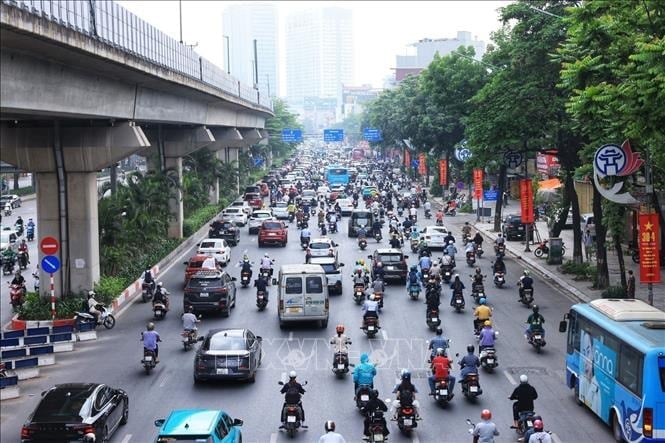
This is one of the strategic solutions aimed at reducing CO₂ emissions, supporting the "net zero emissions" target by 2050 that the Prime Minister committed to at COP26. However, this target is also causing concern among manufacturers, as well as many experts who are worried about the feasibility of the draft.
97% of gasoline-powered cars are at risk of being taken out of the market.
According to the draft of the new National Technical Standard prepared by the Ministry of Construction , from 2030, the average fuel consumption (CAFC) of all new passenger car models manufactured, assembled, and imported in Vietnam must reach 4.83 liters/100 km.
However, this target is causing significant concern among manufacturers. The Vietnam Automobile Manufacturers Association (VAMA) argues that this is an "excessively strict" level that could have a "huge impact and almost completely alter the status quo of the Vietnamese automotive industry."
According to VAMA's research, with a target of 4.83 liters/100 km by 2030, most traditional gasoline-powered (ICE) vehicles and even some hybrid vehicles currently on the Vietnamese market will not meet this standard. Specifically, 96% of traditional gasoline-powered vehicles and 14% of current hybrid vehicles will not meet the standard.
Although not specifically named, some of the most fuel-efficient hybrid models currently available in Vietnam include the Honda CR-V e:HEV RS with advanced technology, yet the manufacturer's stated combined fuel consumption is still 5.2 liters/100 km; the Toyota Innova Cross Hybrid at 4.92 liters/100 km; and the KIA Sorento HEV at 5.9 liters/100 km... When fuel standards are tightened, these models will struggle to meet the proposed figure of 4.83 liters/100 km.
Furthermore, considering the period from 2026 to 2030, most VAMA members will not meet the overall average fuel consumption target for the entire enterprise in the first year or throughout the entire period of regulation implementation, even after taking into account the efforts of enterprises to transform product technology.
Therefore, to meet the fuel consumption target of 4.83L/100 km, automakers would have to stop selling up to 97% of their current traditional gasoline-powered models. Alternatively, to maintain sales volume, businesses would have to dramatically increase the production of electrified vehicles (hybrid cars, plug-in hybrid cars, fully electric cars) by up to 868% in just five years.
VAMA argues that this is almost "impossible" because the charging station infrastructure and power grid do not yet meet the demand. Consumers are not yet ready to switch to electric vehicles. The domestic automotive industry will be strongly impacted, affecting production, jobs, and government revenue.
Businesses propose a more "harmonious" roadmap.
In light of the aforementioned challenges, VAMA has proposed a more "reasonable" implementation roadmap. Specifically, the average fuel consumption target is set at 6.7 liters/100 km in 2027; reduced to 6.5 liters/100 km in 2028; further reduced to 6.3 liters/100 km in 2029; and stabilized at 6 liters/100 km by 2030.
According to VAMA's calculations, under this scenario, Vietnam can still achieve its international commitment to reduce CO₂ emissions by 15.66 million tons by 2030, while minimizing the impact on the market compared to the 4.83 liters/100 km scenario. If this roadmap is adopted, automakers will still need to make significant efforts in restructuring their product portfolios (reducing gasoline-powered vehicle production by approximately 34% and increasing electrified vehicle production by at least 366%), but it will be more feasible.
This proposal also received input and support from associations and regulatory bodies in the United States and Japan. Representatives from these countries all argued that the current target was too strict and suggested extending the adjustment and transition period to give manufacturers more time to adapt.
The American Automobile Manufacturers Association (AAPC) recommends that Vietnam maintain its target of 6 liters/100 km by 2030 and only reduce it to 4.83 liters/100 km after 2035. Meanwhile, the Japan Automobile Manufacturers Association (JAMA) agrees with the 6 liters/100 km target and proposes extending the production adjustment period from 3 years to 5 years, in line with the development cycle of electric and fuel-efficient vehicle technology.
Automotive industry experts believe that reducing CO₂ emissions and improving energy efficiency are inevitable trends. However, the reality is that charging infrastructure is not yet widespread, the cost of electric vehicles remains high, while the vast majority of Vietnamese people still choose gasoline-powered cars due to price and convenience. A target of 6 liters/100 km by 2030 is more feasible, ensuring both technological advancement and market stability.
Representatives from the Ministry of Construction, the lead agency in drafting the document, stated that they have fully noted all opinions and will study them before reporting to the competent authorities, aiming to ensure both the fulfillment of commitments to reduce greenhouse gas emissions and the stability of the domestic automotive industry.
Industry experts also believe that the issue of fuel consumption limits for cars is not just a technical standard, but a decision with far-reaching impacts on consumers, businesses, and the entire automotive industry.
Automotive expert Nguyen Minh Dong, M.Sc., engineer at Volkswagen's Design and Testing Center (Germany), argues that issuing fuel consumption standards without accompanying requirements for gasoline quality is an approach that is not entirely correct from a technical standpoint and does not fully understand modern engine technology. Mr. Dong emphasized that the issue lies not in the technological capabilities of car manufacturers, but in whether the engine is using the correct type of fuel that meets the standards.
Mr. Dong also pointed out the experience in Europe, where instead of imposing a single fuel consumption figure, the regulatory agency directly controls CO2 emissions, which is both more accurate and fairer, because fuel consumption depends on the type of vehicle, engine capacity, and weight. It's impossible to lump everything together and apply a single figure. A 1.5L car cannot have the same standards as a 3.0L car.
To address this, automotive expert Nguyen Minh Dong proposed a three-step roadmap: Mandating that gasoline sold meet Euro 5 standards at least one year before any new regulations for vehicles; directly applying international emission standards such as Euro 5 and Euro 6 instead of setting their own figures; and giving manufacturers at least two years to prepare.
Source: https://baolamdong.vn/siet-chuan-nhien-lieu-can-lo-trinh-hai-hoa-hon-391468.html


![[Photo] Prime Minister Pham Minh Chinh presides over a meeting on private sector economic development.](/_next/image?url=https%3A%2F%2Fvphoto.vietnam.vn%2Fthumb%2F1200x675%2Fvietnam%2Fresource%2FIMAGE%2F2025%2F12%2F20%2F1766237501876_thiet-ke-chua-co-ten-40-png.webp&w=3840&q=75)






















































































Comment (0)