(NLĐO) - Data from NASA's observational facilities has baffled scientists by revealing an Earth-sized object is "befriending" a black hole.
An international research team has detected unprecedented signals from the monstrous black hole at the center of the galaxy 1ES 1927+654, located 270 million light-years away in the constellation Draco.
"In 2018, the black hole began changing its properties right before our eyes, with massive bursts of optical, ultraviolet, and X-ray radiation," NASA quoted Associate Professor Eileen Meyer from the University of Maryland at Baltimore County (UMBC).
Many scientists have been tracking the "monster heart" of 1ES 1927+654 ever since.
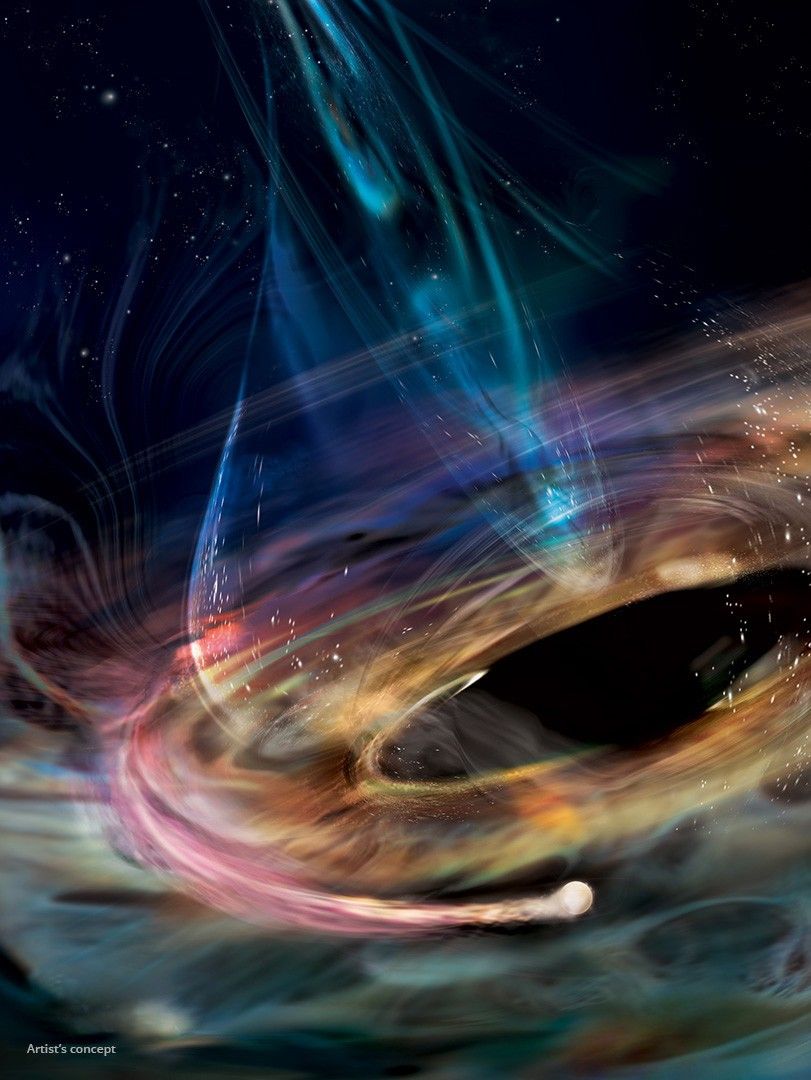
Graphic depicting an Earth-sized white dwarf star living next to a monstrous black hole - Image: NASA/Aurore Simonnet
By 2023, an international research team led by UMBC and NASA's Goddard Space Flight Center had observed a steady increase over several months of low-energy X-rays emanating from this black hole.
This is evidenced by data from numerous observation facilities of NASA and ESA (European Space Agency).
A more in-depth study in 2024 revealed a powerful and extremely unusual radio burst emanating from the black hole, with streams of ionized gas, or plasma, stretching from both sides of the monstrous entity, totaling about half a light-year in size.



Overall data from different years also shows that the X-ray signal from this black hole continuously increases and decreases by 10% every few minutes.
Researcher Megan Masterson from the Massachusetts Institute of Technology (MIT), a co-author, concluded: "One way to create these oscillations is with an object rotating around the black hole's accretion disk."
This discovery is astonishing, given the extremely harsh environment surrounding black holes. Even more surprising is that this mysterious object is currently existing stably right on the edge of the black hole's event horizon.
The event horizon is the inner boundary of spacetime, a limit that anything that falls into will never reach the observer again.
Over the course of more than two years, the oscillation period of the mysterious object decreased from 18 minutes to just 7 minutes, which is quite normal when something is too close to a black hole and its orbit is shortened by the monstrous gravitational pull of this creature.
However, a surprising development occurred when the latest signals revealed a stable oscillation cycle. Therefore, the mystery behind the object's ability to resist the power of a supermassive black hole becomes an even more intriguing question.
"We were shocked by this at first," the research team admitted.
But then they realized there was a possibility: As the object moved closer to the black hole, matter began to be stripped from it by its massive companion.
This loss of mass can compensate for the energy taken away by gravitational waves, preventing inward movement.


![[GALLERY] 20-Year-Old Compact Cameras Unexpectedly Make a Comeback Thanks to Gen Z](https://vphoto.vietnam.vn/thumb/192x108/vietnam/resource/IMAGE/2026/06/24/1782275945979_anh-1-png.webp)
So what could this companion be? - NASA asks.
A small black hole would plunge headlong into a monstrous black hole, while a normal star would be quickly torn apart by tidal forces.
The study, scheduled for official publication in the February issue of the scientific journal Nature, suggests that a white dwarf the size of Earth is the most plausible answer.
White dwarfs are the "zombie" remnants of Sun-like stars after they run out of energy and collapse.
Source: https://nld.com.vn/soc-voi-trai-dat-tu-coi-chet-hien-ra-tu-bo-vuc-lo-den-196250120094449817.htm

![[Image] Paris's oldest bridge goes viral after transforming into a giant cave.](https://vphoto.vietnam.vn/thumb/1200x675/vietnam/resource/IMAGE/2026/06/24/1782283441197_ndo_br_dsc05314-jpg.webp)



![[Photo] Prime Minister Le Minh Hung presides over the thematic session on promoting science and technology development and innovation.](https://vphoto.vietnam.vn/thumb/1200x675/vietnam/resource/IMAGE/2026/06/23/1782207872934_ndo_br_dsc-1724-jpg.webp)



![[GALLERY] Google's free AI feature is causing a sensation, Vietnamese people are using it a lot.](https://vphoto.vietnam.vn/thumb/402x226/vietnam/resource/IMAGE/2026/06/24/1782277759727_ni-1-png.webp)


![[GALLERY] 20-Year-Old Compact Cameras Unexpectedly Make a Comeback Thanks to Gen Z](https://vphoto.vietnam.vn/thumb/402x226/vietnam/resource/IMAGE/2026/06/24/1782275945979_anh-1-png.webp)