

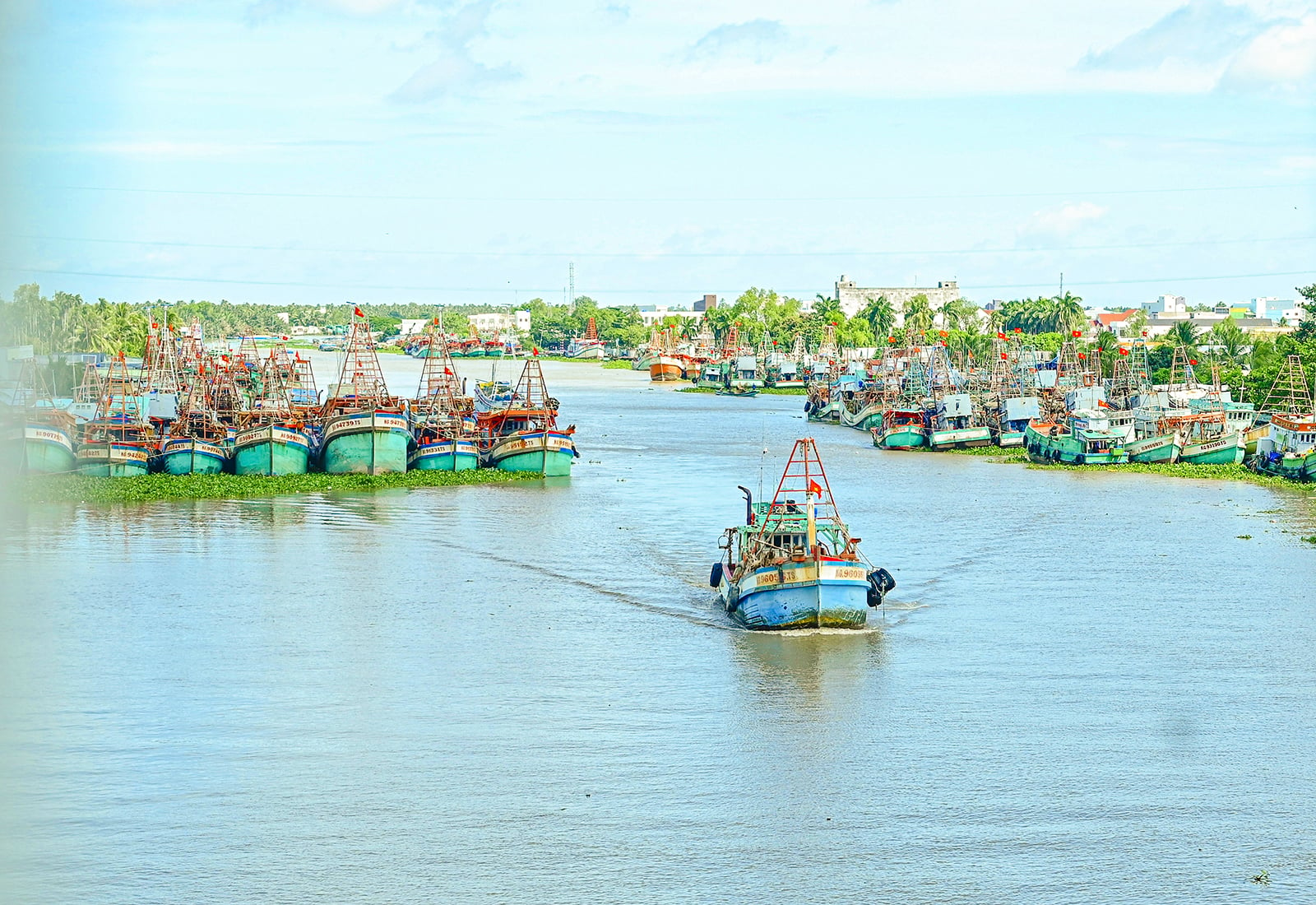
Fishing boats anchored on the Cái Bé river. Photo: PHAM HIEU
Following the small concrete road running parallel to the Cai Be River, we stopped at the garden of Mr. Du Van Thai, residing in An Ninh hamlet, Binh An commune. From afar, the garden resembled a multi-layered ecological painting: above were lush green coconut trees, in the middle were rows of straight betel nut trees, and below were long stretches of pineapple plants.
In his garden spanning over 2 hectares, Mr. Thai's hands nimbly cut ripe pineapples, preparing them for delivery to his customers. Mr. Thai shared: “This riverside land is enriched with alluvial soil year-round, and during the severe dry season, saltwater intrusion is mild. Previously, rice was grown here, but the yield wasn't high due to the low-lying terrain and frequent flooding. Then, people switched to gardening using a three-tiered ecological model, providing both fruit for consumption and a stable income.”
According to Mr. Thai, the coconut-areca-pineapple model maximizes land use and creates a harmonious ecosystem, resulting in a profit of approximately 200 million VND per year. Besides practicing a three-tiered ecological model, the people of Tac Cau islet also utilize the canal surface area for fish farming. Thanks to their diligence, hard work, and application of scientific advancements, especially the establishment of a collective brand for Tac Cau pineapples, the income of the people here is significantly higher than many other agricultural models. “Coconuts, areca nuts, and pineapples don't compete for sunlight, so they are suitable for planting in the same area. When fertilizing pineapples, all three benefit. Most importantly, if one type of fruit loses value at harvest, the others compensate, minimizing losses,” Mr. Thai said.
Recalling the impoverished times, Mr. Thai said that the area was mostly inhabited by Chinese immigrants who settled there around the 1930s. Back then, the land was vast, the population sparse, and the vegetation dense, making transportation difficult, mainly by boat. Due to the low-lying terrain, agricultural production faced many challenges. To cope, people built dikes around the islets and planted nipa palms outside to protect against waves and erosion. Each plot of land also had its own embankment and underground drainage system with valves to prevent the orchards from being flooded… “Now, the lives of people along the banks of Cai Be and Tac Cau islets are more prosperous thanks to agricultural production, fishing, and trade and services,” Mr. Thai confided.
While stories of change unfold on the shore, the life of fishermen on the Cai Be River is vibrant. Mr. Nguyen Van Duoc takes his boat out into the middle of the river with a few nets and some simple tools. Mr. Duoc says, “Back then, I used to go fishing for fish and shrimp with my father on the Cai Be and Cai Lon rivers. There used to be so much; you could just cast your nets and come back to collect as much as you wanted. Now there’s less, but I can’t bring myself to give up the profession.”
Mr. Được is over 60 years old this year. His eyes are deeply wrinkled. His hands are calloused and tanned. For him, the Cái Bé and Cái Lớn rivers are his livelihood and a repository of memories. His entire life has been intertwined with the water, from the time he followed his father rowing boats to set traps, to when he got married, had children, and now his children have grown up and gone to work far away, leaving only him and his wife behind, still clinging to the river day after day…
At midday, Mr. Duoc pulled in his net. Today's catch only consisted of a few small freshwater fish, but he still smiled: "We eat what we get; as long as there's water, we can still make a living."
As evening falls, the winding bends of the Cai Be River become bustling. Trawling boats are moored close together. On the boats, fishermen are busily preparing for their next trip out to sea. “Along the Cai Be and Cai Lon rivers, many people make a living from fishing. Fishing is hard work; they spend many days at sea before returning to shore. Although it's tough, it's thanks to this that many generations have been able to make a living and raise their children to be successful,” Mr. Duoc said.
At the end of the day, the Cai Be River becomes enchanting, bathed in the golden hues of the sunset. Smoke from the houses along the river rises, carrying the aroma of cooked rice and fragrant braised fish, like a call for everyone to return home and reunite after a hard day's work.
| The Cái Bé River flows from Hòa Hưng commune through several communes in the western part of the Hậu River region. In the lower reaches, the Cái Bé River, along with the Cái Lớn River, encircles the Tắc Cậu islet, finally emptying into Rạch Giá Bay. |
PHAM HIEU
Source: https://baoangiang.com.vn/song-cung-dong-cai-be-a483717.html
![[Photo] National Assembly Chairman Tran Thanh Man working with the Standing Committee of the National Assembly's Ethnic Council](https://vphoto.vietnam.vn/thumb/1200x675/vietnam/resource/IMAGE/2026/05/21/1779337435930_ndo_br_1-jpg.webp)

![[Image] "Journey of Hope" promotes the organ and tissue donation movement in Vietnam.](https://vphoto.vietnam.vn/thumb/1200x675/vietnam/resource/IMAGE/2026/05/20/1779294400833_1-8910-jpg.webp)







































































Comment (0)