

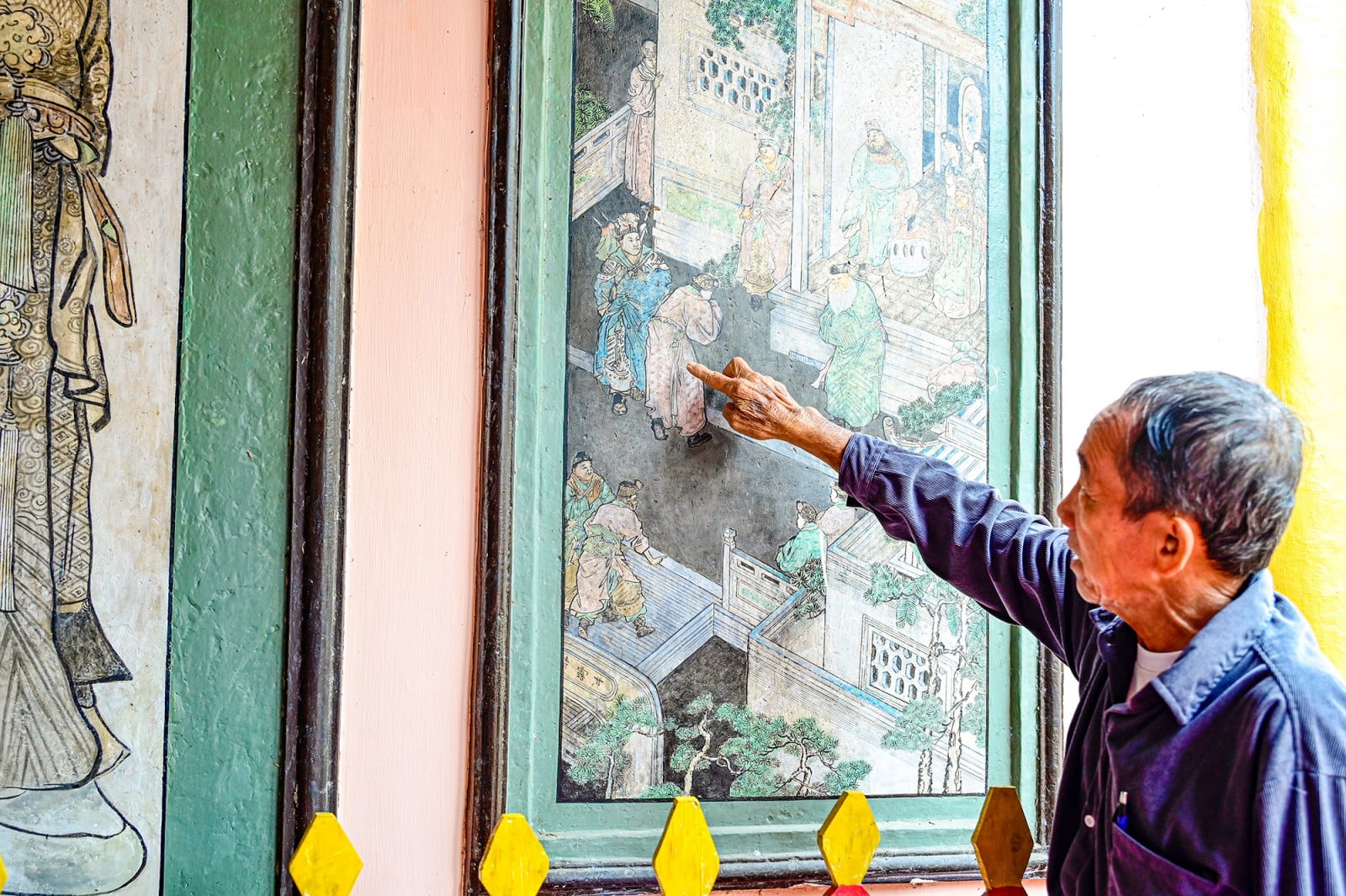
A mural depicting famous scenes and anecdotes from Chinese history and literature. Photo: PHAM HIEU
The predecessor of Quan Đế Pagoda was Vĩnh Lạc Temple, built by the Chinese community in 1752 to worship the ancestors who contributed to the founding of the village. In 1837, Vĩnh Lạc Temple was rebuilt and renamed Già Đá Ancient Temple. In 1852, Emperor Tự Đức bestowed the title of Quan Thánh Đế Temple upon the temple. In 1882, the temple was rebuilt again, finally completed in 1925, and officially named Quan Đế Pagoda, a name it retains to this day.
Having looked after the temple for many years, Mr. Trinh Van Hoa said that it is not only a place of religious activity for the Chinese community in An Giang but also a structure preserving many unique cultural and artistic values. Besides the beauty of its ancient architecture, the system of murals in the temple, painted since 1924, are valuable works of art. This system consists of 12 paintings on the left and right walls of the temple, each with a poem written in elegant cursive Chinese characters, creating a lively and beautiful effect. “The paints are special, so even though they are over a hundred years old, they all retain their original lines and colors. Therefore, these murals are also rare evidence of Vietnamese-Chinese folk art in the southern region,” Mr. Hoa said.
Each mural depicts famous stories from Chinese history and literature. Particularly striking is the "Oath of Brotherhood in the Peach Garden," where Liu Bei, Guan Yu, and Zhang Fei raise their cups and swear an oath of brotherhood, evoking the chivalrous spirit of the heroes of the Three Kingdoms era. Another impressive scene is "Guan Yu's Crossing Five Passes and Slaying Six Generals." The image of Guan Yu, with his red face, wielding his Green Dragon Saber, and riding his warhorse into battle, is portrayed with great majesty. The strong, decisive lines demonstrate the skillful craftsmanship of the ancient artisans. Beyond expressing loyalty and righteousness, the paintings also convey the moral values that the Chinese people have always upheld: loyalty, integrity, and trustworthiness… “Through each painting, viewers are transported into the world of historical stories and classic Eastern literature. All of this creates a vibrant, cinematic composition, even though they were painted centuries ago,” Mr. Hoa shared.
Beyond their artistic value, the murals at Quan De Pagoda reflect the rich spiritual life of the Chinese community in An Giang. These paintings, depicting historical events and ancient legends, serve as a way for ancestors to pass on moral lessons to their descendants about filial piety, unity, and the spirit of overcoming hardship in a foreign land. Mr. Ly Tan An, a resident of Rach Gia ward, shared that in the cultural life of the Chinese community, Guan Yu is not only a historical figure but also considered a symbol of loyalty and integrity. Therefore, the frequent appearance of Guan Yu in the murals reflects the community's belief and aspiration for goodness, helping to protect peace, ward off bad luck, and bring good fortune.
"In Chinese temples, especially those of the Teochew, Cantonese, and Fujian ethnic groups, there are always murals depicting stories from the Three Kingdoms period with flowing and vivid brushstrokes. These murals are not only entertaining stories but also educational lessons about loyalty and the moral principles of the nation," Mr. An said.
Today, Quan De Pagoda is a unique cultural intersection between the Chinese and Vietnamese communities in the Southwestern region of Vietnam. The centuries-old murals are vivid evidence of the long history of cohabitation and cultural exchange in this land. Through each brushstroke and color imbued with the passage of time, viewers can sense the depth of history and the aspiration to preserve their roots of generations of the Chinese people in the South.
Source: https://baoangiang.com.vn/buc-tranh-bich-hoa-tram-nam-a486234.html

![[Photo] General Secretary and President To Lam receives Amazon's Senior Vice President David Zapolsky](https://vphoto.vietnam.vn/thumb/1200x675/vietnam/resource/IMAGE/2026/05/22/1779466547770_a1-bnd-3513-6601-jpg.webp)

































































Comment (0)