

In Ca Mau , the Provincial People's Committee has just issued a plan to implement traceability for agricultural, forestry, and aquatic products for the period 2026-2030, with the goal of expanding the data transparency system for key products and products under the One Commune One Product (OCOP) program to serve both domestic and export markets.
Previously, the locality had implemented traceability for an additional 20 new OCOP products from 17 production facilities, with over 62,000 QR codes issued and data updated on the province's traceability portal.
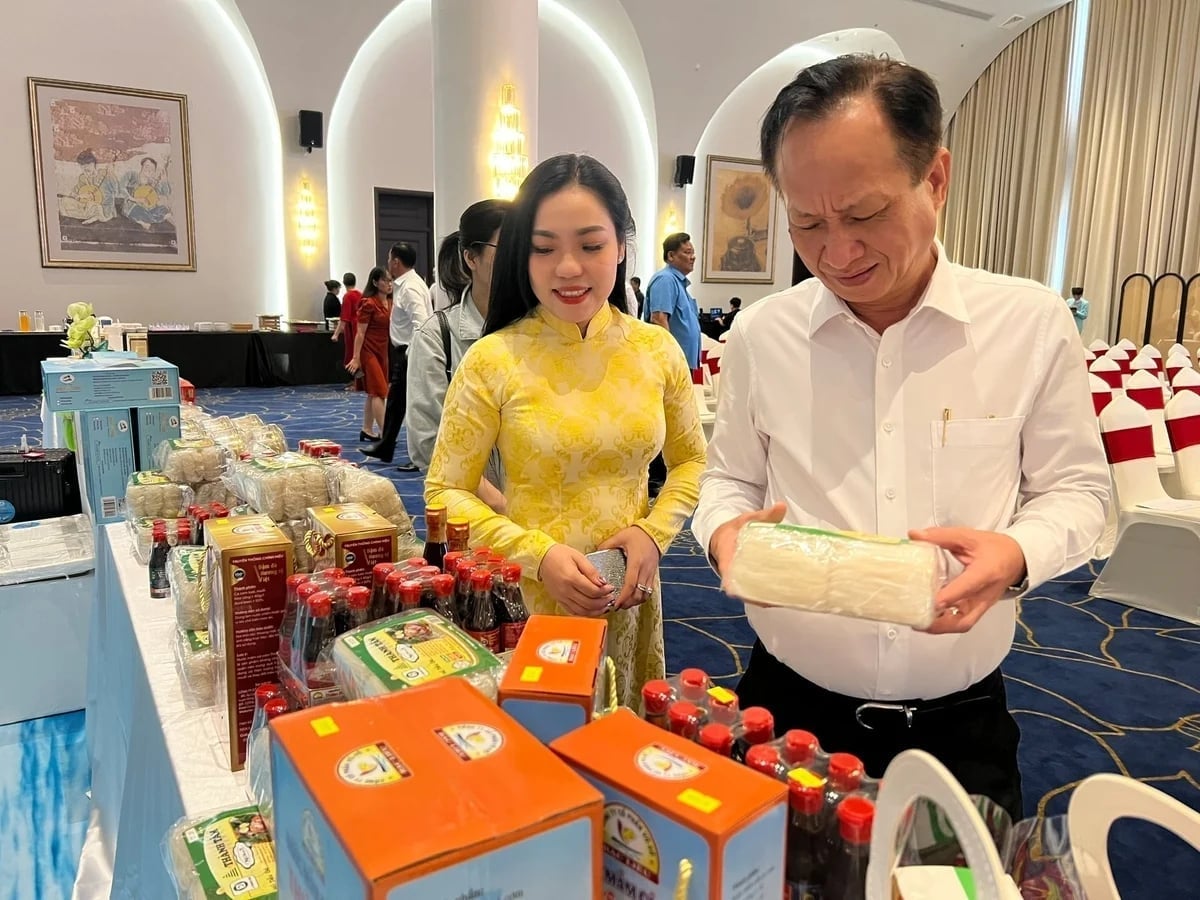
Ca Mau is stepping up digital transformation in trade promotion and consumption of OCOP products. Photo: Trong Linh.
In Dong Nai , the OCOP program for 2025-2026 is shifting its focus to enhancing the commercial capacity of local businesses. In addition to product ranking and evaluation, many establishments are receiving support in improving packaging and labeling, standardizing processes, and connecting to retail distribution systems.
According to the City People's Committee, participating in the OCOP program helps many local products increase their value and expand their access to supermarkets and modern distribution channels.
Meanwhile, some localities such as Tuyen Quang, An Giang , and Ho Chi Minh City have begun expanding the OCOP program by linking it with traceability, data standardization, and local experiences. Ho Chi Minh City has even included OCOP products in the priority group for applying traceability systems in its 2026 implementation plan.
These changes show that the approach to OCOP in many localities has differed from the initial stages of the program's implementation. While previously the OCOP label was primarily seen as an identifier for local specialties, many places are now beginning to view it as a guarantee mechanism for product quality, origin, and reputation.
That trend is also institutionalized in Decision 358/QD-VPDP-OCDL of the Central Office for New Rural Development Coordination on the promulgation of regulations on the management and use of OCOP certification marks.
In this context, OCOP is defined as a "certification mark" registered for intellectual property protection and used to certify Vietnamese OCOP products. The trademark owner is the Central Office for New Rural Development Coordination under the Ministry of Agriculture and Environment.
The regulations also specify the conditions for using the certification mark. Accordingly, organizations and individuals wishing to use the OCOP logo on packaging, promotional materials, or business vehicles must have products that have been certified with 3 stars or more and whose certification is still valid.
Products bearing this label must meet the specifications, standards, and quality requirements as outlined in the registration and evaluation dossier approved by the competent authority.
In addition to regulating the right to use, the regulations also establish a mechanism for inspecting and monitoring the use of the certification mark. The Central Office for New Rural Development Coordination authorizes provincial People's Committees and local OCOP management agencies to organize inspections and monitoring of entities using the mark in their respective areas.
The monitoring content includes checking product characteristics, quality standards, and detecting intellectual property infringement related to the certification mark.
Another noteworthy point is that the regulations include a mechanism for suspending and revoking the right to use the certification mark in cases of infringement. Actions such as affixing the mark to products that do not meet the requirements, providing false or misleading information to consumers, or continuing to use the mark after suspension are all considered violations of the regulations.
The maximum suspension period is 6 months; if the violation is not rectified, the organization or individual may have their right to use the certification mark revoked.
The unified management of certification marks aims to "protect the reputation, enhance the value, economic efficiency, and competitiveness" of OCOP products in domestic and international markets.
This reflects the context of the OCOP program entering a new phase of development, with an increasing number of products (currently over 10,000 products nationwide) and market demands no longer limited to local specialties. The OCOP criteria have also expanded to include requirements for traceability, management capacity, brand development, and commercialization potential.
In fact, in many localities, this process has been underway for the past few years. From focusing on achieving "star ratings," many OCOP (One Commune One Product) entities have invested in packaging, quality standards, data traceability, and branding to maintain market trust. With the new regulations, these requirements are gradually being placed within a unified management framework at the national level.
Source: https://nongnghiepmoitruong.vn/tu-nhan-ocop-den-cam-ket-ve-thuong-brand-quality-d812654.html

![[Image] Hanoi's urban life under the challenge of a "scorching hot" environment](https://vphoto.vietnam.vn/thumb/1200x675/vietnam/resource/IMAGE/2026/05/25/1779706979265_nang-nong-t5-2026-minh-duy-7-4636-jpg.webp)
![[Image] Close-up view of the interchange connecting the two expressways and Long Thanh Airport.](https://vphoto.vietnam.vn/thumb/1200x675/vietnam/resource/IMAGE/2026/05/25/1779703378210_ndo_br_z7863716673926-224453a31600126cce10622af6290afd-4549-jpg.webp)


































































































Comment (0)