

Improving the quality of domestic soybean varieties.
Soybean cultivation, once a vital crop in Vietnam's agriculture , is experiencing a sharp decline in acreage each year. According to statistics from the General Statistics Office, while the country had approximately 200,000 hectares of soybeans in 2010, this figure is projected to drop to only about 20,000 hectares by 2025, a decrease of 90%.
In contrast to the shrinking domestic soybean growing area, soybean imports have increased rapidly year after year. In 2010, Vietnam imported approximately 270,000 tons of soybeans, and this is projected to increase to around 1.5-2 million tons by 2025. This indicates a growing demand for soybeans in Vietnam.
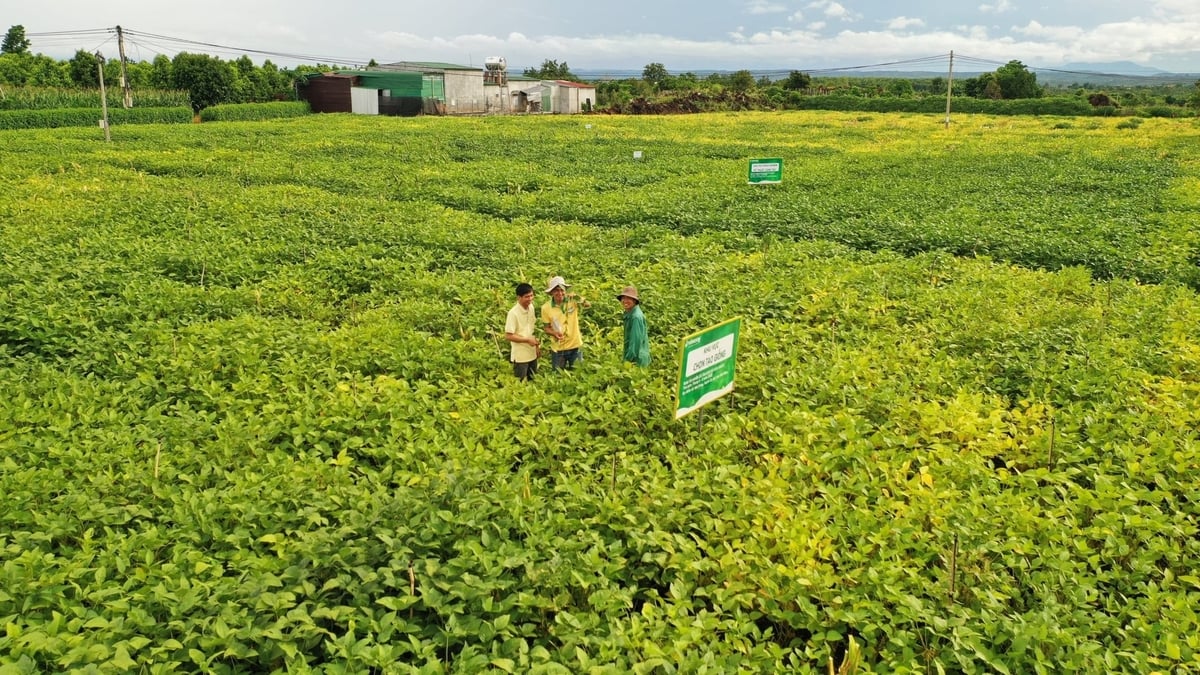
Currently, the area planted with soybeans in Vietnam is approximately 20,000 hectares. Photo: Le Khanh.
Most imported soybeans currently serve the animal feed industry. However, the demand for soybeans as food is also significant, while domestic sources are insufficient. One of the reasons soybean cultivation is gradually losing its competitive advantage is the low yield of native varieties and their limited economic efficiency, leading farmers to switch to other crops.
Meanwhile, soybeans are a highly valuable crop, especially for green and sustainable agriculture. Besides their high nutritional content, soybean plants are considered a "natural nitrogen factory." Underneath the plant's roots are nodules containing nitrogen-fixing bacteria, which help improve soil quality, increase fertility, and reduce the need for chemical fertilizers.
In the context of modern agriculture aiming for emission reduction, resource conservation, and sustainable development, soybeans and other legumes are increasingly considered important links in the crop structure. Based on this reality, in 2013, Vinasoy Soy Milk Factory established the Vinasoy Soybean Research and Application Center (VSAC) to focus on researching, restoring, and developing new soybean varieties suitable for production conditions in Vietnam for food processing.

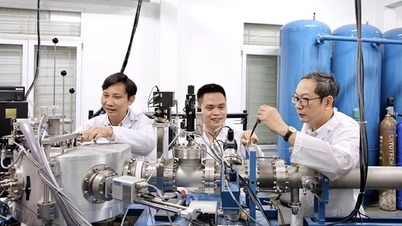
Molecular genetic technology using Real-time PCR systems helps shorten the time required for developing new soybean varieties. Photo: Le Khanh.
In 2014, the Center began implementing a breeding program using modern technology. In just over four years, the unit successfully researched and received recognition for its first soybean variety, VINASOY 02-NS. This was considered a major breakthrough because previously, the research and breeding process for a new variety could take 8-10 years.
Dr. Le Hoang Duy, Director of the Center, said that to shorten research time, the Center has applied molecular genetic technology on a Real-time PCR system to verify hybrids from the very beginning. After creating hybrid seeds and planting them, leaf samples are taken after about 10-20 days for DNA analysis to accurately determine whether the hybrid plants meet the requirements. This technology helps to quickly screen, increase accuracy, and significantly shorten the time for breeding.
Beyond just aiming for high yields, new soybean varieties are also being researched for their resistance to pests and diseases, adaptability to various ecological zones, and suitability for processing into soy milk products. In particular, Vinasoy has chosen to develop non-GMO, indigenous soybean varieties similar to the Japanese model, focusing on serving the food industry rather than primarily for animal feed.
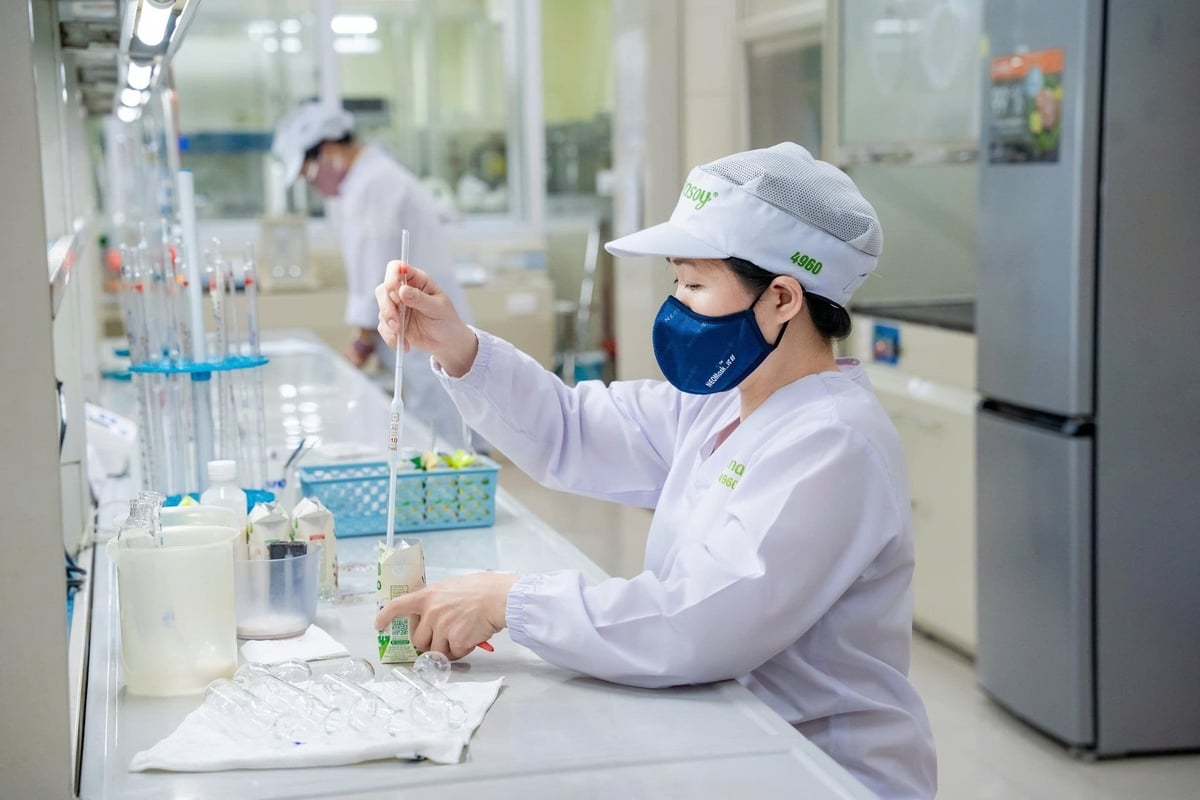
The Vinasoy Soybean Application Research Center focuses on researching, restoring, and developing new soybean varieties suitable for production conditions in Vietnam for food processing. Photo: Le Khanh.
To support research, the Center has established a gene bank with approximately 2,500 different lines/varieties, including domestic and imported sources. All are non-genetically modified. This is considered a crucial "genetic data repository" for scientists to select superior traits as parent material for breeding new varieties.
Following VINASOY 02-NS, the Center continues to research more specialized varieties such as VINASOY 06-HI, which has isoflavones 2-4 times higher than regular soybeans. Many new varieties with suitable omega 3-6-9 ratios and higher levels of health-beneficial compounds are also being researched and protected.
Sustainable farming in raw material areas
Not stopping at seed research, Vinasoy is aiming to build a closed-loop soybean chain from seed selection and breeding to technology transfer and product purchase from farmers to establish a raw material area. After successfully developing new varieties, the company conducts trials to determine suitable ecological zones, and simultaneously researches cultivation processes combined with mechanization to improve production efficiency before transferring them to farmers.

Vinasoy's main soybean growing area is currently the Cu Jut region (Lam Dong province), with an annual area of approximately 200-300 hectares. Photo: LK
Currently, Vinasoy's soybean seed and raw material areas are distributed across many regions nationwide, including the North, Central, Central Highlands, and South, with overlapping production seasons.
According to Dr. Le Hoang Duy, soybean plants are very sensitive to photoperiod, so many varieties are only suitable for certain regions. This is also why selecting and breeding varieties with broad adaptability is very important.
The VINASOY 02-NS soybean variety, developed by the Vinasoy Soybean Research and Application Center, has shown good adaptability in various regions when combined with appropriate technical procedures. This is one of the outstanding achievements of the breeding program using modern technology.
One of Vinasoy's major raw material areas is the Cu Jut region (Lam Dong province), which has the potential to develop approximately 1,000 hectares of soybeans. Currently, the company is collaborating with farmers to cultivate about 200-300 hectares annually.

Vinasoy's collaborative soybean cultivation models with farmers yield twice the productivity of native varieties. Photo: Le Khanh.
In the first crop of 2025, the average yield of the VINASOY 02-NS variety reached approximately 2.6 tons/ha, with many households achieving up to 3.5 tons/ha. This is a very high yield for soybeans, especially considering that many previous native varieties only reached a maximum of about 1.6 tons/ha.
In the Cư Jút area, soybeans are cultivated in rotation with crops such as sweet potatoes and peanuts. This model helps improve soil quality, reduce pests and diseases, lower fertilizer costs, and increase crop yields in subsequent seasons. This approach aligns with current trends in sustainable agriculture.
Not only in the Central Highlands, Vinasoy is also promoting research into a model of soybean-rice rotation. In many localities in the Mekong Delta, continuous production of three rice crops is no longer highly effective. Some households now only cultivate two crops and then leave the land fallow. This is a very suitable time to introduce soybean cultivation.

Besides its high yield, the VINASOY 02-NS soybean variety also demonstrates good adaptability in various regions. Photo: Le Khanh.
Intercropping soybeans between rice crops not only saves irrigation water and controls disease but also increases the organic matter content of the soil thanks to its natural nitrogen-fixing ability. In Northern Vietnam, soybeans were once commonly grown during the winter season but have gradually declined. Currently, Vinasoy is collaborating with agricultural and plant breeding research centers and institutes to gradually restore this production area.
“Our long-term goal is not only to expand the area of soybean cultivation but also to contribute to a positive impact on Vietnam’s future soybean industry development policies. We look forward to collaborating with research institutions, the agricultural sector, and local authorities to gradually revive the Vietnamese soybean industry,” shared Dr. Le Hoang Duy.
Source: https://nongnghiepmoitruong.vn/cong-nghe-mo-duong-hoi-sinh-cay-dau-nanh-viet-d811782.html


![[Image] Close-up view of the interchange connecting the two expressways and Long Thanh Airport.](https://vphoto.vietnam.vn/thumb/1200x675/vietnam/resource/IMAGE/2026/05/25/1779703378210_ndo_br_z7863716673926-224453a31600126cce10622af6290afd-4549-jpg.webp)
![[Image] Hanoi's urban life under the challenge of a "scorching hot" environment](https://vphoto.vietnam.vn/thumb/1200x675/vietnam/resource/IMAGE/2026/05/25/1779706979265_nang-nong-t5-2026-minh-duy-7-4636-jpg.webp)



























































Comment (0)