

When you eat meat, fish, eggs, milk, beans, or nuts, your body doesn't directly absorb protein in its intact form. Protein is broken down by enzymes in the stomach and small intestine into smaller protein chains and individual amino acids. The small intestine then absorbs these into the bloodstream, according to the health website Healthline (USA).
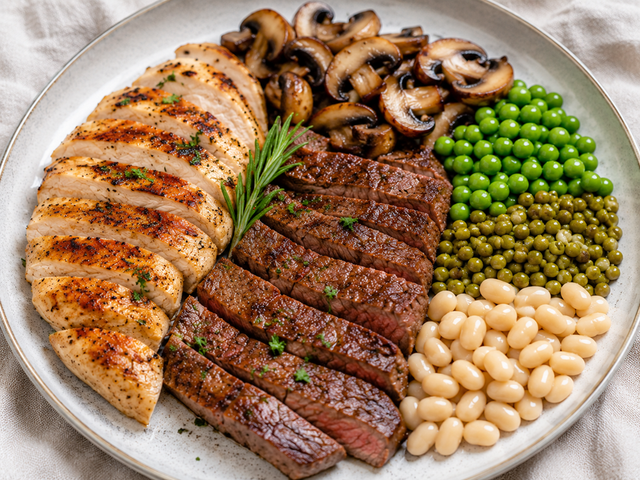
A balanced diet should include both plant-based and animal proteins.
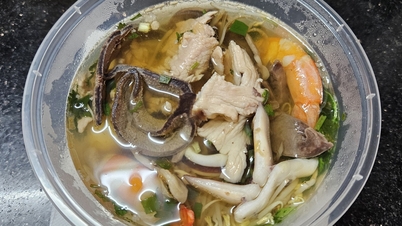
PHOTO: N. Quy created using AI
Therefore, when we say a protein is more easily absorbed, it usually relates to two factors. First, the degree to which the protein is efficiently digested. Second, the amount of essential amino acids that the body actually utilizes after digestion. This ability to absorb essential amino acids is assessed using the DIAAS index.
Animal protein sources have advantages.
Animal protein sources such as eggs, milk, fish, chicken, and beef generally have advantages in both digestibility and amino acid composition. This is because they contain all nine essential amino acids in fairly balanced proportions. These are amino acids that the body cannot produce on its own.
Furthermore, animal proteins tend to have a more readily digestible structure due to their protein structure. Some research evidence suggests that dairy proteins have a DIAAS score above 100, while many plant proteins have significantly lower scores. Specifically, the DIAAS score for milk is around 114, eggs around 113, and chicken breast around 108. In contrast, in plants, the DIAAS score for chickpeas is around 83, rice around 59, and wheat around 40.
This doesn't mean plants are less nutritious. It simply shows that in many cases, with the same amount of protein, the body can utilize animal protein more efficiently than plant protein.
Plant proteins are often more difficult to absorb due to several barriers. This is because of phytates, tannins, or digestive enzyme inhibitors found in legumes, grains, and seeds. These can hinder the protein breakdown process.
Plants are generally high in fiber, a component that is very beneficial for gut health. However, in some cases, it can slow down the rate of protein digestion. Additionally, many individual plant protein sources do not contain all the essential amino acids.
Not all plant proteins are of low quality.
However, not all plant proteins are of low quality. Some sources are still considered quite good. Soybeans are a prime example, as they contain all the essential amino acids and are much more easily digestible than many other legumes. Quinoa and buckwheat also have relatively balanced amino acid compositions.
For vegetarians or those looking to reduce meat intake, there are still many ways to ensure adequate protein. For example, legumes can be combined with whole grains. Additionally, nutrient-rich plant-based protein sources such as soybeans, lentils, chickpeas, and nuts should be prioritized.
For older adults, those engaging in high-intensity exercise, or those recovering from illness, combining both animal and plant proteins often helps meet nutritional needs more effectively, according to Healthline .
Source: https://thanhnien.vn/protein-dong-vat-va-protein-thuc-vat-loai-nao-de-hap-thu-hon-185260515194401136.htm



![[Image] Hanoi's urban life under the challenge of a "scorching hot" environment](https://vphoto.vietnam.vn/thumb/1200x675/vietnam/resource/IMAGE/2026/05/25/1779706979265_nang-nong-t5-2026-minh-duy-7-4636-jpg.webp)
![[Image] Close-up view of the interchange connecting the two expressways and Long Thanh Airport.](https://vphoto.vietnam.vn/thumb/1200x675/vietnam/resource/IMAGE/2026/05/25/1779703378210_ndo_br_z7863716673926-224453a31600126cce10622af6290afd-4549-jpg.webp)










![[Video] Preventing and avoiding sunstroke and heat exhaustion during hot weather](https://vphoto.vietnam.vn/thumb/402x226/vietnam/resource/IMAGE/2026/05/26/1779753818307_hinh00-01-19-09still001-png.webp)

















































































Comment (0)