

Goods are available, but there's a lack of connection with tourism.
According to statistics, international tourists' shopping spending in Vietnam currently accounts for only about 12-15% of their total trip expenditure, the lowest in Southeast Asia. In many countries in the region, this rate is usually over 20-25%. A major reason for this is that the goods and shopping ecosystem are not yet attractive enough.
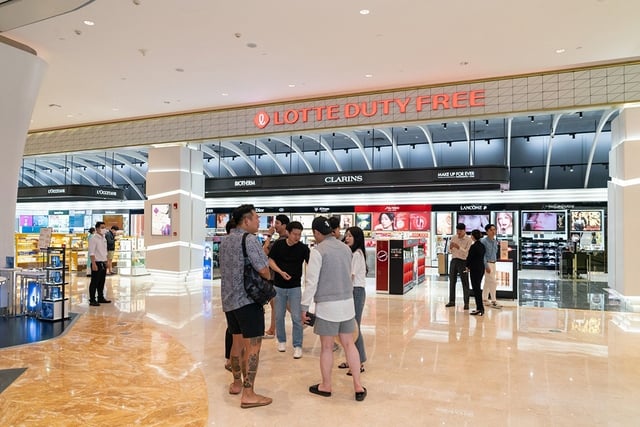
Da Nang is the first locality in Vietnam to have a Downtown Duty Free shop.
PHOTO: NA
Mr. Tran Tuong Huy, Deputy Director of the Institute for Social Tourism Research, commented: the product structure at tourist destinations still does not closely reflect the actual needs of each group of international tourists; many places still mainly sell T-shirts, common souvenirs, or mass-produced products. Meanwhile, foreign tourists are increasingly interested in local products with unique characteristics and meeting international standards. Countries in the region sell very strongly local products with their own brands, while in Vietnam, many places still sell similar items, and there are even quite a few goods imported from China, counterfeit goods, and imitations.
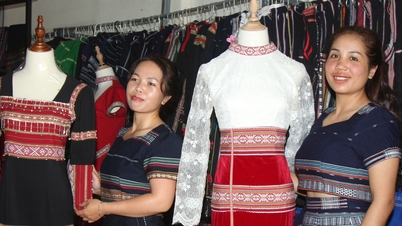
During the development of the Cho Lon Market (Binh Tay Ward, Ho Chi Minh City) into a shopping tourist destination, Mr. Huy's research team thoroughly analyzed the consumer behavior of different international tourist groups. European tourists are often interested in products bearing the hallmarks of Vietnamese culture such as fabrics, silk, lacquerware, hand-embroidered paintings, ao dai (traditional Vietnamese dress), ao ba ba (traditional Vietnamese blouse), or personalized souvenirs such as cloth bags, drawstring backpacks, cups, notebooks, lanterns, and traditional kites. Meanwhile, American tourists tend to prefer handicrafts such as ceramics, handmade jewelry, conical hats, folk paintings, hand-embroidered items, or tailoring services. For the Indian market, the most popular product categories include jewelry, bracelets, gemstones, pearls, brocade, household items, and embroidered paintings and gold-leaf oil paintings.
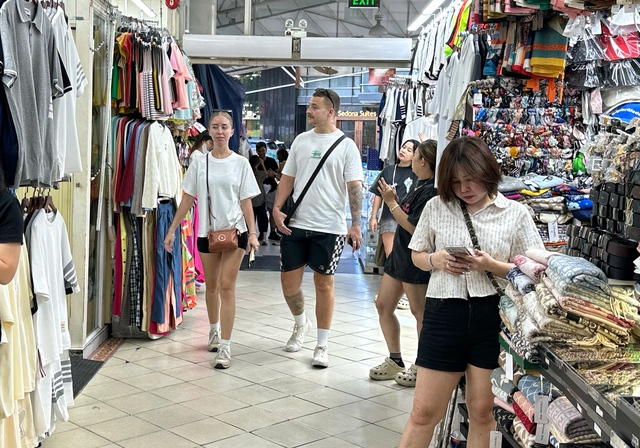
International tourists are not yet enthusiastic about spending money on shopping when traveling in Vietnam.
PHOTO: CAO AN BIEN
Asian tourists, especially from Thailand, Indonesia, or Malaysia, tend to buy confectionery, tea, coffee, gifts made from bamboo, conical hats, handicrafts, rattan and bamboo weaving, embroidery, and fashion accessories...
"We have everything we need; the problem is we haven't yet organized a suitable sales ecosystem for tourists. Many products have potential but lack investment in packaging, shipping standards, or international sales standards," Mr. Huy said, citing an example: "I've witnessed many Indian tourists visiting Ho Chi Minh City who really like Vietnamese fruits, especially star apples, but most can only eat them on the spot and almost can't buy them to take back home. We don't have a suitable packaging, preservation, or logistics system for tourists. Meanwhile, if you buy wine in Australia, the product already has suitable packaging for air transport, and customers can be assisted in transporting it to the airport without having to carry it themselves."
The shopping paradise projects are sadly "shelved".
In mid-April, the Department of Domestic Market Management and Development (Ministry of Industry and Trade) organized a consultation workshop on the "Development of Outlet and Duty-Free Shop Models in Vietnam until 2030, with a vision to 2045" project. In the context of a volatile global environment and a transitional phase for the Vietnamese retail market, the Ministry of Industry and Trade expects outlet and duty-free shop models to become a "double lever" to boost consumption, tourism, and economic growth.
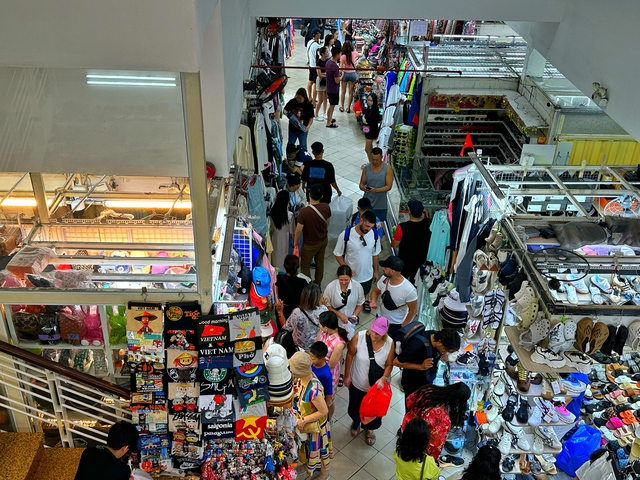
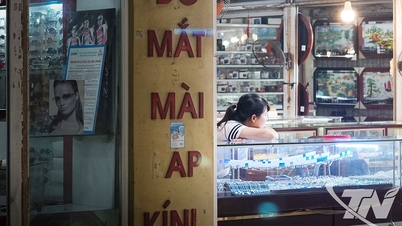
Some of Ho Chi Minh City's busiest shopping districts are flooded with counterfeit and fake goods.
PHOTO: CAO AN BIEN
The plan aims to establish at least five tourism-linked outlet centers nationwide by 2030 in key locations such as Hanoi, Ho Chi Minh City, Da Nang, Quang Ninh, and Phu Quoc (An Giang). Further ahead, by 2045, the "high-end outlet village" model will be developed across all three regions, becoming iconic shopping and experiential destinations.
The Ministry of Industry and Trade's plan has delighted tourism and trade businesses, but it has also raised considerable doubts. Since April 2019, before the Covid-19 pandemic swept the world, Ho Chi Minh City had already begun developing a plan to transform itself into a regional shopping and trade hub. However, for many years, this goal has remained unfulfilled, and the city's tourism industry continues to struggle to attract tourists.
In October 2023, in response to Ho Chi Minh City's determination to boost tourism, "luxury goods king" Jonathan Hanh Nguyen submitted a proposal to the City People's Committee, suggesting that Parkson Shopping Center (Ben Thanh Ward) be transformed into the first street-level duty-free shop in Ho Chi Minh City. The billionaire's idea was to build Parkson Saigon Tourist Plaza into a shopping mall combining luxury, international-class dining and entertainment services. Simultaneously, he proposed utilizing additional ground-floor spaces, especially the corner location at Le Thanh Ton - Dong Khoi, for street-level duty-free shops. This would lead to the convergence of renowned international brands in Ho Chi Minh City, realizing the "Premium Outlet Commercial and Service Urban Area" project in Thu Thiem, including a world-class Premium Outlet shopping area; a complex of commercial, tourism, and service functions concentrating branches of financial companies, banks, offices, shopping stores, and entertainment complexes…
Many travel agencies in Ho Chi Minh City had hoped to have another "money-making" destination complex for inbound tours. However, due to disagreements over the location, this idea had to be abandoned.
In April 2024, the signing of a cooperation agreement by a leading Chinese tourism group in Ho Chi Minh City to research and build a duty-free shopping center, with the goal of attracting millions of Chinese tourists to Vietnam to spend money, once again fueled ambitions to become a "shopping paradise" for the country's largest economic hub.
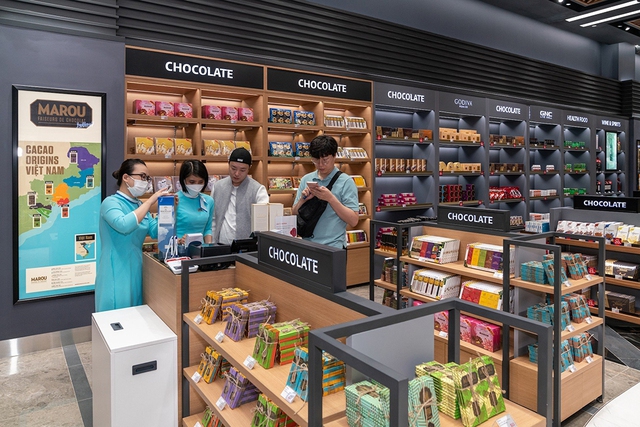
Duty-free shopping areas are always attractive destinations, drawing customers to spend money.
PHOTO: NA
But since then, nothing has progressed.
Aviation and tourism expert Luong Hoai Nam expressed deep regret that many excellent and feasible projects, which businesses were passionate about and willing to invest in, were missed. He assessed that the duty-free shop model in Vietnam has traditionally been confined to international airports, facing certain limitations as passengers arriving and departing at the airport sometimes do not have the need or have limited time to shop. The process of refunding value-added tax (VAT) for tourists who shop upon returning home is still in its infancy, with many shortcomings, and few people take advantage of it.
Meanwhile, countries like Singapore, Japan, and Thailand are doing very well and are increasingly improving their tax refund policies and solutions for tourists with a convenient system. As a result, when mentioning shopping paradises, tourists immediately think of Singapore, Thailand, and even China, but no one mentions Vietnam.
On the other hand, preferential policies, incentives, and encouragement for tourism are too limited. Since their proposal, shortcomings ranging from land availability for establishing retail outlets within the city, factory outlet systems near the city or in the suburbs, to tax exemptions, tax reductions, and on-site VAT refund systems at shopping locations with simple and easy procedures, have yet to be resolved.
Vietnam's shopping destination has yet to take shape.
For tourism to develop, there must be clusters of diverse entertainment and recreational services that create a huge attraction and generate substantial revenue. Vietnam is currently lacking such places to meet the needs of tourists in terms of time and spending in a safe and civilized manner.
Aviation and tourism expert Luong Hoai Nam
Source: https://thanhnien.vn/khach-den-viet-nam-tieu-gi-bo-trong-manh-dat-mau-mo-tu-mua-sam-185260525211523284.htm
![[Image] Hanoi's urban life under the challenge of a "scorching hot" environment](https://vphoto.vietnam.vn/thumb/1200x675/vietnam/resource/IMAGE/2026/05/25/1779706979265_nang-nong-t5-2026-minh-duy-7-4636-jpg.webp)




























































Comment (0)