

As farmers enter the "digital age"
In Hanoi, digital transformation in agriculture is being strongly implemented, becoming a driving force for promoting high-tech agricultural production, increasing the value of agricultural products, and raising people's incomes. One typical model is the Soc Son Medicinal Plant Conservation and Development Cooperative (Trung Gia commune). The application of QR codes for product traceability has helped the Cooperative expand its market, access partners, and enhance product value.
According to the Director of the Cooperative, Nguyen Thanh Tuyen, technology not only helps to sell products more efficiently but also builds trust with customers through transparent data. "Farmers can now prove the quality of their products with specific data, thereby improving their negotiating position and reducing dependence on intermediaries," Ms. Nguyen Thanh Tuyen shared.
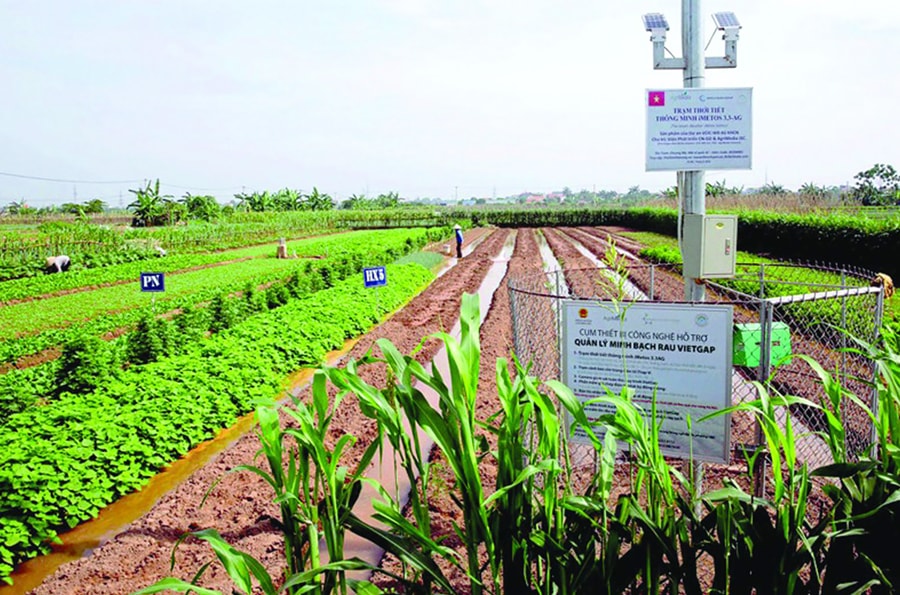
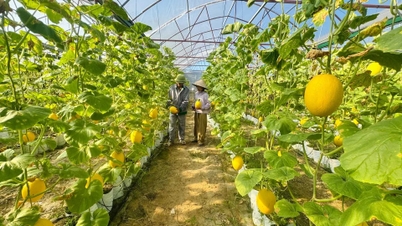
Not only with medicinal herbs, many models of clean vegetable production in Hanoi also show clear effectiveness from digital transformation. The Chuc Son Clean Vegetable and Fruit Cooperative is a prime example. According to Hoang Van Tham, Director of the Chuc Son Clean Vegetable and Fruit Cooperative (Chuong My ward), with an area of nearly 18 hectares, of which more than 12 hectares meet VietGAP standards and 5 hectares meet GlobalGAP standards, the model is bringing high economic efficiency.
A key highlight is the complete digitization of the production process through the FACEFARM software. From planting and cultivation to harvesting and packaging, everything is tightly managed on a digital platform. The cooperative has also invested in an automated drip irrigation system, smart greenhouses, and an iMetos 3.3 AG weather monitoring station to control temperature, humidity, and other environmental factors. Thanks to the application of technology, productivity and product quality have been significantly improved, while also reducing production costs and saving water and fertilizer.
“Digital transformation has helped the cooperative's vegetable products meet the stringent standards of major supermarket chains in Hanoi. Currently, the cooperative supplies about 3 tons of vegetables to the market daily, generating tens of billions of dong in revenue annually and creating stable jobs for hundreds of local workers. More importantly, digital transformation is shaping a new production mindset for farmers: green, clean, transparent, and market-oriented production,” Mr. Hoang Van Tham emphasized.
According to the Hanoi Department of Agriculture and Environment, the city has so far established 406 high-tech agricultural models, including 262 crop farming models, 119 livestock farming models, and 25 aquaculture models. Many businesses and cooperatives in the city have participated in electronic systems applying information technology, using QR codes for traceability and listing products on e-commerce platforms.
According to Nguyen Kim Phuc, Deputy Director of the Digital Transformation Department (Ministry of Agriculture and Environment), digital transformation and innovation are the "key driving force" and the inevitable path for Vietnamese agriculture to enter a new phase of development - more efficient, transparent, and sustainable.
Towards green agriculture
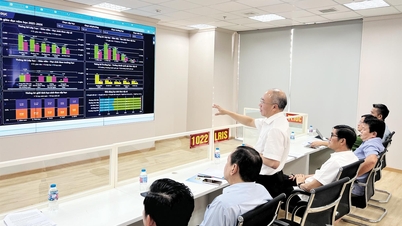
In its development strategy until 2030, Hanoi aims to build at least 10 concentrated high-tech agricultural zones, digitize 100% of production areas, and establish a city-wide agricultural data center. According to Ta Van Tuong, Deputy Director of the Hanoi Department of Agriculture and Environment, if the roadmap is followed correctly, Hanoi will have the foundation to become a modern urban agricultural center in the North, moving towards a green, smart model capable of competing in the global supply chain.
To realize this goal, Hanoi needs to continue promoting the digitization of land, crop, livestock, and aquatic data; connecting industry databases with the national system to serve management and administration as well as support the production and business activities of people and businesses.
In addition, the city is focusing on promoting digital trade, supporting key products and OCOP products to be listed on e-commerce platforms in order to expand markets for agricultural products.
According to Pham Duy Khanh, Director of the Center for Rural Development (Institute of Agricultural Strategy, Policy and Environment), it is necessary to quickly build a national data bank on digital agriculture, develop an integrated monitoring and surveillance system, and train a team of technology experts with a deep understanding of agricultural production specifics. In particular, improving digital skills for farmers should be implemented through pilot models, allowing people to directly experience the effectiveness before scaling up.
It is clear that digital transformation in agriculture is not simply about introducing machinery or software into production, but also about changing the management mindset and market approach of farmers. When technology is applied correctly, Vietnamese agriculture will have the opportunity to break through towards a modern, transparent, efficient, and environmentally friendly direction, thereby creating a solid foundation for sustainable development in the future.
Source: https://hanoimoi.vn/chuyen-doi-so-mo-loi-cho-nong-nghiep-xanh-885442.html





![[Photo] Delegation attending the 14th Congress of the Vietnam Trade Union visits the Mausoleum of President Ho Chi Minh.](https://vphoto.vietnam.vn/thumb/1200x675/vietnam/resource/IMAGE/2026/06/03/1780451842301_ndo_br_img-3824-jpg.webp)



































































Comment (0)