


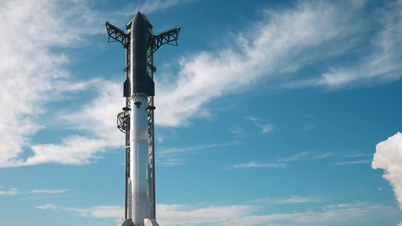
SpaceX successfully tests its next-generation Starship rocket. Photo: Xinhua News Agency.
The rocket was launched at 5:30 p.m. local time on May 22, carrying 20 Starlink simulator satellites. SpaceX confirmed that the stage separation was successful, allowing Starship to continue its journey as planned.
According to SpaceX, this was the first flight using the upgraded Starship V3, equipped with improved Raptor engines, a new navigation system, a more optimized control surface, and hardware to support future orbital missions and lunar flights.
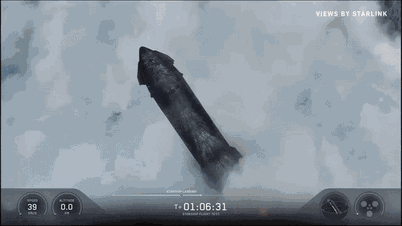
Starship, approximately 124 meters tall, was considered the most powerful launch system ever developed. The mission's primary objective was to test the performance of upgraded systems under real-world flight conditions and to collect data for further development of the Starship program. This was considered a key project for CEO Elon Musk to realize his ambition of sending humans to Mars. However, during its return to Earth, the Super Heavy booster stage exploded in mid-air upon landing in the Gulf of Mexico as planned. Despite this, the upper stage of Starship continued its journey, allowing engineers to gather additional technical data to further refine the system.
SpaceX says incidents during test flights were taken into account in the development of the fully reusable launch system. The Starship program now plays a crucial role in NASA's Artemis plan to return astronauts to the Moon, and also aims to send humans to Mars in the future.
Minh Phuong
Source: WION, Xinhua, AP
Source: https://baothanhhoa.vn/spacex-thu-nghiem-thanh-cong-ten-lua-starship-the-he-moi-288626.htm





































































































Comment (0)