

In the draft Law amending and supplementing a number of articles of the Land Law, which the Ministry of Agriculture and Environment has just submitted to the Government, one of the contents that has attracted public attention is the proposal to adjust the rights of land users when the authorities have announced land reclamation but have not yet made a decision.
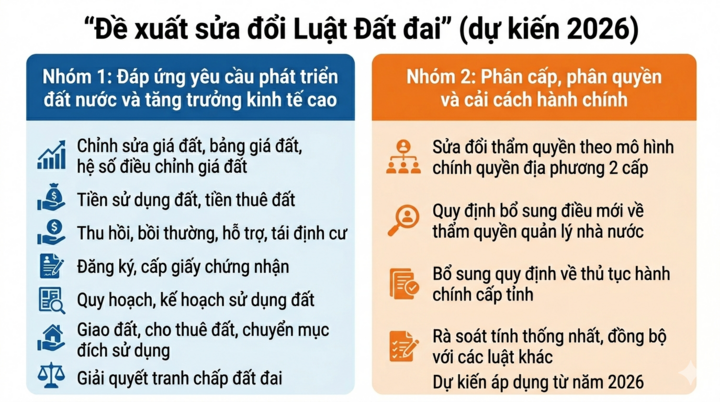
Tighten land transactions while awaiting land reclamation.
In reality, while awaiting land acquisition, landowners can still transfer, gift, or contribute their land use rights (land title certificate) as capital. However, this can lead to the buying and selling of land in anticipation of compensation, with the aim of exploiting the policy for personal gain.
To address this, the Ministry proposes that those who receive land use rights as a transfer, gift, or capital contribution should only be entitled to compensation, support, and resettlement corresponding to those whose land was previously expropriated.
According to the Ministry of Agriculture and Environment, tightening land transactions during the period awaiting land acquisition will curb speculation and ensure fairness in compensation and land clearance policies.

There is a situation where many people are accumulating agricultural land, waiting for it to be included in the planning scheme so they can receive compensation. (Illustrative image)
Recently, after the Land Law 2024 came into effect, a situation has emerged in the market where many people are "hoarding land in anticipation of compensation," especially around areas planned for infrastructure, industrial zones, highways, ring roads, airports, etc. This is because the new law changes the way land prices are determined to be closer to market prices, and also adds many regulations on resettlement support, property compensation, and investment costs in land.
Mr. Pham Duc Toan - CEO of EZ Property Company - commented that even before the 2024 Land Law was applied, the real estate market had already seen individuals, groups, and organizations buying up land in anticipation of changes under the new law.
Mr. Toan cited that the 2024 Land Law has perfected the mechanisms and policies for managing and using agricultural land by expanding the limit for receiving transfers of agricultural land use rights to no more than 15 times the land allocation limit in the locality.
And as soon as most of the obstacles were removed, agricultural land began to be sought after again. It became common for many businesses to buy up this type of land in localities to build farms, high-tech agricultural models, or industrial models. Alternatively, many investors bought up agricultural land in anticipation of land clearance and compensation at high prices.
Sharing the same view, Mr. Nguyen Quang Huy - CEO of the Finance and Banking Faculty (Nguyen Trai University) also assessed that, in reality, over the years, whenever information about planning or large infrastructure projects emerges, the market often sees a wave of short-term land hoarding to profit from compensation differences. This not only drives up land prices rapidly compared to their real value but also increases land clearance costs, directly affecting the efficiency of public investment and project progress.
More importantly, if speculation based on planning information is allowed to continue, the market will gradually develop a mentality of "investing based on policy expectations" instead of based on actual land use needs and the real exploitation value of the land. This is detrimental to the stable development of the economy .
" Amending the Land Law, including adjusting the rights of land users, will help to curb this situation ," Mr. Huy predicted.
Compensation should be based on land prices at the time the planning was announced.
If speculation based on planning information is allowed to continue, the market will gradually develop a mentality of "investing based on policy expectations" instead of based on actual land use needs and the real exploitation value of the land. This is detrimental to the stable development of the economy.
Mr. Nguyen Quang Huy - CEO of the Faculty of Finance and Banking (Nguyen Trai University)
Commenting on the proposed amendments to the Land Law, experts believe that, in the context of the real estate market entering a restructuring phase towards greater transparency and sustainable development, the planned amendments to the Land Law, especially the content on controlling land transactions during the period awaiting land acquisition to limit "buying and selling in anticipation of compensation," demonstrate a commendable effort by the management agency in improving the institutional framework and reducing market distortions.
However, according to Mr. Nguyen Quang Huy, to curb speculation "anticipating compensation," the approach should focus on controlling benefits arising after the land acquisition announcement, rather than absolutely prohibiting transactions.
First, it is necessary to clearly establish a "legal timeframe" from the date of the official notice of land acquisition or announcement of the planning. After this time, transactions can still be carried out, but the right to receive compensation, support, or resettlement policies should be determined according to the original land user. This approach both maintains market transparency and reduces short-term speculative incentives.
Furthermore, transparency of information is crucial. When planning information is not publicly and consistently available, disparities in access to information often arise, giving a certain group of speculators an advantage over the market. Therefore, it is necessary to promote the digitization of land data, publicly disclose planning information in real time, and ensure that citizens have equal access to information.
In addition to administrative tools, further research should be conducted on financial tools such as imposing high taxes on short-term transactions or the added value resulting from changes in planning. This is a soft solution but has long-term effectiveness, and is also in line with the modern governance trends of many countries.
However, according to Mr. Huy, the control measures need to be designed harmoniously, because the right to transfer land remains a legitimate property right of the people. The goal should be to limit the exploitation of policies for personal gain, not to disrupt legitimate civil transactions.
Furthermore, the proposal that those who receive land use rights as a transfer, gift, or capital contribution are only entitled to compensation, support, and resettlement corresponding to those whose land was previously expropriated is a fairly reasonable and feasible approach.

Experts predict that amending the Land Law will curb land speculation and hoarding in anticipation of compensation.
The positive aspect is that this proposal directly impacts speculative incentives. When compensation benefits no longer increase with the resale of land during the pre-reclamation period, the attractiveness of "buying in anticipation of compensation" will significantly decrease.
However, for the policy to be fully effective, it requires an interconnected land data system, clear regulations on the "finalization of rights" deadlines, and increased transparency and monitoring of unusual transactions in areas where land is being prepared for acquisition.
" If implemented comprehensively, this would not only be a solution to address a short-term market phenomenon but also contribute to building a more transparent real estate environment, reducing speculation, and directing land resources towards more substantive and sustainable economic development in the long term ," Mr. Huy emphasized.
A leader of a real estate company in Hanoi also suggested that, to curb land speculation in anticipation of compensation, the Land Law should only provide compensation based on the current land use at the time the planning is announced, and not include abnormal price increases after project information is released. At the same time, those who buy land after the planning is announced should also have their compensation rights limited.
Source: https://vtcnews.vn/sua-luat-dat-dai-het-thoi-dau-co-gom-dat-de-don-den-bu-ar1017932.html


![[Photo] General Secretary and President To Lam presides over a working session with the Central Policy and Strategy Committee on the development of the materials industry.](https://vphoto.vietnam.vn/thumb/1200x675/vietnam/resource/IMAGE/2026/05/21/1779359935432_a3-bnd-3129-1412-jpg.webp)
![[Photo] National Assembly Chairman Tran Thanh Man working with the Standing Committee of the Law and Justice Committee](https://vphoto.vietnam.vn/thumb/1200x675/vietnam/resource/IMAGE/2026/05/21/1779378929214_ndo_br_1-4610-jpg.webp)
























































































Comment (0)