

 |
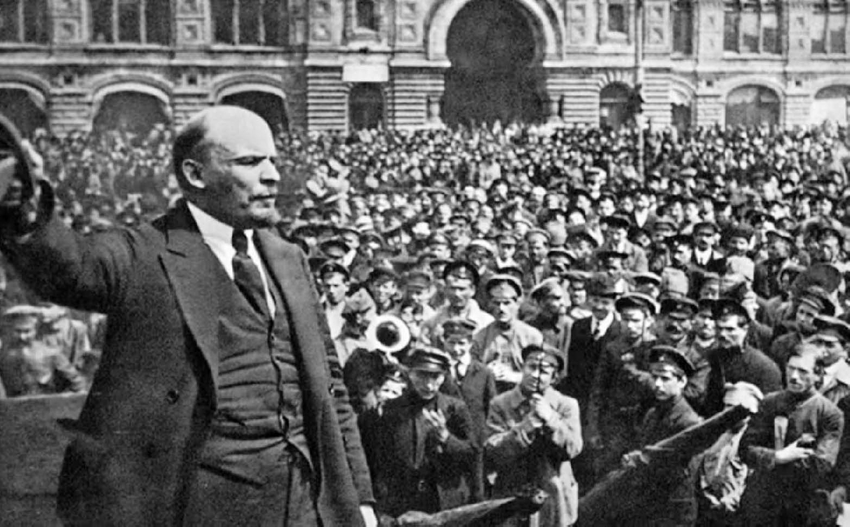
| Leader VI Lenin giving a speech in Red Square, Moscow in 1917. Photo: Archival material. |
1. One hundred and seven years ago (November 7, 1917 – November 7, 2024), under the leadership of the Russian Bolshevik Party, headed by leader VI Lenin, the working class and working people of Russia rose up en masse to overthrow the bourgeois regime, establishing the first Soviet state of workers and peasants in the world , ushering in a new era in human history – the era of transition from capitalism to socialism on a global scale, possessing profound humanistic and contemporary values, and having a widespread and attractive influence on oppressed nations, including Vietnam.
The October Revolution in Russia was the most significant event of the 20th century, the first and most important victory of Marxism-Leninism and the proletariat.
This revolution carried the mission of giving birth to real socialism – a new, just, and democratic form of social development, with groundbreaking and enlightening value for humanity. The emergence of the Soviet Union – the result of the October Revolution – abolished Tsarist Russia and established a new Russia – the Soviet Union – bringing the working class and the working masses to power; transforming the millennia-old dreams and aspirations of all strata of society for a social system free from exploitation, oppression, and injustice, where the people are masters, into reality.
The successful October Revolution in Russia led to the birth of the socialist state – the first proletarian dictatorship in human history – and transformed socialism from theory into reality in world political life, becoming the stronghold of opposition to capitalism.
For the first time in human history, a democracy for the masses, guaranteeing the real interests and power of workers in all areas of social life, was implemented. The Soviet state quickly adopted and implemented historical documents such as: the "Decree on Land," the "Decree on Peace ," the Declaration on the Rights of the Peoples of Russia, and the Declaration on the Rights of the Working and Exploited People." The Soviet regime laid the foundation for workers of all nationalities living in Russia to participate in building a new society that would bring prosperity, happiness, and justice to everyone and other oppressed peoples…
2. After nearly ten years of wandering in search of a way to save the country, the Vietnamese revolutionary Nguyen Ai Quoc joyfully embraced the light of the October Revolution. In July 1920, in Paris (France), he read Lenin's "First Draft of the Theses on the National and Colonial Questions" and happily exclaimed, "Lenin's Theses moved me, inspired me, enlightened me, and filled me with such confidence! I was so happy I almost cried. Sitting alone in my room, I spoke aloud as if addressing a large crowd: O my suffering and oppressed compatriots! This is what we need, this is the path to our liberation!"
He grasped the core ideology of Lenin: Proletariat of all countries and oppressed peoples unite! The thesis answered his question about the path to national independence and freedom for the Vietnamese people. He affirmed that there was no other way to save the country and liberate the nation than the path of proletarian revolution. This path linked the goal of national independence with the goal of socialism, linking the Vietnamese revolution with the trend of the times, and demonstrated the value and attractiveness of the October Revolution. In 1927, in his work "The Revolutionary Path," he clearly stated: "Only by following the path of the October Revolution - the only correct path - can the Vietnamese Revolution achieve true independence and freedom."
By creatively absorbing and applying Marxist-Leninist principles on humanism in general, and the humanistic values for the cause of human liberation of the Russian October Revolution in particular, in the process of leading the revolution, the Party and President Ho Chi Minh always determined that liberating people from all oppression, exploitation, and injustice; from poverty and backwardness, and enabling them to have a prosperous, free, and happy life; for people to be liberated and have a prosperous life, the prerequisite is that the country must be independent and the people must be free.
Drawing on the leadership experience of the Russian Bolshevik Party in the struggle for power, he focused on leading and directing the preparation of all conditions for the establishment of a political party of the Vietnamese working class based on the principles of building a new type of party as outlined by VI Lenin. From the very beginning of the Communist Party of Vietnam, the Party affirmed its commitment to upholding the banner of national independence and socialism, considering it the guiding principle throughout the Vietnamese revolution.
According to President Ho Chi Minh: “The purpose of the revolution is to build an independent, unified, free, prosperous, and strong Vietnam. To make the people happy and to build a prosperous and glorious society.” Therefore, from the very beginning of the nation's founding, President Ho Chi Minh paid great attention to the policies of the Party and Government towards the people. He affirmed: “We must take utmost care of the people's lives. If the people are hungry, the Party and Government are at fault; if the people are cold, the Party and Government are at fault; if the people are uneducated, the Party and Government are at fault; if the people are sick, the Party and Government are at fault…” These are truly the great values that the proletarian revolution led by the Communist Party has brought to all strata of the people.
Source: https://baothuathienhue.vn/chinh-polit-xa-hoi/suc-hap-dan-tu-cach-mang-thang-muoi-nga-147745.html




























![[Infographic] Vietnam's Economic Situation Report, Q1 2026: Strong Growth Momentum](https://vphoto.vietnam.vn/thumb/402x226/vietnam/resource/IMAGE/2026/04/04/1775298512042_tang-truong-kinh-te-viet-nam.jpeg)
![[Image] Close-up view of the 10-lane road connecting to Long Thanh Airport](https://vphoto.vietnam.vn/thumb/402x226/vietnam/resource/IMAGE/2026/04/04/1775291871988_ndo_br_1-resize-5690-jpg.webp)















Comment (0)