Illustration: THIEN BAO
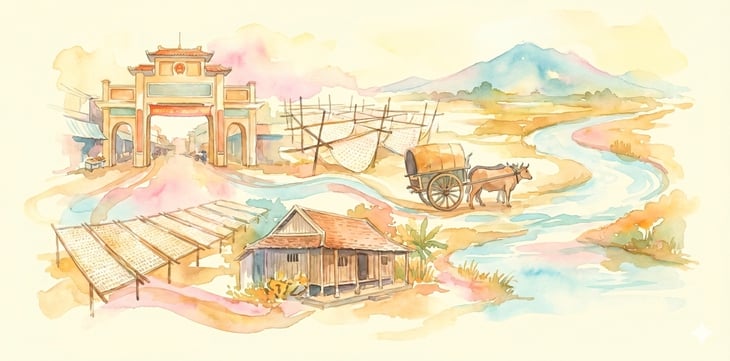
1. One day, a picture of a street sign at a corner of the park where Gia Long and Quang Trung streets meet in the old Trang Bang town suddenly went viral on social media.
People were amused that two famous historical figures, who were once sworn enemies, had "met," a meeting that seemed unprecedented anywhere else in our country. I was delighted and excited that my hometown had suddenly become famous, and I left a comment on the post: "See how unique Trang Bang is?!"
Actually, these two streets have been named that way for sixty or seventy years already. In 1960, my maternal uncle's family moved to Gia Long Street for convenience with his work, and my brother-in-law's house on Quang Trung Street was nearby, and they've been there for about the same amount of time.
No one felt there was anything amiss. The two roads formed two sides of the triangular plot of land, with National Highway 22 on the other side. Later, the land was cleared and a spacious park was built, and the humble street signpost stood out prominently in a new corner. Opposite it was the former Trang Bang Town People's Committee building, which was also the former District Chief's residence before liberation.
When suddenly asked about something that had become commonplace for decades, the humorous locals in my area replied casually: "We just meet up for coffee or drinks to have some fun, why bother arguing and tiring ourselves out!" That being said, the people in this region are not ignorant of history at all.
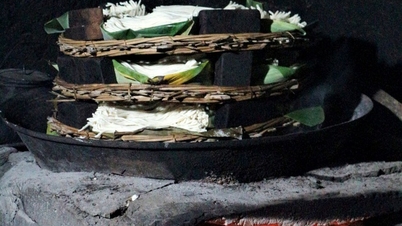
Speaking of the victors and vanquished, it brings to mind the offerings to fallen soldiers in the village square whenever a family held a memorial service. Even when food was still a difficult issue, families holding a memorial service would try to set out as many plates, bowls, and trays as possible for the offerings.
The offering tray for the main deceased is given priority, followed by the tray for the ancestors, the tray for the earth god, and especially, there is always a tray for the soldiers placed in the yard. During the war, my hometown was called the "rice and beans" region, and the tray for the soldiers was for those who had died from bullets and bombs; there was no one chosen.
It was normal for my grandmother Tư to spend almost an hour chatting whenever she went to Mrs. Hai Đê's shop. Mrs. Hai was a Heroic Vietnamese Mother; back when liberation was just like everyone else, she was struggling, opening a shop selling rice, salt, and fish sauce to the people around there.
My grandmother, Mrs. Tư, had a brood of sons, three of whom were Republic of Vietnam soldiers who died in battle. I can't remember what those two women talked about in those countless afternoons. Even later, when her health was failing and she could no longer travel, Mrs. Tư would occasionally ask her daughter-in-law how Mrs. Hai was doing. They were pure friends and mothers, sharing the hardships of fate and the torments of war.
In the film "Red Rain," two mothers travel by boat on the Thach Han River to release flowers into the water as a tribute. One side releases yellow flowers, the other releases white flowers. Their image is so beautiful, thanks to the beautiful actors, the beautiful lighting, and the beautiful camera angles; the difference between white and yellow flowers doesn't matter to these mothers who have lost their children.
The beauty I once saw was ordinary yet magnificent, like Mrs. Hai's shop at the top of the hill, where Mrs. Tu occasionally dropped by with her bamboo table and chairs, and the two women would chat softly. This shows that the spirit of harmony and non-discrimination seems to be an inherent characteristic of the people of Trang Bang.
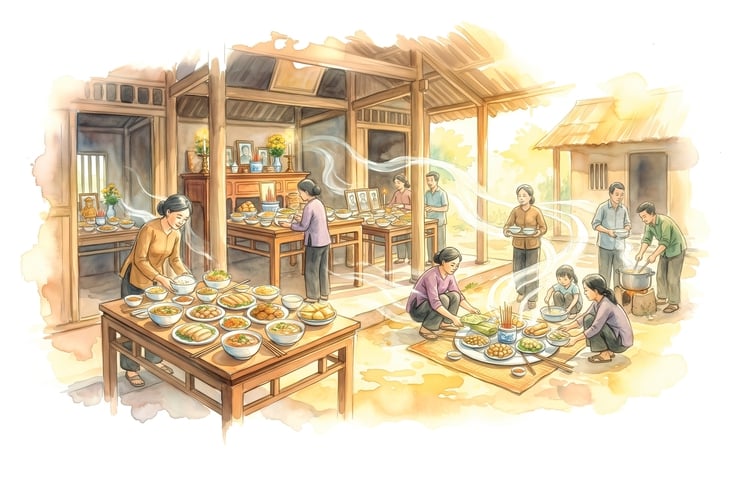
Illustration: THIEN BAO
Others might be surprised to see the intersection of Quang Trung and Gia Long streets, but the people in my hometown are happy and relaxed. It's a memory, a peaceful state of mind, and a gratitude towards our ancestors. For my family, it's a moment of reflection, a reminder of how precious peace and harmony are…
2. When I was a student, my English teacher once asked me where I was from. A few weeks later, when we met again, she said she had just returned from Da Lat and had passed by my house! So when I said I was from Trang Bang, she mistook it for Trang Bom. I remember just laughing and saying, "You're mistaken, teacher! I'm from Tay Ninh , how could you have passed by there?"
Well, it was a lighthearted story, but it made me think constantly about the things that make my hometown more memorable. My hometown is always special in my heart; every road, every bridge, every tree holds so many stories to cherish. And yet, Trang Bang has become Trang Bom – how painful! I told myself, I have to find a way to fix this.
And indeed, later on, when anyone asked me where I was from, I would smile and say, "It's from Trang Bang rice paper," or introduce myself as "Trang Bang rice noodle strands!" This method was effective, because Trang Bang rice noodle strands or sun-dried rice paper later became well-known and loved by many people, making it difficult to mistake them for each other.
Anyone traveling from Ho Chi Minh City to Tay Ninh to visit Ba Den Mountain, the Holy See, or the Moc Bai border gate will find it hard to resist the temptation when passing through an area with cuisine that is both refined and subtly sweet, encompassing almost all the yin-yang and nutritional philosophies of Vietnamese cuisine.
Thinking about the specialties of my region, about the role of the women of Trang Bang in the process of "creating" the sun-dried rice paper, suddenly fills me with pride. I once read that it was General Bui Thi Xuan who invented rice paper to solve the problem of military supplies during King Quang Trung's lightning-fast military campaign.
In Northern and Central Vietnam, rice paper is the soul of the homeland, a part of the culinary culture. In the South, in Trang Bang, the rice paper is cooked once by steam, once by sun, once by fire, and then once by dew to create the unique dew-dried rice paper. Water, sun, fire, and dew create an interesting transformation, and every time I think of it, I find my homeland so endearing and the rice paper so resilient.
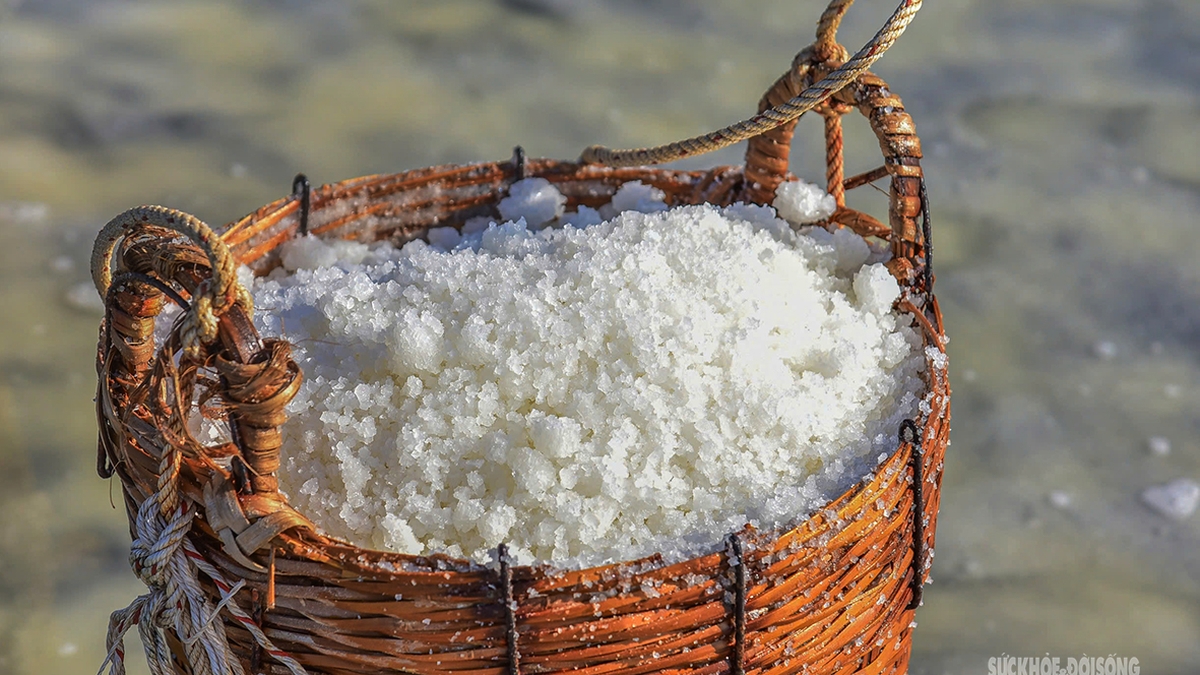
It's similar to the fact that my hometown doesn't have a sea for salt production, nor water for shrimp farming, yet Tay Ninh shrimp salt is what gives so many people such a rich and flavorful taste.
Right at the intersection where Quang Trung and Gia Long met, is also where the road named after Dang Van Truoc begins. He was a prominent figure who contributed to the founding and development of the Trang region from ancient times to the present day. His life story is also full of interesting details.
Even today, many elderly people in Trang Bang still replace the word "truoc" with "trac" when saying it to avoid using the taboo word, and when referring to him in everyday life, they call him "Ông Cả" (Old Man).
This reflects the reverence the people have for their revered ancestor. He led the people in suppressing bandits and also commanded them in digging a canal connecting to the Trang Bang stream to open a road and establish a market.
That is the old Trang Bang market, which some researchers have considered a "Hoi An" of the Southeast region because both have a long history of commerce, were once bustling trading centers, closely associated with waterways, a model of boats on the docks, and possess distinctive cultural, historical, and architectural values of a bygone era.
But it wasn't that simple. The story of Ông Cả digging the canal led to a dispute with Bình Tịnh village because the latter wanted a monopoly on trade and transportation. The Left Deputy Magistrate of the Criminal Department of Phiên An (Gia Định) ruled against Ông Cả, ordering him to be flogged 80 times.
However, since digging the canal was beneficial to the people, the village officials of Binh Tinh had to allow the people of Phuoc Loc village (which is the area of Trang Bang ward today) to use it. The Trang Bang Phuong Chi (Trang Bang Chronicle) by author Vuong Cong Duc wrote: "Because of a long-standing feud with Binh Tinh village, in 1826, while resting in the Cay Cao area (now An Tinh ward), he was poisoned by three villains. After mounting his horse, he began to feel the effects of the poison but managed to regain his strength and passed away at Trang Bang market on the 26th day of the 3rd lunar month."
Now, next to Ông Cả's tomb near the Bùng Binh River (Đôn Thuận), there is a statue of a horse that is worshipped, and someone always cuts fresh grass for this loyal horse every day. In Trảng Bàng, the biggest memorial service in the region is the Ông Cả memorial service.
From morning till night, the cemetery was brightly lit and bustling, the atmosphere both solemn and warm, as all were people from Trang Bang. Local businesspeople highly valued this memorial service; they came to the tomb to offer gifts, after which the organizers distributed cakes and fruits for everyone to take home as a small blessing from Ông Cả (the deceased).
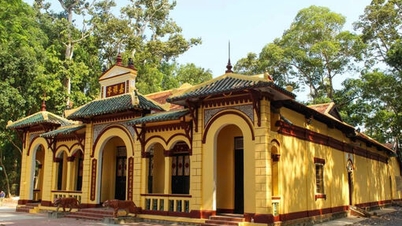
In 1836, during the reign of Emperor Tự Đức, Ông Cả was bestowed the title of Guardian Deity of Gia Lộc Temple by the Huế court. In 1933, Emperor Bảo Đại bestowed the title upon him again because the previous decree had been stolen and taken to another temple in Bình Dương for worship. Thus, he was bestowed the title twice by the imperial court. After 1975, the road passing by his temple was named Đặng Văn Trước by the government.
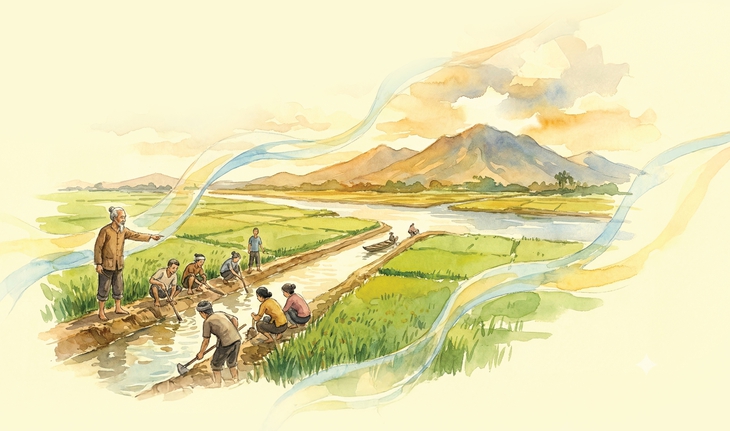
Illustration: THIEN BAO
3. Speaking of showing gratitude to our ancestors, recently, for some unknown reason, the topic of General Le Van Duyet suddenly resurfaced on social media. I asked my father and my former teacher for their opinions on this matter.
Both of them said casually: "We are descendants, how much do we know to comment or judge? But whoever the people worship and admire is right, my child. Those who contributed to opening up new places and those who contributed to preserving them deserve the people's gratitude."
I'm reminded of the heartbreaking story of my family during the war years at the corner of Gia Long and Quang Trung streets. In 1969, my older sister, a 9-year-old girl, was playing idly at the corner of Quang Trung and Gia Long streets near our house at number 8 Gia Long when a bomb hit, and a piece of shrapnel lodged in the back of her neck.
There wasn't much blood, but she had lost all feeling in her legs. After a long period of desperate treatment for her, my uncle found a lifeline and registered my sister to go to Germany under a humanitarian program that Germany offered to Vietnamese children affected by the war in 1970. My sister left at a very young age, alone, with her legs paralyzed, but there was no better option.
Germany didn't give my sister back her normal legs, but everything else is fine. My sister now uses a wheelchair, has a happy family with her children and grandchildren. Every few years, during Tet (Vietnamese New Year), she returns to Vietnam to enjoy the Tet atmosphere in Trang Bang with rice paper, shrimp salt, and more.
The first time she passed by the spot where the war had taken her legs, her heart skipped a beat. But later, it calmed down; the past was long gone. The war had taken a part of her, but she still had so much left. Her homeland and family were still here, and above all, she understood that living a decent and happy life until now was truly a privilege.
Back to the topic
TRUONG GIA HOA
Source: https://tuoitre.vn/tam-thuc-trang-bang-20260202172335021.htm




![[Photo] General Secretary and President To Lam presides over a meeting on preparations for the review of one year of operation of the three-tiered government system.](https://vphoto.vietnam.vn/thumb/1200x675/vietnam/resource/IMAGE/2026/06/02/1780391821195_a1-bnd-4595-9717-jpg.webp)




























































Comment (0)