

 |
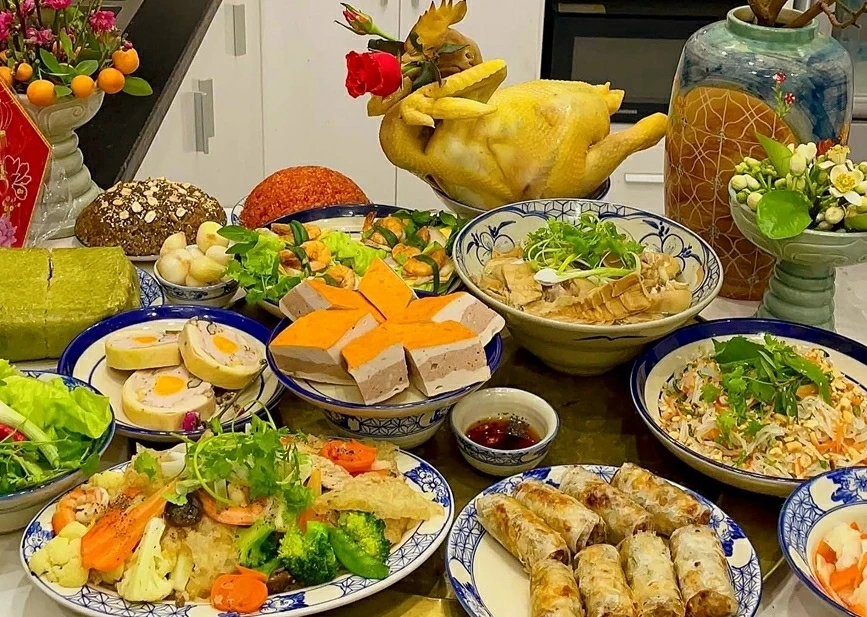
| A traditional Tet (Lunar New Year) meal in Hanoi . (Source: People's Army Newspaper) |
The traditional Tet feast - abundance accompanied by sacred values.
For those who have lived through previous generations, memories of the traditional Tet holiday meal are often associated with images of extremely elaborate and meticulous preparation.
According to long-standing beliefs, the prosperity of the new year must be expressed through a complete feast, not only rich in material wealth but also symbolizing a wish for abundant blessings throughout the year. Therefore, the traditional Tet meal was often meticulously prepared as a way of conveying hopes for prosperity to the family.
In different regions, local customs and specialties have shaped the unique characteristics of each traditional Tet (Lunar New Year) meal.
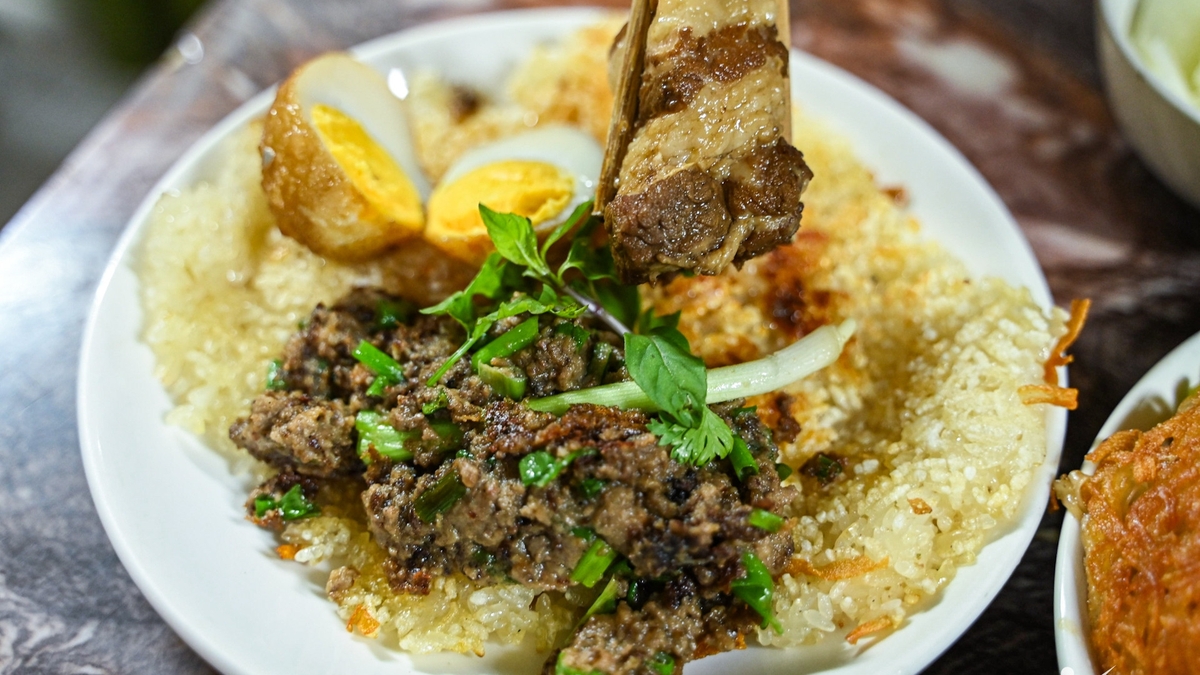
In Northern Vietnam, a region heavily influenced by the cold winter climate, dishes are often simple yet satisfying, ensuring a balance of flavors and colors. Typical examples include the square-shaped banh chung (rice cake) symbolizing the earth according to the concept of a round sky and a square earth; pork sausage and stir-fried pork representing abundance; vibrant red gac sticky rice symbolizing good fortune; and alongside these are bamboo shoot soup, pork skin rolls, jellied meat, and pickled onions – all blending together to create a harmonious whole, not only in terms of cuisine but also evoking a feeling of warmth and comfort.
Central Vietnam, a region often known for its harsher weather conditions, offers a unique twist to Tet (Lunar New Year) menus with flavorful dishes that can be preserved for a long time. Skillfully wrapped banh tet (sticky rice cakes) with savory or sweet fillings are a familiar sight on every Tet feast table; alongside them are braised pork, beef sausage, and pickled vegetables – dishes meticulously seasoned with various spices to suit the region's characteristic cold climate.
Meanwhile, the South, blessed with abundant natural resources, highlights its Tet feast with incredible diversity and richness. Appealing dishes such as braised pork with eggs and rich coconut milk, flavorful pickled shallots and dried shrimp, sticky rice cakes wrapped in purple leaves characteristic of the riverine region, and a variety of tropical fruits create a visually stunning array of colors while embodying the joyful spirit of spring.
Despite the distinct ingredients and cooking methods across the three regions, the most notable commonality is the meticulousness in each dish. Skilled home cooks create a feast of culinary artistry, not only delicious but also conveying messages of reverence for ancestors and good wishes for the new year. Therefore, the traditional Tet feast is not merely a cultural beauty but also the soul of the Vietnamese Lunar New Year, passed down through generations.
The period of innovation - when the Tet feast expanded and cultural exchange occurred.
Beginning in the late 20th century, Vietnamese society entered a period of reform, bringing about significant changes in life, including culinary culture and the traditional Tet (Lunar New Year) feast.
A blend of regional influences
In the past, banh chung (square sticky rice cake) was mainly popular in the North, while banh tet (cylindrical sticky rice cake) was a specialty of the South. However, nowadays, both types of cakes have become familiar throughout the country. Thanks to developed transportation and trade services, people in urban areas can easily buy Tet specialties from anywhere. This makes the Tet feast even more diverse, transcending the boundaries of regional traditions.
The trend is towards convenience and simplification, yet without compromising on richness.

Many families nowadays tend to simplify their Tet (Lunar New Year) feast, reducing the number of complex dishes such as mixed vegetable soup, jellied meat, pork sausage, or pickled vegetables. Instead, they only cook favorite or easy-to-prepare dishes. Some more elaborate dishes can be ordered ready-made, or even replaced with pre-processed or frozen foods. As a result, the Tet feast, while smaller, offers a wider variety of choices.
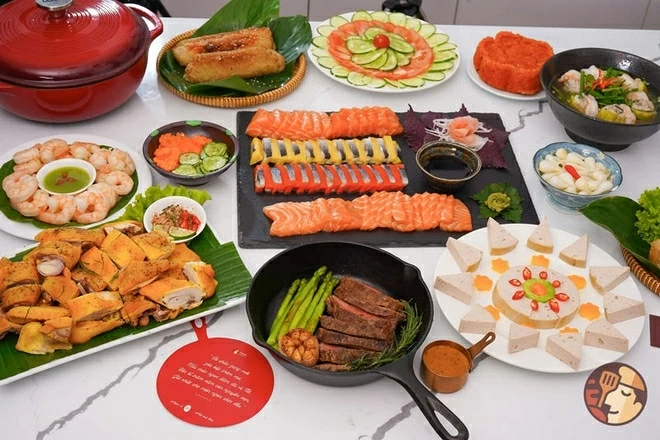 |
| A modern Tet feast featuring many dishes imported from abroad. (Source: iCooking) |
The appearance of foreign dishes
With strong cultural exchange, many dishes imported from abroad, such as hot pot, salads, roast chicken, sushi, beefsteak, and Western pastries, have gradually appeared in Tet meals. Although they don't carry traditional symbolic meaning, these dishes satisfy modern needs and tastes, and are especially appealing to the younger generation.
Over time, the Vietnamese Tet feast has not only preserved its traditional essence but has also expanded to harmonize with the modern lifestyle and global cultural exchange.
The Tet feast in modern times - where tradition and new lifestyles meet.
The Vietnamese Tet (Lunar New Year) feast has undergone significant changes over time, especially in the context of modern life with its fast pace and the interplay between tradition and new trends.
A minimalist Tet holiday - cook less, eat just enough.
Nowadays, many families are prioritizing Tet meals with fewer dishes but significantly improved quality. As health awareness increases, especially among the younger generation, Tet meals are also changing in a healthier direction, such as reducing greasy dishes, focusing on adding more green vegetables, choosing fresh and clean ingredients, and cutting down on starch and sugar.
This minimalist approach is not at all about downplaying the Lunar New Year, but rather aims to reduce waste and provide light and easily digestible meals after the festive days.
Tet feast and the commercialization of the economy.
Food delivery has become a popular choice as modern lifestyles don't allow much time for meal preparation. Sticky rice cakes (bánh chưng) and pork sausage (giò chả) are often ordered from reputable establishments; braised meat, braised fish, or Tet sweets are purchased as combos; and even the entire ancestral offering feast is served by restaurants as a complete package.
In large urban areas, services like home catering help many families save considerable time and effort, while also reducing the burden on women – who usually bear the main responsibility in preparing for Tet.
The Tet feast - a place where families bond.

Contrary to the traditional notion that Tet (Vietnamese New Year) must be a feast with every dish imaginable to show prosperity, today's younger generation focuses more on spiritual values rather than outward appearances. For them, a Tet meal is only truly complete when all family members gather, chat happily, and share moments together. Therefore, the focus of the Tet meal has shifted from "perfection in appearance" to "spiritual connection."
Innovate with creative Tet cuisine.
To add excitement to each Tet holiday, many families are boldly incorporating new, modern dishes to enrich their palates or cater to the needs of young children. Besides familiar traditional dishes like banh chung (sticky rice cake), gio cha (pork sausage), and pickled onions, new dishes such as shrimp and pork salad, beef rolls with cheese, seafood hot pot, or healthy options are becoming increasingly popular. Creativity in cuisine is also a way to make Tet fresher and more relevant to modern life.
Overall, the modern Tet meal still retains its core value of connecting family love, while constantly evolving to harmonize with today's dynamic lifestyle. Whether it takes on a new or simpler form, the Vietnamese Tet meal remains a sacred symbol of national culture and family affection.
Regardless of the addition or removal of dishes, whether traditions are simplified or modernized, the Tet feast remains a symbol of the Vietnamese family – a place connecting the past, present, and future. And it is this adaptability that allows the Tet feast to continue to thrive, to continue to be the soul of the first days of the New Year.
Source: https://baoquocte.vn/tan-man-ve-mam-com-tet-nguoi-viet-360537.html






























![[Video] Sunset at Lap An Lagoon – Where the sun sets over the fishing nets](https://vphoto.vietnam.vn/thumb/1200x675/vietnam/resource/IMAGE/2026/05/31/1780192137701_beach-landscape-sea-water-nature-grass-745871-pxhere-com.jpeg)






















Comment (0)