

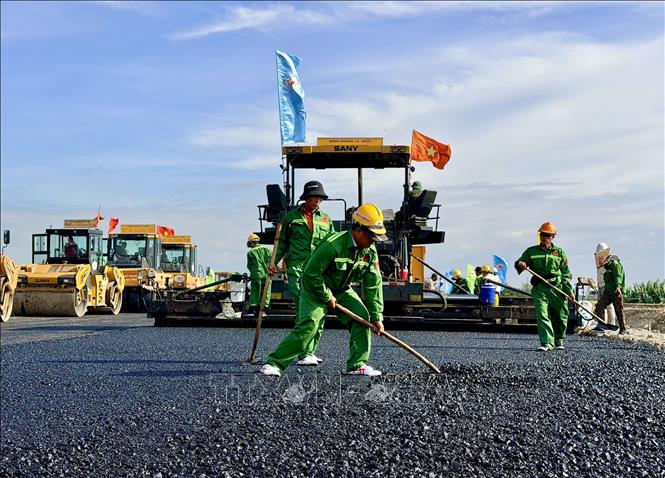
Not only is the number of projects impressive, but it also serves as vivid evidence of the Party and State's determination to make strategic breakthroughs in infrastructure, creating a solid foundation for a new phase of national development. To further clarify the positive impacts and great expectations of this event for the business community, a reporter from the Vietnam News Agency interviewed Lawyer Bui Van Thanh, Head of NewSun Law Office - an expert with many years of experience providing legal and investment advice to domestic and foreign businesses.
Mr. Bui Van Thanh, from the perspective of the business community, how do you assess the significance of the simultaneous groundbreaking and inauguration of 234 large-scale infrastructure projects at the end of 2025, especially in terms of their impact on the investment and business environment?
First of all, I believe this is an extremely strong and positive policy message from the Party and the State right before the 14th National Congress. The fact that 234 infrastructure projects have been started, inaugurated, and opened to traffic is a commendable effort. For the business community, this event brings two core values: confidence and opportunity.
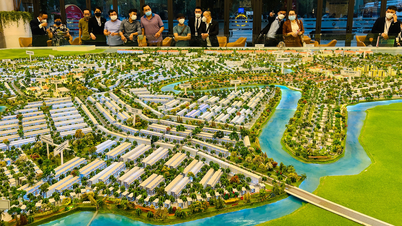
Businesses are seeing consistency between the government 's planning, policies, and implementation capabilities. This dispels concerns about the risk of "suspended planning," benefiting investors, especially those involved in large-scale manufacturing and industrial real estate projects. This, in turn, allows them to confidently make long-term investment decisions or expand their scale. Complete infrastructure is the "guarantee" for their sustainable development. Regarding opportunities, this "infrastructure wave" directly creates a series of new business opportunities. The ability to fill industrial parks, attract secondary investors, and access to credit will significantly improve. Infrastructure developers and industrial real estate businesses will undoubtedly be among the first to seize this opportunity to enhance the attractiveness of their projects.
Besides the significance in terms of confidence and long-term investment opportunities, what, in your opinion, are the specific and "immediate" economic benefits that businesses, especially in manufacturing, import-export, and logistics, will enjoy from this infrastructure "wave"?
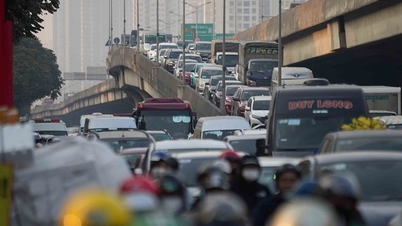
The most immediate and obvious benefit is the improvement in cost and time efficiency. Regarding reduced logistics costs, this is the most direct impact. When expressways, seaports, and connecting infrastructure are put into operation, transportation time will be significantly shortened. This will lead to a reduction in fuel costs, vehicle depreciation, and especially inventory costs for manufacturing and import/export businesses. In the context of fierce global competition, on-time, consistent delivery at lower costs is a crucial competitive advantage.
Furthermore, this is also a major boost for logistics businesses. This group of businesses will be the most direct and powerful beneficiaries. Good infrastructure helps them increase vehicle turnover, reduce wasted waiting time, and optimize operating costs. More importantly, synchronized infrastructure facilitates the formation of modern logistics centers, allowing businesses to shift from a purely transportation model to providing complete supply chain solutions, thereby enhancing competitiveness and improving profit margins.
Furthermore, this leads to ripple effects for many small and medium-sized enterprises (SMEs). Not only the "big players," but also the SME community benefits silently but sustainably as average logistics costs across society decrease and market access expands. This is a prerequisite for SMEs to participate more deeply in the supply chains of leading corporations and FDI enterprises.
As he analyzed, expectations placed on the new infrastructure system are very high. However, in order for the infrastructure to truly translate into tangible economic benefits, what accompanying issues, in his opinion, do we need to address?
This is a very practical question. From NewSun's legal consulting experience, we find that hard infrastructure is only a "necessary condition". For infrastructure to truly become a national competitive advantage, we need a "sufficient condition" which is a synchronized and transparent institutional system.
In practice, many projects with prime locations and good infrastructure connections are still slow to be implemented or operate inefficiently due to obstacles related to land, investment, construction, and environmental procedures. Therefore, the biggest challenge today is not the number of projects started or completed, but the ability to promptly remove institutional "bottlenecks" and put policies into practice. Without strong reforms to administrative procedures, the advantages from infrastructure could be negated by compliance costs and legal risks.
Conversely, when the "two-horse chariot" of infrastructure and institutions operates smoothly, businesses will have a solid foundation to make long-term investment decisions. This is the true basis for enhancing the competitiveness of the Vietnamese economy in the new era, realizing the development aspirations set forth by the 14th National Congress of the Communist Party of Vietnam.
Thank you very much, Lawyer!
Source: https://baotintuc.vn/kinh-te/tao-niem-tin-va-dong-luc-but-pha-20251219162713977.htm
![[Photo] The General Secretary, President and his wife meet with Vietnamese-Chinese friendship leaders.](https://vphoto.vietnam.vn/thumb/1200x675/vietnam/resource/IMAGE/2026/04/15/1776264829725_vna-potal-tong-bi-thu-chu-tich-nuoc-to-lam-gap-mat-nhan-sy-huu-nghi-viet-nam-trung-quoc-8703641-3130-jpg.webp)
![[Photo] National Assembly Chairman Tran Thanh Man attends the opening session of IPU-152](https://vphoto.vietnam.vn/thumb/1200x675/vietnam/resource/IMAGE/2026/04/16/1776277863731_ctqh5-jpg.webp)

![[Photo] My Son at night: A thousand-year-old heritage site amidst the Milky Way](https://vphoto.vietnam.vn/thumb/1200x675/vietnam/resource/IMAGE/2026/04/15/1776261039184_ndo_br_chon6-jpg.webp)
![[Photo] Mrs. Ngo Phuong Ly meets and exchanges views with Mrs. Peng Li Yuan](https://vphoto.vietnam.vn/thumb/1200x675/vietnam/resource/IMAGE/2026/04/16/1776277858080_phu-nhan-1-jpg.webp)


































































Comment (0)