France is the third country, after Japan and Italy, to invest in and operate high-speed rail, making the TGV train a "national pride".
"Shrinking" France with high-speed trains: France is the second country in Europe to invest in and operate high-speed rail, and like Japan and Italy, this stems from the need for a conventional rail network that cannot meet demand. According to research by the Transport Newspaper, France researched and invested in high-speed rail in the context of the energy crisis of the 1970s, the rapid development of express highways, and increasingly accessible air travel options. Meanwhile, the traditional rail system, after 150 years of operation, had deteriorated, making rail transport no longer a viable option for travel needs.
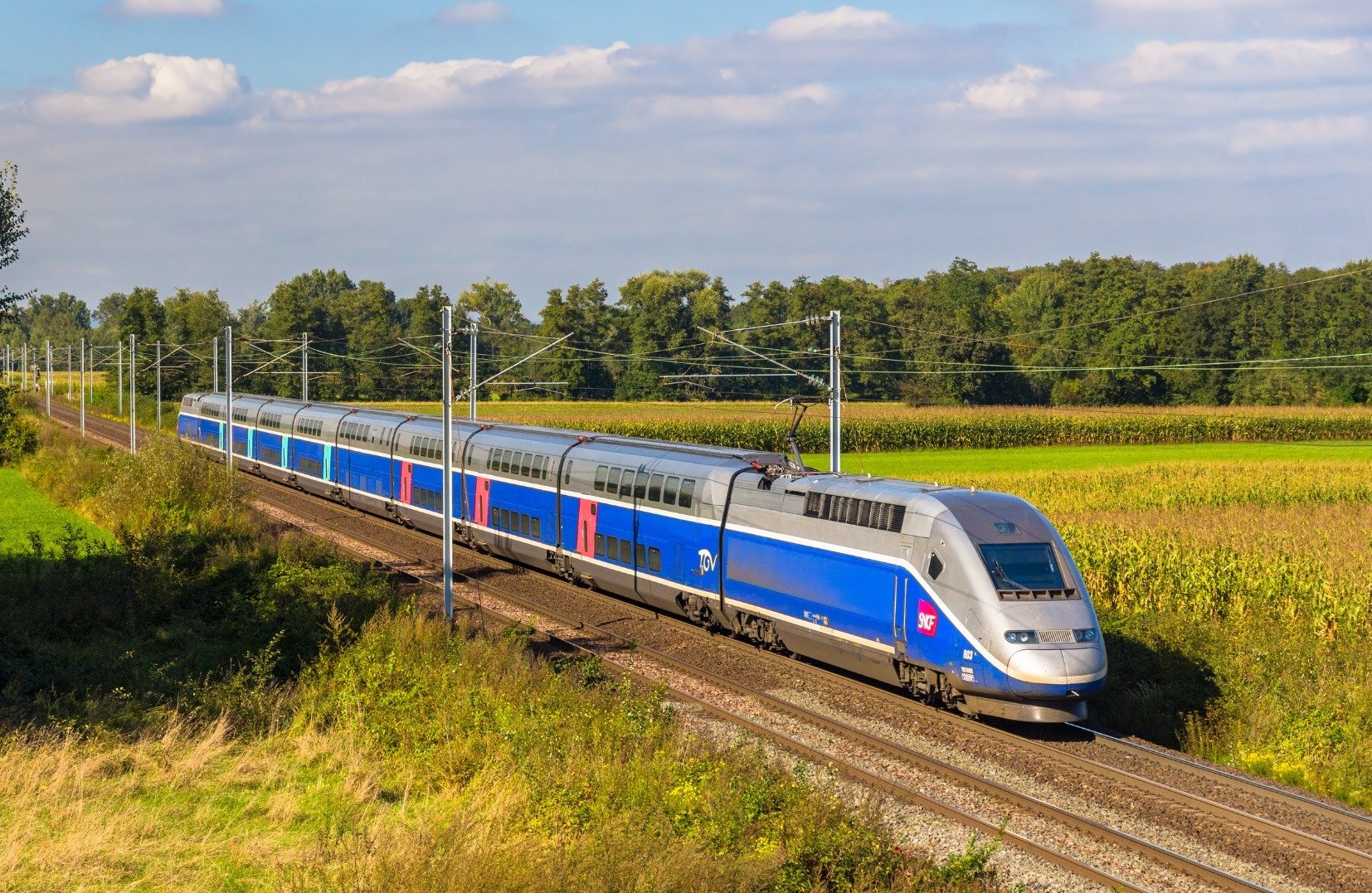
TGV high-speed trains in France (Photo: internet).
How Da Nang is overcoming bottlenecks and aiming for double-digit growth.Following the consolidation and operation of a two-tiered local government model, Da Nang is implementing a series of policies to remove bottlenecks related to land, projects, and the investment environment, creating a foundation for the city's double-digit growth.
Faced with the need to restructure the economic development space and improve the competitiveness of the railway system, the French government decided to develop a high-speed rail line (Train à Grande Vitesse - TGV) on the overloaded Paris-Lyon corridor. In 1981, France put into operation the first TGV line connecting Paris and Lyon, with an operating speed of 260 km/h; however, the design and test speeds achieved a world record of 380 km/h. The introduction of the TGV marked the beginning of a new breakthrough period for the French railway industry. The TGV "shrinked" France and even Europe to a radius of 3-4 hours of travel, connecting major French cities. Between 1990 and 2010, many more TGV lines were inaugurated nationwide. These include the 50km Eurostar line with the Channel Tunnel to England, the Thalys line connecting Belgium and the Netherlands , linking France with Europe and England with reasonable travel times, high safety standards, and good service quality. French high-speed trains (TGV) are largely focused on passenger transport; only a few small, high-value goods were previously transported on specialized trains converted from TGV Sud-Est passenger trains (La Poste mail trains). However, due to low demand, these trains ceased operation in 2015 due to losses. In the 10 years following the inauguration of the first TGV service, passenger numbers have continuously increased significantly. According to the French national railway group (SNCF Group), the TGV system is estimated to serve approximately 250,000 passengers daily, averaging 90 million people per year. By the end of 2003, the TGV had transported 1 billion passengers, and by 2010, this figure had risen to 2 billion. At its peak, the TGV accounted for about 75% of passenger transport volume on routes managed by SNCF. The advantages that allow the TGV to compete with air and road transport are shorter travel times, diverse and convenient services, safety, and significantly lower fares compared to air travel. Furthermore, its environmental friendliness is a crucial factor for French citizens, making the TGV unrivaled on routes under 1,000 km and journey times under 3 hours.
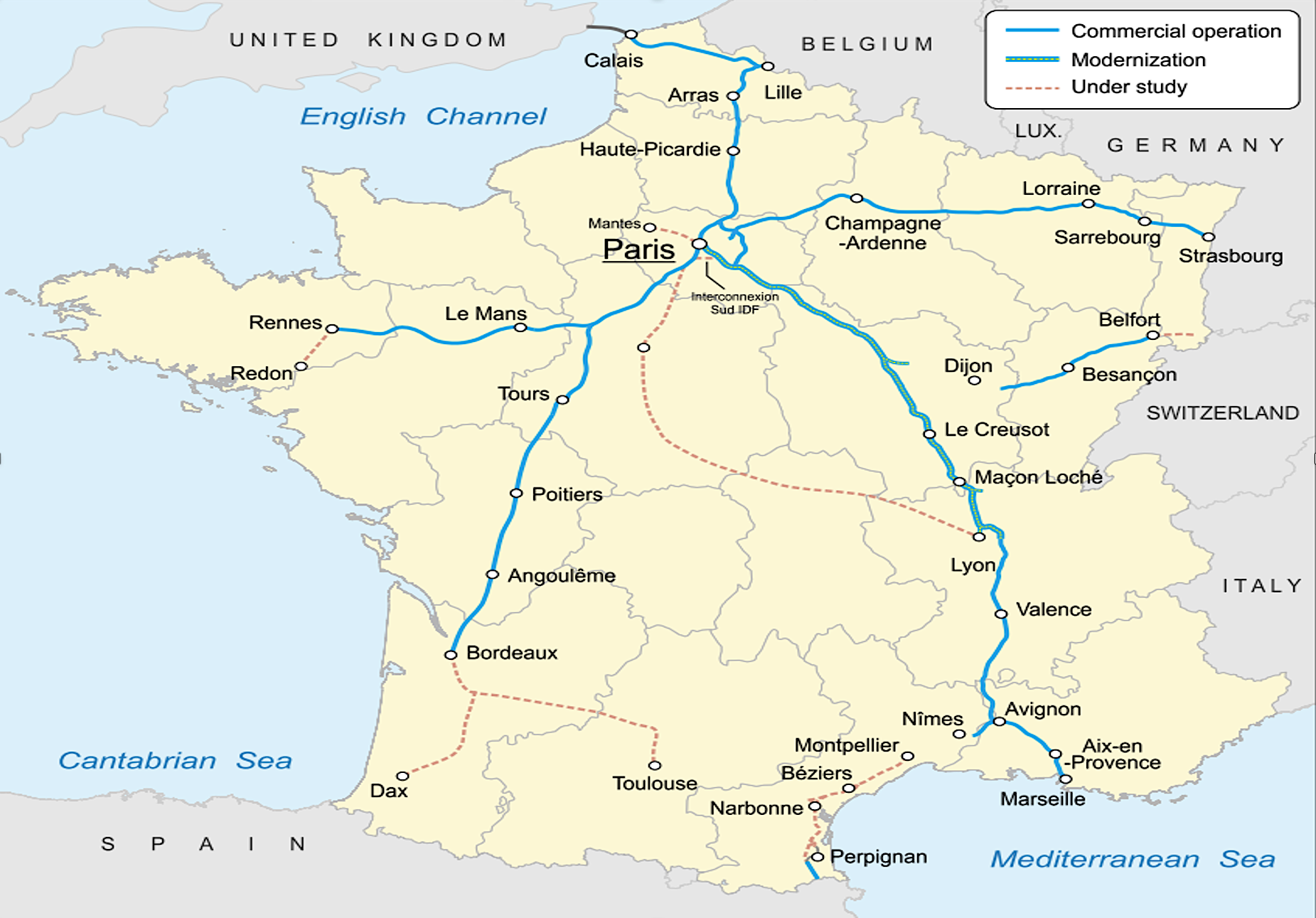
According to the International Union of Railways (UIC), France currently has 12 high-speed rail lines in operation, with a total length of 2,735 km; all with a maximum operating speed of 300-320 km/h. In its long-term plan, France aims to invest in an additional 1,242 km, bringing the total length of high-speed rail to 3,977 km.
In France, the investment and management of high-speed rail are entrusted to companies owned by the French government . The sources of funding for high-speed rail lines are diverse, but government or government-owned companies still account for the largest proportion, followed by regional governments along the route. For example, on the Rhin-Rhône line (eastern branch, phase 1), government and government-owned company funding accounts for over 60%; funding from the regional governments of Franche-Comté, Alsace, and Burgundy together accounts for over 28%; and other sources contribute. Following several phases of restructuring and mergers, from January 2015 to the present, the task of building, owning, managing, and operating French railways has been undertaken by SNCF to ensure optimal use of the national railway network, safety, service quality, and cost control according to established conditions. This ensures fair competition and non-discrimination among railway operators. Self-research and technology export: As a country with original technology, France has developed and achieved many successes in high-speed rail investment. In 2007, France broke the world record for the fastest test run of a high-speed train at 574.8 km/h. To this day, this remains the world record for rail-based train technology. TGV technology has been exported and transferred to many European countries, Morocco, and South Korea . For the French, TGV is a "national pride".
Strengthening the friendship between Vietnam and the United States.On July 3rd, as part of the Pacific Partnership - Friends of the Pacific 2026 program, the U.S. Army Pacific delegation, led by Lieutenant General Joel Vowell, Deputy Commander of the U.S. Army Pacific, paid a courtesy visit to the Quang Tri Provincial Military Command.
France has relatively flat terrain, and trains mainly run on embankment tracks. The demand for transport is not high due to the absence of densely populated corridors. Therefore, French trains tend to prioritize comfort, improve speed, and require minimal construction, thus avoiding the need for research into reducing axle load. This leads to the use of concentrated propulsion systems, which reduce maintenance costs and noise for passengers. The favorable terrain allows for the use of large-radius curves, enabling the use of shared bogies to increase rigidity and speed. French technology is used for both passenger and freight trains, as well as high-speed and conventional trains. However, France is gradually shifting towards operating high-speed passenger trains exclusively. To achieve a speed of 320 km/h, the TGV must use special tracks and a series of improvements that allow the train to run at high speeds based on the following principles: high-power motors, a low center of gravity, an aerodynamic shape, secure coupling points, and accurate signals to assist the driver when visibility is limited at high speeds. The tracks are specially designed to withstand high speeds, minimize vibration and noise, and ensure safety and comfort for passengers. Continuous improvements in technology and design have helped the TGV maintain its leading position among countries producing high-speed rail trains, meeting the ever-increasing demands of passengers for speed and comfort.