

Are propeller-driven UAVs losing their advantage?
After more than four years of conflict in Ukraine, many NATO countries have significantly increased their investment in UAVs, believing that they will be a game-changer in modern warfare.
However, according to some military experts, the reality on the battlefield is showing a different trend: inexpensive propeller-driven UAVs may gradually lose their advantage to the emergence of jet-powered UAVs and low-cost interceptor missiles.
One of the most notable changes is that Russia is reportedly upgrading the Shahed UAV by equipping it with turbojet engines instead of the traditional propeller engines.
This allows the new UAVs to reach speeds of around 740 km/h, many times higher than the approximately 145 km/h of the older Shahed models, while also operating at significantly higher altitudes. This change makes it much more difficult for Ukrainian propeller-driven interceptor UAVs to operate.
Interceptor drones, which previously only reached speeds of around 450 km/h, are no longer capable of tracking targets as effectively as before, forcing them to switch to a direct approach tactic with a much lower probability of success.
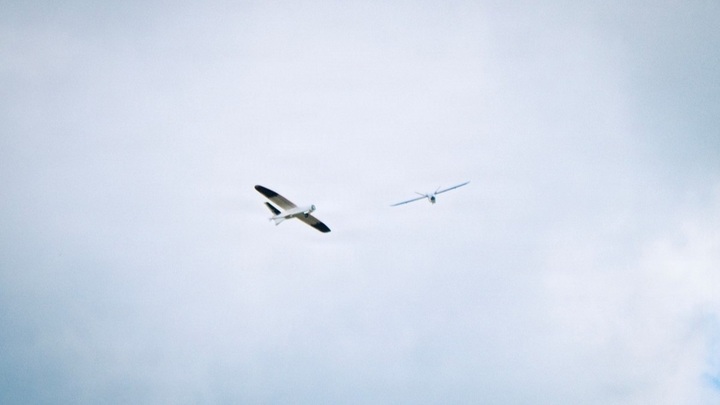
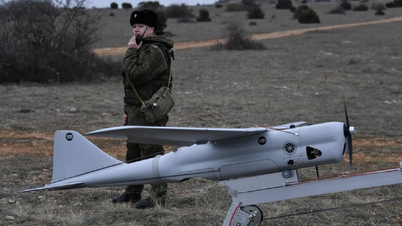
Drone. Photo: War on the Rocks
According to analysts, the classic rule of air combat is repeating itself: speed and altitude remain crucial factors for survival.
While many Western countries continue to invest heavily in propeller-driven UAVs for both offensive and defensive anti-drone operations, Russia and Iran are reportedly moving toward a different model – inexpensive jet-powered UAVs combined with interceptor missiles.
One example cited is Iran's 358 missile, which is said to cost around $90,000 per missile but is capable of engaging a variety of airborne targets such as Shahed UAVs, MQ-9 Reapers, or AH-64 Apache helicopters.
According to some, this could be a more sustainable approach than relying entirely on propeller-driven UAVs.
However, many believe that UAVs will not disappear from the battlefield but will change their role. Instead of directly engaging targets as they do now, propeller-driven UAVs could become transport platforms or "mother ships" carrying inexpensive interceptor missiles.
In this approach, UAVs will handle long-distance travel at low cost, while missiles will take care of the final high-speed attack phase. Beyond combat, UAVs and ground robots remain crucial in logistics, such as transporting ammunition, resupply, or evacuating wounded soldiers from dangerous areas.
Does the future belong to inexpensive interceptor missiles?
Many experts believe that the biggest challenge for modern air defense today is cost. If the enemy can produce thousands of jet-powered UAVs for only tens of thousands of dollars, using air defense missiles costing hundreds of thousands or millions of dollars to intercept them becomes economically inefficient.
This led to the idea of developing a low-cost, automated interceptor missile class that uses artificial intelligence and autonomous guidance systems to destroy low-cost UAVs or cruise missiles.
These systems are expected to cost only a few thousand to a few tens of thousands of dollars each, yet still be capable of intercepting high-speed targets.
The Western defense technology sector has now seen a growing number of companies pursuing this direction, including startups in the US and Europe developing small-scale, mass-produced interceptor missiles.
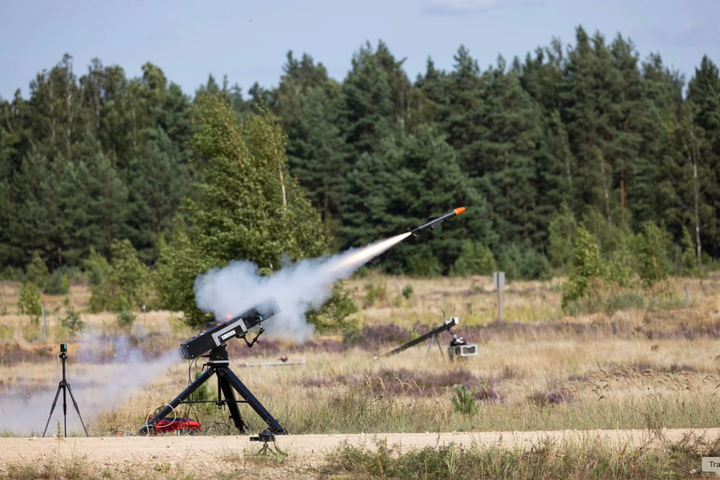
A low-cost missile prototype is being tested. (Photo: WSJ)
However, one of the problems facing the West is that missile production is still far more complex than civilian UAV production.
Jet propulsion systems, sensors, and navigation systems require specialized supply chains and highly skilled engineering teams that not every country can easily scale up.
Meanwhile, China now plays a significant role in the global supply chain of low-cost UAV components and engines. According to many experts, this is what helps Beijing accumulate the industrial capacity and experience to develop new generations of low-cost air defense systems.
Some of China's inexpensive anti-UAV air defense systems, such as the FK-3000 and Yitian, have begun to attract attention due to their ability to carry a large number of interceptor missiles.
Observers believe the Ukrainian battlefield may have ushered in a new transitional phase of air warfare – where propeller-driven UAVs no longer play the "decisive weapon" role they did a few years ago, giving way to faster, more automated, and much cheaper systems.
Source: https://vtcnews.vn/ten-lua-gia-re-se-thay-uav-thong-tri-chien-war-tren-khong-ar1019305.html
![[Photo] General Secretary and President To Lam presides over a meeting on preparations for the review of one year of operation of the three-tiered government system.](https://vphoto.vietnam.vn/thumb/1200x675/vietnam/resource/IMAGE/2026/06/02/1780391821195_a1-bnd-4595-9717-jpg.webp)




















































































Comment (0)