


Speaking to the Nguoi Lao Dong newspaper, Mr. Gia Khang (residing in District 4, Ho Chi Minh City) recounted that about two months ago, a friend who works at a bank needed to meet a credit card opening target and begged him to help. Out of respect for his friend, he opened a regular credit card for personal and family expenses.
The trouble of canceling a credit card.
Last week, a bank employee informed Mr. Khang that he had another credit card linked to his current one, and requested him to pay a fee. He was very surprised, not understanding why, despite only opening one card, the system showed two active cards linked together.
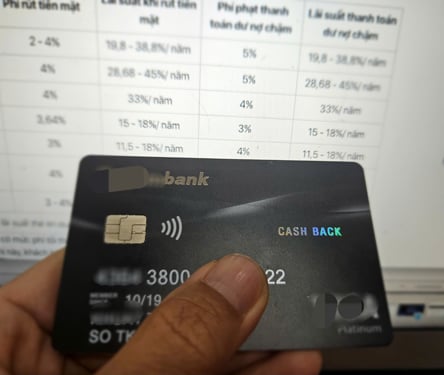
Recently, many consumers have encountered problems with credit cards that allow them to spend now and pay later. (Photo: LAM GIANG)
"I filed a complaint through the hotline, but the bank hasn't responded yet. This isn't the first time; about two years ago, when I borrowed money from the bank to buy a house, the condition was that I had to open a credit card. I later discovered I had two. It took me a long time to cancel them, and now I'm facing this situation again," Mr. Khang recalled.
Many people also find themselves in a frustrating situation after opening a credit card and then struggling to cancel it. Mr. Le Hoang (residing in Binh Thanh District, Ho Chi Minh City) said he recently received a call from a consultant at a bank headquartered in Hanoi , informing him that if he reactivated his credit card, the annual fee would be waived for the next three years. Remarkably, this was the same credit card that he had struggled with for a whole week just a month before finally being able to cancel.
According to Mr. Hoang, at the beginning of 2024, an acquaintance who worked at Bank V. invited him to open a credit card with a limit of 44 million VND to meet the issuance quota. Out of respect for his friend, he agreed to open the card even though he had no intention of using it. The card application process was very smooth; only a phone number and citizen identification card were needed, and he received the card after only one week.
During the process of opening the card, employee V. said that Mr. Hoang had to deposit 10,000 VND to activate it and that it would be refunded, but did not mention that interest would be charged on this amount. More than 6 months later, his card account had been debited the initial 10,000 VND and incurred additional overdue interest and late payment fees, totaling nearly 200,000 VND.
"I was very surprised because I thought I hadn't spent anything but I was still charged a late payment fee. Even worse, after paying this amount, I went to the bank to close the card, but the staff told me I had to… go home and call the hotline to register for cancellation. After I reported the cancellation, the hotline operator said someone would confirm it in 3-5 days… Opening a card is easy, but closing it is such a hassle," Mr. Hoang said angrily.
Similarly, Mr. Quoc Ngoc (residing in Thu Duc City) also spent two weeks going back and forth to the bank several times before he could close his credit card. According to this bank's regulations, credit card holders who want to cancel must call the hotline, but the system is frequently overloaded. When someone finally answered, the employee said that his account still had 600,000 VND in promotional credit, and the balance hadn't reached zero yet, so he couldn't cancel it. To cancel, he would have to use up all of this promotional credit!
The explanation should be clearly explained to the cardholder.
Why is it so easy to get a credit card – banks heavily advertise it as being ready in just a few minutes (if you meet the requirements) – but closing it is so much more difficult?
Some banks only accept card closures via their call center instead of visiting a branch or using the banking app. An employee of a commercial bank explained that closing credit card accounts via the call center is to reduce the workload and pressure on staff at branches and transaction offices.
Dr. Chau Dinh Linh from the Ho Chi Minh City University of Banking believes that the situation of users rushing to open credit cards and then struggling to close them because they don't need them is a consequence of a period when banks expanded card issuance and employees were focused on meeting sales targets. Many people simultaneously own multiple types of credit cards (cashback cards, shopping cards, co-branded cards, etc.) with varying credit limits and needs.
"Credit card businesses typically offer high profit margins from interest rates (average credit card interest rates are around 30%-35%), fees, promotions, and cash flow from payment accounts… which is why banks are competing to issue cards regardless of users' actual needs. Meanwhile, many people open cards even when they don't need them, out of politeness to relatives and friends, so they know almost nothing about the interest rates they have to pay, the types of penalties, and use the cards very carelessly. In reality, not a few cases have resulted in bad debt due to uncontrolled spending and inability to repay," analyzed Dr. Chau Dinh Linh.
According to financial expert Phan Dung Khanh, he once owned seven credit cards, mostly out of politeness to friends or acquaintances who asked him to open them for them. Because he works in the financial industry, he's noticed that credit card application contracts are often very long and detailed, so very few customers read them carefully before signing. Not to mention, the contracts usually contain very complex content.
"Once, I read a credit card contract and found the regulations unreasonable, so I requested adjustments. The bank staff said that this was a general legal framework and could not be amended. If that's the case, to be fair to cardholders, in addition to the contract, the bank should summarize specific information for customers about interest rates, penalty fees, and potential risks if interest is not paid on time," Mr. Phan Dung Khanh suggested.
Source: https://nld.com.vn/the-tin-dung-de-mo-kho-huy-196240827213843362.htm



![[Photo] General Secretary To Lam attends the opening session of the Peace Council on Gaza.](https://vphoto.vietnam.vn/thumb/1200x675/vietnam/resource/IMAGE/2026/02/19/1771516865192_tbttolam5-jpg.webp)

































































































Comment (0)