

According to reports from three leading global auditing and consulting firms—Deloitte, PwC, and KPMG—the global semiconductor market is expected to surpass $1 trillion in sales this year—a historic peak, driven by a wave of investment in artificial intelligence (AI), satellites, and robotics. But perhaps few realize the power of these tiny chips, no bigger than a fingernail, that are propelling global corporations to compete with giants and transforming entire economies .
In a statement yesterday, South Korean SK Group Chairman Chey Tae-won said that its memory chip manufacturer SK Hynix aims to double its wafer production capacity in the next five years.
CD-shaped wafers are the base material on which chips are "printed." Each modern chip contains anywhere from a few million to 200 billion transistors. Each transistor is only a few nanometers long (about 1/40,000th the length of a human hair), acting like a tiny electrical switch. Through billions of on/off cycles per second, these transistors perform calculations, store data, process information, or run AI algorithms.

So how is it possible to print billions of transistors onto each chip? That's why the name ASML comes up: the Dutch company – the world's sole manufacturer of lithography machines worth hundreds of millions of dollars each – used to lithograph microcircuits onto wafers to create high-tech chips.
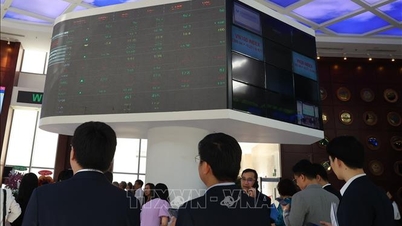
As demand for memory chips surged, stock prices jumped, propelling three memory chip manufacturers—Samsung Electronics, SK Hynix, and Micron—to reach a market capitalization of $1 trillion in May. Exports of all types of memory chips increased 3-5 times, helping South Korea's exports reach record highs and driving its stock market to consecutive new highs.
Mr. Do Van Huong, Senior AI Chip Research Engineer at Asicland, South Korea, stated: "According to current signals, the semiconductor industry's growth cycle could last at least until 2027. The reason is the booming demand for AI, leading to a huge demand for DRAM, HBM, and NAND. Even if future AI models optimize memory more, the scale of AI applications will still grow faster than the rate of memory savings. Meanwhile, expanding chip factories will take 2-3 years, so the supply cannot increase immediately, helping to continue supporting chip prices."
According to experts, although chip manufacturers are accelerating the expansion of their production facilities, increasing output immediately is very difficult because advanced chip production requires factories worth tens of billions of dollars, an environment cleaner than a hospital operating room, and thousands of processes.

Source: https://vtv.vn/thi-truong-chip-ban-dan-vuot-1000-ty-usd-10026060323211872.htm













![Transforming from Resolution 57: [Part 3] High-tech agricultural center](https://vphoto.vietnam.vn/thumb/402x226/vietnam/resource/IMAGE/2026/06/03/1780491765550_2928-4922-img_7193-010813_454-010814.jpeg)


















































![[Video] Sunset at Lap An Lagoon – Where the sun sets over the fishing nets](https://vphoto.vietnam.vn/thumb/1200x675/vietnam/resource/IMAGE/2026/05/31/1780192137701_beach-landscape-sea-water-nature-grass-745871-pxhere-com.jpeg)





































Comment (0)