Setting aside specific religious and spiritual factors, in the context of today's constantly changing education landscape, exploring Zen meditation as a psychological aid in schools offers many advantages in educational methodology.
In relation to Zen, education is not just about imparting knowledge, but also a journey to help people rediscover balance, tranquility, and compassion in their souls. However, in today's digital age, schools are under many pressures: fast-paced life, demanding exams, constantly changing technology that distracts concentration, and both teachers and students are exhausted in the race for achievement. Amidst this reality, Zen, with its nature as the "art of mindful living," is being recognized as a humane, healing, and intellectually enlightening method of education.
If introduced into schools, Zen helps teachers and students return to themselves, thereby enabling education to be conducted on a foundation of tranquility, understanding, empathy, and sharing.
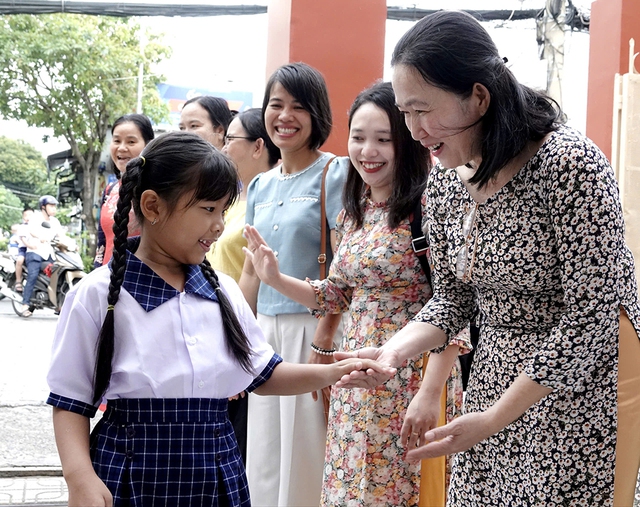
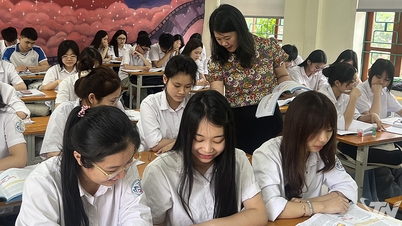
Education should cultivate character in students and teach them the art of living in harmony.
PHOTO: D.N. THACH
MEDITATION IN A TECHNOLOGY-BASED EDUCATIONAL ENVIRONMENT
The word "Zen" originates from Sanskrit, meaning "contemplation" or "inner contemplation." When it was transmitted to China, it was transliterated as "Zen-na," shortened to "Zen" (禪). Essentially, Zen is the art of mindful living, the ability to dwell in the present moment, undisturbed by thoughts or anxieties.
In the field of education, Zen can play a role as a form of emotional, moral, and intellectual education. Zen teaches people to observe their own minds, understand their own emotions and those of others, and thus approach life and activities with tolerance and mindfulness. Zen Master Thich Nhat Hanh once said: "Teaching without teaching how to breathe, how to listen, how to smile... is only half the job." Zen is the way to "teach the other half"—that is, the education of the soul.
In the context of the many changes in today's school environment, meditation plays a positive role for both students and teachers. For students, meditation helps them cultivate focus and mindfulness. This is because students today are surrounded by countless distractions such as phones, social media, pressure from grades, and exams. When their minds are drawn away, learning becomes superficial and lacks depth. Adding some meditation will help students develop their ability to concentrate through simple exercises (such as breath control, controlling emotions when presenting lessons, taking exams, or simply sitting still for a few minutes at the beginning of a class...).
Students will learn to recognize their emotions without being controlled by them, thereby reducing anger, anxiety, and fear. This is extremely necessary in today's school environment, where exam pressure and peer relationships can easily cause students to lose their psychological balance.
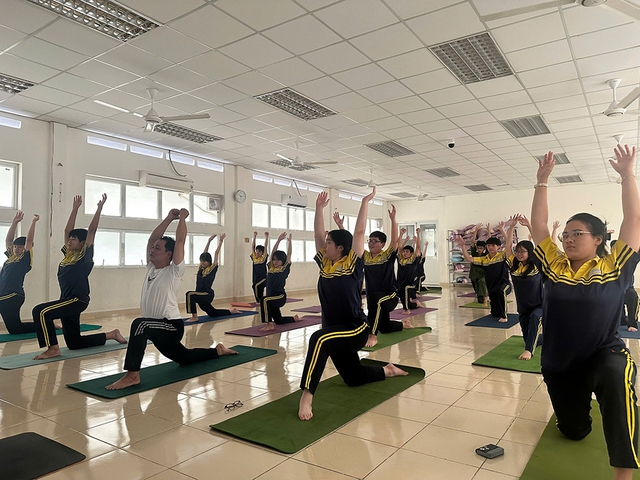
Students from Bui Thi Xuan High School (Ben Thanh Ward, Ho Chi Minh City) during a yoga class.
PHOTO: HTP
Meditation also helps cultivate character in students, teaching them the art of living harmoniously. When students learn to listen to themselves, they also learn to listen to others, develop empathy and love, and reduce school violence. "A student who knows when to stop before saying hurtful things, who knows how to smile instead of reacting angrily, that is the profound result of education through meditation," shared a retired teacher in Ho Chi Minh City.
For teachers, meditation helps cultivate a calm energy, maintain inner peace, reduce professional stress, and restore positive energy. Meditation helps teachers spread the spirit of humanistic education, a type of education based on love and compassion, like the spirit of Nam Cao's short story " Tears ."
Teachers who practice Zen meditation will teach students less through pressure and more through understanding. They see behind students' wrongdoings a fear or lack of affection, and therefore respond with compassion instead of punishment. This awareness creates a healthy, humane school environment, where "education is about transformation, not oppression or punishment." This is also an important criterion of the current policy of building happy schools.
MANY APPLICATIONS
When Zen meditation is introduced into schools, it not only impacts individuals but can also transform the entire group. In many countries such as Japan, South Korea, the United States, and the United Kingdom, programs like the "Mindfulness in School Project," "Calm Classroom," or "Peaceful Schools Program" have proven effective in reducing school violence, decreasing absenteeism, and increasing happiness and bonding between teachers and students.
In Vietnam, some schools in Ho Chi Minh City, Hue, and life skills classes in Hanoi , Da Nang, etc., have applied gentle meditation during class activities. As a result, students are less prone to anger, perform better academically, and the class environment becomes more harmonious and peaceful.
At the beginning of the 2025-2026 school year, Bui Thi Xuan High School (Ben Thanh Ward, Ho Chi Minh City) will introduce 11 completely free school program contents, including yoga, cooking, gym, and global citizenship. If schools treat meditation as a life skills subject like this, I think many students will enroll.
The remaining challenge is how to introduce Zen into schools in a way that is not cumbersome and avoids being perceived as the religiousization of the school environment.
This can be done in many ways, such as: 5 minutes of quiet reflection at the beginning of class, walking meditation in the schoolyard, after each lesson... Meditation can be integrated into literature, art, and music , so that students can feel the tranquility and contemplation in the works.
It can be affirmed that Zen is not just a method of sitting still, but an art of mindful living and education through the heart. When Zen enters schools, it opens up a new education not just for knowing, but for understanding, for compassion, and for learning and progressing. Zen Master Thich Nhat Hanh once said: "Education is not about cramming knowledge, but about helping students become themselves in peace and understanding." This idea is similar to the highest purpose of learning proposed by UNESCO: "Learning to affirm oneself."
Source: https://thanhnien.vn/thien-trong-giao-duc-thoi-cong-nghe-185251113213422353.htm






































































































Comment (0)