

From soldier-driver to courageous political commissar in Truong Son
Recently, during a conversation with us, alongside stories of wartime experiences and countless memories of the trials and tribulations on the legendary Truong Son trail, he always remembered his comrades who fought alongside him on every stretch of the road with deep emotion and pride. “Just thinking about my comrades from the fierce years of war, especially those who fell in the Truong Son Mountains, fills my heart with longing and remembrance. I can't live without being decent. Whatever we can do for our comrades, we are all very happy…,” Major General Hoang Anh Tuan confided.
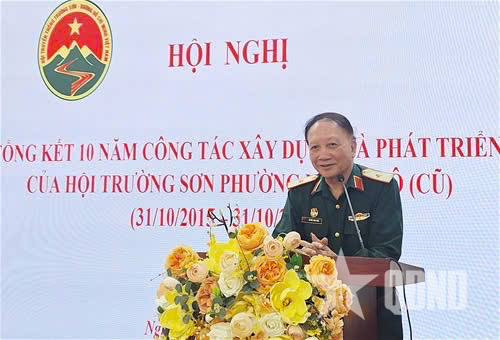 |
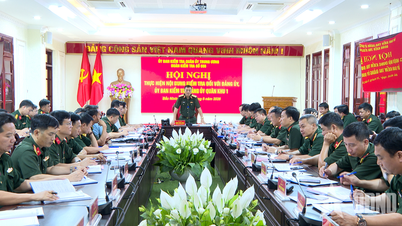
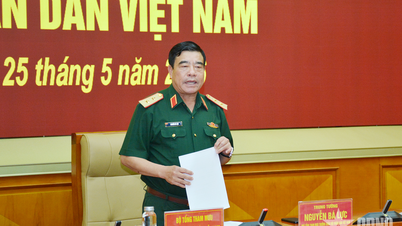
| Major General Hoang Anh Tuan delivered a speech at the conference summarizing 10 years of work in building grassroots-level associations. |
Currently, in his capacity as the Standing Vice Chairman of the Vietnam Truong Son - Ho Chi Minh Trail Veterans Association, he remembers them in a unique, "very Truong Son" way. That is, continuing his journeys with his colleagues in the Association's Executive Committee and tens of thousands of Truong Son members, returning to the old battlefields to express gratitude to the compatriots and comrades who sheltered and helped them during the arduous years of the resistance war against the US and for national liberation. On each such journey, memories of a not-so-distant past flood back to him…
Sixty-five years ago, on February 20, 1961, young Hoang Anh Tuan left his hometown of Son Tay ( Hanoi ) to enlist in the army. After two months of training, he was assigned to driver training. He recalled with emotion: “To be honest, I didn't like it much at the time. The reason was simple: I thought that as a soldier, I should train on the training ground and then directly carry a gun and perform duties on the battlefield. But after months of training, I clearly defined my mindset. As a soldier, I will complete any task and overcome any difficulty to focus on my work.”
Then Hoang Anh Tuan and his unit marched into the Truong Son Mountains. Initially, he served in the 245th Regiment - An Khe Regiment (then under the General Department of Logistics), reinforcing the Truong Son troops. After several trips receiving and transporting troops from the rest stop near Dong Hoi airport to Lang Ho and the rest stop of the 559th Regiment, he was ordered to move to the West, operating on Highway 12 - one of the horizontal axes connecting the East and West of the Truong Son Mountains. This was also when the Truong Son troops entered the peak of the 1962-1963 dry season transport period. Thus, Hoang Anh Tuan officially became a Truong Son soldier, assigned to various units such as: Battalion 25, 245th Regiment (when the regiment was disbanded, the Battalion went to Supply Depot 1, later separated into Supply Depots 31 and 32); Canoe Battalion 166; Engineering Regiment 515…
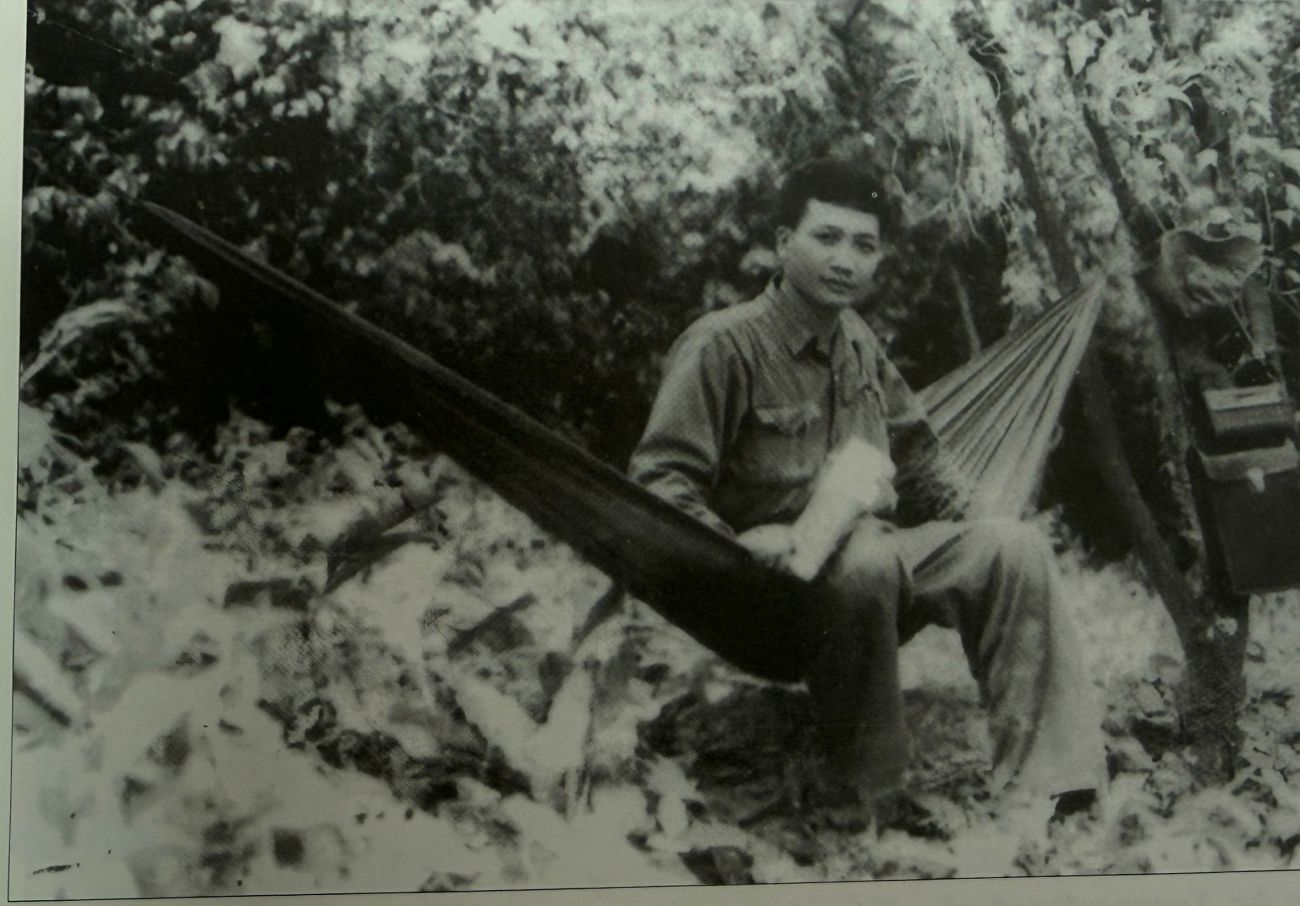 |
| Comrade Hoang Anh Tuan during his time in Truong Son in 1971. |
During his 47 years in the military, except for the first five years as a soldier, Hoang Anh Tuan was entrusted by his superiors with important leadership and command responsibilities, from company level to strategic level. He always strived to complete his missions alongside his comrades and contributed to building many "key figures" who became the valiant Trường Sơn soldiers, the "heroes driving 10,000-ton trucks" known to many, such as Kim Ngoc Quan, Nong Van That, Hoang Van Man, Nguyen Xuan Luc, Nguyen Phuong Danh… They faced death together, an experience he will never forget.
The most memorable experience was when the company commander, Hoang Anh Tuan, received supplies in Zone C and delivered them to Lum Bum (an area on Highway 9). Company Political Commissar Hoang Anh Tuan was in the vehicle driven by Nong Van That, at the rear of the transport convoy. On the way in, the enemy attacked, but the entire company safely delivered the supplies and returned that same night. On the return journey, near the Ka Toc strategic point, the enemy fired upon and dropped bombs, which landed right on the roadside. It was 3 a.m., and deciding to leave the troops near the strategic point for a few hours while waiting for the engineers to clear the bombs and open the road would very likely lead to enemy detection and attack. Therefore, as soon as the vehicle stopped, Hoang Anh Tuan immediately consulted with the on-duty engineering force and decided to drive quickly past the bomb site. In a situation where the chances of success were 50-50, but with no better alternative, he made the bold decision and carried it out with his comrades.
Major General Hoang Anh Tuan recalled: “Knowing the danger, driver Nong Van That suggested I get out and ride in the car behind, but I resolutely refused. After starting the engine, That sped through the critical point. When we were about 100 meters past the barrier, I heard a very loud 'thud' and the car stopped abruptly. I quickly jumped out of the car, and through the thick smoke and dust, I could still see a large bomb crater behind us. The crater was about 5 meters from the edge of the road. After checking the car and finding no damage, I knew we had overcome the magnetic bomb and ordered That to restart the engine. The engine roared to life, and I shouted orders for the entire company to advance past the critical point.”
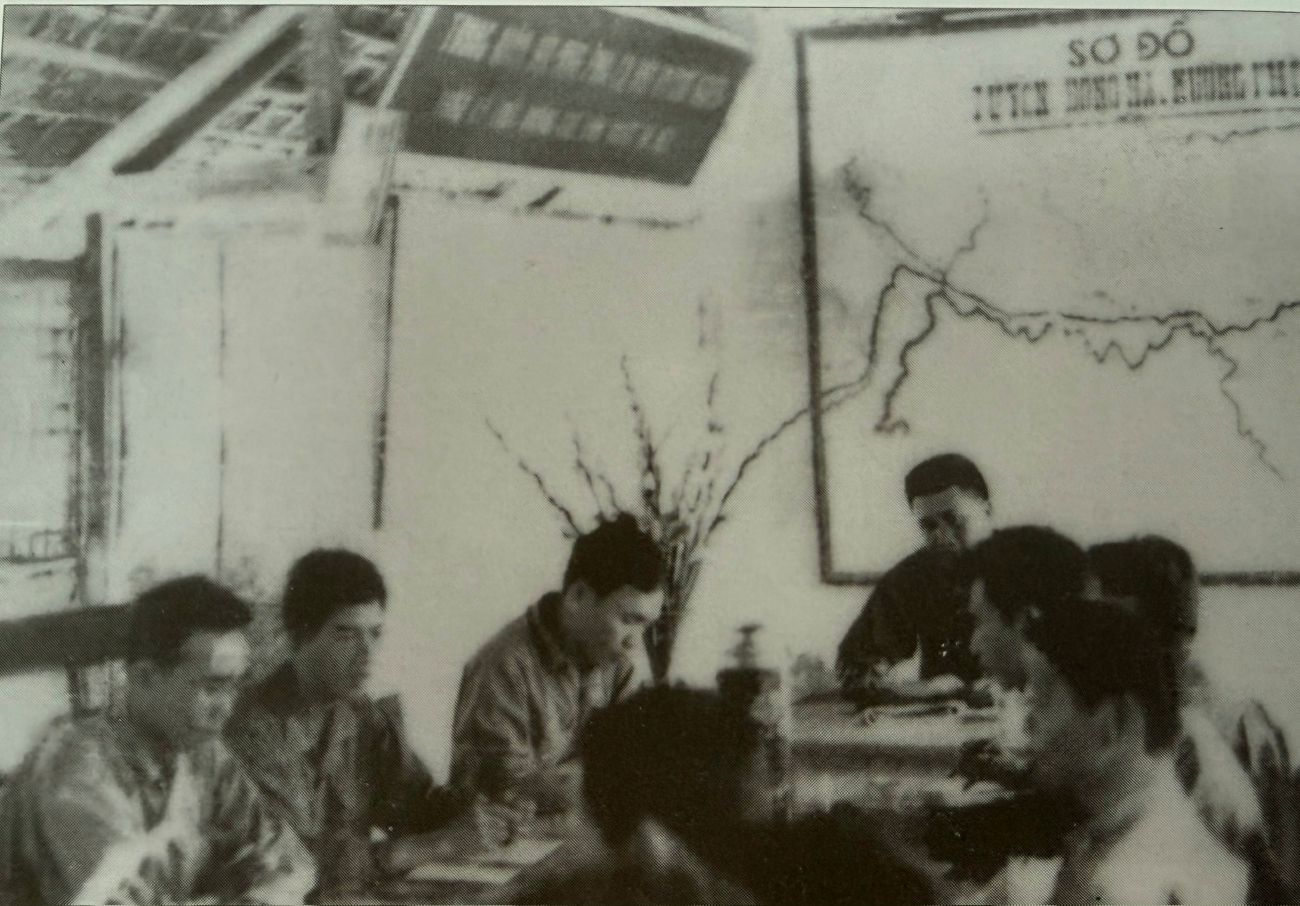 |
| Colonel and Political Commissar of the 515th Trường Sơn Engineering Regiment, Hoàng Anh Tuấn, chaired a meeting to approve the unit's road maintenance plan. |
Another dangerous situation arose when he left the Truong Son Mountains to become the Political Commissar of the 166th Boat Battalion, tasked with supporting the forces defending the Citadel and the eastern flank of Quang Tri. On the night of July 21, 1972, on the Thach Han River, the command boat struck a mine. Political Commissar Hoang Anh Tuan was thrown from the boat by the blast, his face hitting the water, and mud rushed into his mouth and nose. He was rescued and taken to the 14th Medical Team for treatment. Just half a month later, upon hearing that the battalion had been attacked, he resolutely requested to return to his unit to work while receiving treatment. Yet, the "calamity" did not stop there. While actively working with the unit's command to consolidate forces and intensify support for the Citadel, B-52s carpet-bombed the position, causing Hoang Anh Tuan to suffer severe burns to his face, requiring treatment at the Navy Special Forces unit's infirmary. After his wounds temporarily healed, he returned to his unit to fight alongside his comrades, completing the mission of supporting the Citadel until the very last days…
Embark on a journey of connection for the sake of teamwork.
Years of facing fierce bombing and countless insidious enemy tactics, along with numerous hardships, shortages, and traps in the Trường Sơn mountain range, forged Hoàng Anh Tuấn into a man of unwavering resilience.
Despite the bombing and shelling, the vehicles rushed along the routes, increasing the number of trips, running into the morning and evening to complete their assigned tasks. He and his comrades were present on the most fiercely contested routes and strategic points, with places he can never forget, such as: Bai Dinh, Phu La Nhich Pass, Ta Le ford, the A-shaped curve, Xuan Son ferry, Vang Mu, Lum Bum, Cha La, Coc Mac, Tha Khong...
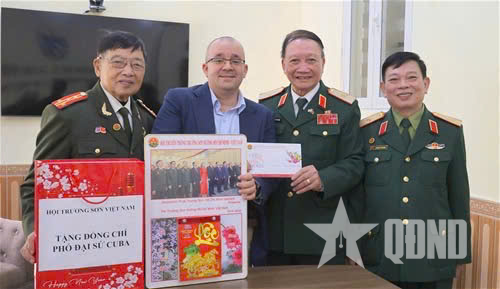 |
| Major General Hoang Anh Tuan (second from the right) and representatives of the Vietnam Truong Son - Ho Chi Minh Trail Tradition Association present gifts to their Cuban friends. |
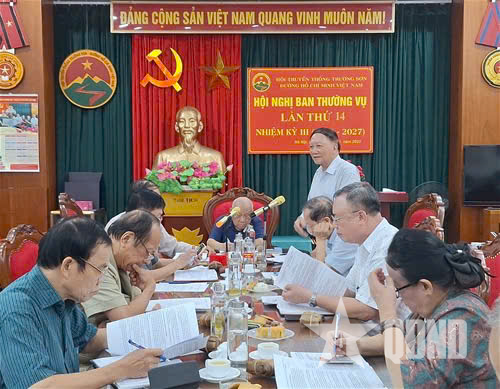 |
Permanent Vice Chairman Hoang Anh Tuan delivered a speech at the meeting of the Standing Committee of the Truong Son - Ho Chi Minh Trail Tradition Association. |
As the person in charge of Party and political work from the grassroots level to the entire army, Major General Hoang Anh Tuan affirmed that Party and political work is always the "soul and lifeblood" of the Army. Political strength is the most important factor, having a decisive meaning, forming the source of strength for our Army to successfully and excellently complete all tasks.
“The Party Committee of the Truong Son Army Corps directly led all combat activities from the battlefield to the grassroots units. A typical event was in 1968 and 1969, when the enemy launched fierce attacks, blocking roads and preventing vehicles from transporting supplies to the battlefield. Many believed we had to revert to carrying supplies on our backs. But the Party Committee of the Truong Son Army Corps held a meeting and decided to defeat the enemy at all costs, determined to fight to reopen the roads, and outlined many necessary measures to overcome the obstacles. Nearly a month later, with great effort, the Truong Son Army Corps defeated the enemy, reopened the road system from the border crossings, and brought transportation activities back on track and developed continuously. In many ways, we built courage and unwavering will to overcome the enemy's bombs and bullets, as well as the difficulties of the mountainous terrain, making the soldiers confident in their unit and in ultimate victory,” said Major General Hoang Anh Tuan.
Upon returning to civilian life, he was one of the pioneers in building the "Common House of the Truong Son Soldiers," named the Vietnam Truong Son - Ho Chi Minh Trail Tradition Association, officially established in 2011. All activities of the Association are carried out with high collective consensus in a democratic and voluntary spirit, with regulations and objectives aimed at uniting members, preserving and promoting the traditions and heritage of Truong Son; organizing and coordinating activities to express gratitude and solidarity with Truong Son, educating the younger generation, and contributing to national development.
Over the past 15 years, the Vietnam Truong Son - Ho Chi Minh Trail Tradition Association, chaired by Major General Vo So and with Major General Hoang Anh Tuan as its Standing Vice-Chairman, has gathered more than 31,000 members. With dedication, enthusiasm, and responsibility, the Executive Committee and various levels of the association have mobilized donations of money and goods totaling hundreds of billions of VND. From this fund, thousands of houses of compassion, savings accounts, and scholarships have been provided to families of wounded soldiers, martyrs, meritorious individuals, members in difficult circumstances, and underprivileged children who excel in their studies, across the country.
During his involvement in the association's work, Major General Hoang Anh Tuan had many groundbreaking ideas and decisions, contributing to spreading the image of Uncle Ho's soldiers and Truong Son soldiers closer to the people. Wherever there were comrades in need of help, Major General Hoang Anh Tuan was there, joining hands to share and contribute. Despite his advanced age and declining health, he was always ready to travel to investigate and survey the situation firsthand, mobilizing all possible social resources, even donating his own money, hoping to alleviate the burden of his comrades' difficult lives.
Source: https://www.qdnd.vn/tuong-linh-viet-nam/thieu-tuong-hoang-anh-tuan-va-hanh-trinh-tri-an-1038273
![[Image] Hanoi's urban life under the challenge of a "scorching hot" environment](https://vphoto.vietnam.vn/thumb/1200x675/vietnam/resource/IMAGE/2026/05/25/1779706979265_nang-nong-t5-2026-minh-duy-7-4636-jpg.webp)
![[Image] Close-up view of the interchange connecting the two expressways and Long Thanh Airport.](https://vphoto.vietnam.vn/thumb/1200x675/vietnam/resource/IMAGE/2026/05/25/1779703378210_ndo_br_z7863716673926-224453a31600126cce10622af6290afd-4549-jpg.webp)



























































Comment (0)