

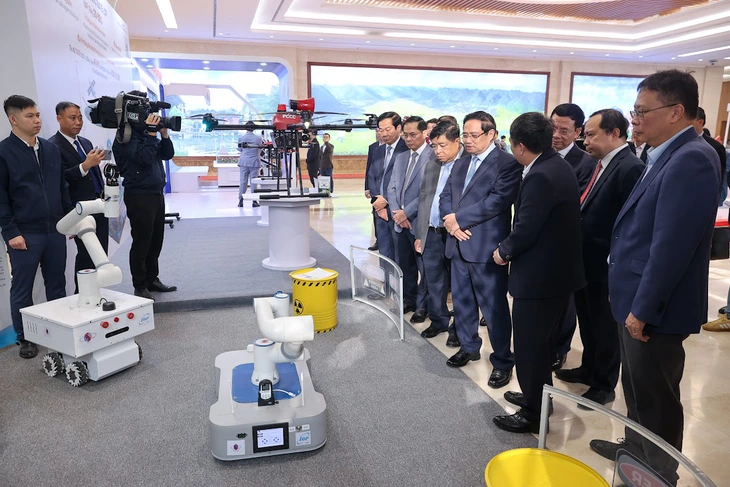
The Prime Minister and delegates visit the exhibition of technology products - Photo: NHAT BAC
At the Government Headquarters, the Prime Minister stated that we have identified the development of the digital economy as a means to innovate the growth model, restructure the economy, improve productivity and competitiveness, build an inclusive and humane digital society, improve the quality of life, ensure equal access to services, narrow the development gap, and promote cultural identity in the digital environment.
In the spirit of "digital economy as the driving force, digital society as the foundation, and people at the center," the 13th National Congress of the Communist Party of Vietnam clearly defined the development of the digital economy, improving productivity, quality, efficiency, and competitiveness of the digital economy, and gradually developing the digital economy and digital society.
We need to determine where we stand in the global value chain.
In December 2024, Resolution 57 of the Politburo identified this as a top priority breakthrough, the main driving force for the rapid development of modern productive forces, the improvement of production relations, the renewal of national governance methods, socio-economic development, the prevention of backwardness, and the achievement of breakthrough development and prosperity in the new era, helping to recognize the role and position of the digital economy and digital society.
The Prime Minister suggested a frank, objective analysis, supported by specific data, is needed on the current state of Vietnam's digital economy and digital society development, highlighting outstanding achievements and our current position in the global technology value chain.
Along with that, we will share valuable experiences, lessons learned, and innovative approaches in developing the digital economy and digital society, especially lessons from large technology corporations and leading localities, in order to replicate successful models.
He also requested a clear identification of existing shortcomings, limitations, weaknesses, obstacles, and bottlenecks, especially in terms of institutions and policy mechanisms, in order to deploy and develop cross-border digital services, taxation, intellectual property, and cybersecurity.
"How can we remove the remaining bottlenecks in data connectivity and sharing? What specific mechanisms are needed for Vietnam to become a cradle of innovative startups and new technology development?"
"What needs to be done to build a civilized, inclusive digital society where no one is left behind? How can we effectively mobilize and utilize social resources, such as public investment, private investment, foreign investment, and public-private partnerships?", the Prime Minister asked.
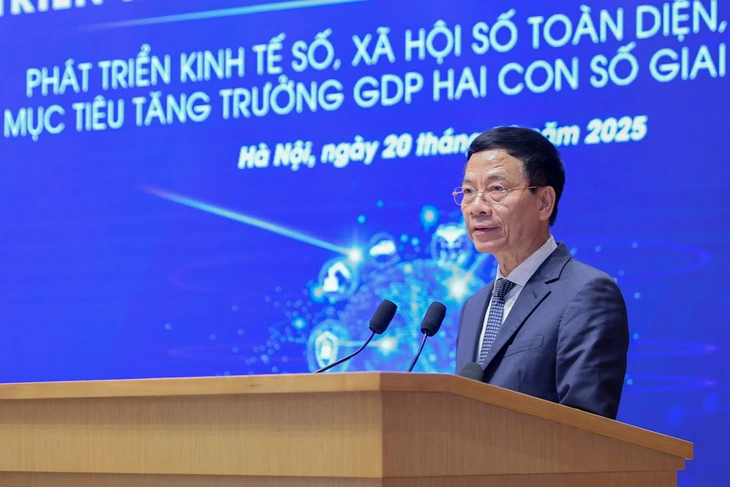
Minister of Science and Technology Nguyen Manh Hung - Photo: NHAT BAC
National digital economy structure
In his report, Minister of Science and Technology Nguyen Manh Hung stated that Vietnam is entering a strategic acceleration phase to realize its aspiration for rapid and sustainable development, aiming to transform the country into a high-income nation in the coming decades. In this journey, the digital economy and digital society are no longer an option, but an inevitable path, a core driving force for growth and innovation in the development model.
According to Mr. Hung, Vietnam's digital economy currently still mainly involves digitizing old activities and has not yet strongly shifted towards creating new growth models. The proportion of the digital economy in GDP is increasing rapidly, but domestic added value remains low and heavily dependent on cross-border platforms. Many small and medium-sized enterprises have not yet truly participated in the digital value chain.
Therefore, the task ahead is to build a national digital economic structure, instead of digitizing individual sectors in a fragmented manner. This involves restructuring the entire economy, from production, distribution, and consumption to market organization, corporate governance, and the allocation of social resources.
Data, AI, and computing power are considered the fundamental production capabilities of the digital economy. Network operators must become the backbone of the national digital space, not just telecommunications networks, but also data centers, cloud computing, edge computing, platforms, and cybersecurity.
The shift is from e-government, which involves digitizing procedures, to a data-driven and predictive model-based state. This includes developing a national digital market centered on businesses, building a people-centered digital society, and establishing digital trust as its foundation.
Source: https://tuoitre.vn/thu-tuong-chung-ta-dang-dung-o-dau-trong-chuoi-gia-tri-cong-nghe-toan-cau-20251220101839271.htm


![[Photo] Prime Minister Pham Minh Chinh attends the Conference on the Implementation of Tasks for 2026 of the Industry and Trade Sector](/_next/image?url=https%3A%2F%2Fvphoto.vietnam.vn%2Fthumb%2F1200x675%2Fvietnam%2Fresource%2FIMAGE%2F2025%2F12%2F19%2F1766159500458_ndo_br_shared31-jpg.webp&w=3840&q=75)






























































































Comment (0)