


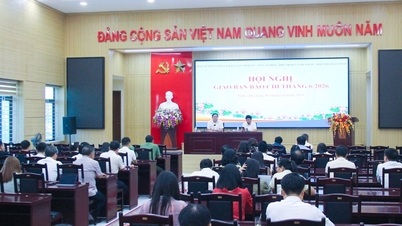
Also attending were Deputy Prime Minister Le Thanh Long, Chairman of the National Committee on the Elderly of Vietnam; leaders of central ministries and agencies, and a number of international organizations. The conference was broadcast live to provinces and cities nationwide.
In his opening remarks at the conference, Prime Minister Pham Minh Chinh assessed that this important conference has long-term strategic significance for sustainable development, and although it is a new topic, it is meaningful in the context of the rapidly aging population occurring globally in general and in Vietnam in particular.
On behalf of the Party and State leaders and General Secretary To Lam, with personal feelings, the Prime Minister sends his respectful greetings, heartfelt regards, and best wishes to all delegates, distinguished guests, and comrades.

The Prime Minister stated that this conference is taking place against the backdrop of a very complex and unpredictable global situation, impacting issues related to energy security, food security, monetary policy, fiscal policy, and macroeconomic stability…
In this context, we must find new driving forces and resources to help mitigate existing limitations, shortcomings, and difficulties; simultaneously promoting both supply and demand, fostering social development, and ensuring social justice, progress, equality, and social security.
Currently, the "silver economy" is becoming an inevitable trend for humanity worldwide. According to United Nations data, approximately 58 million people enter the elderly age group each year; this number is expected to double by 2030; global average life expectancy is increasing rapidly; and the group of people aged 80 and over is growing at the fastest rate.

Vietnam entered the aging population phase in 2011 with a rapid increase in the proportion of elderly people. According to the General Statistics Office, the aging index in 2024 is projected to be 60.2% (an increase of 11.4% compared to 2019 and 16.9% compared to 2014). The number of people aged 60 and over is 14.2 million (an increase of 2.8 million, 1.25 times higher than in 2019, and an increase of 4.7 million, 1.5 times higher than in 2014). It is projected that by 2030, there will be approximately 18 million elderly people, an increase of nearly 4 million compared to 2024.

This presents both opportunities and challenges, creating pressure on social welfare but also serving as a driving force for innovation in the country's sustainable growth and development model. The documents of the 14th National Congress of the Party not only view the elderly as beneficiaries of welfare benefits but also as a part of the human resources, setting a target of a Human Development Index (HDI) of 0.8; an average life expectancy of 75.5 years, with a minimum of 68 years of healthy life. Vietnam aims to be among the top 40 countries with the highest Happiness Index in the world. This forms the political basis for economic development.
Accordingly, the Central Policy and Strategy Committee was tasked with developing a plan for the development of a silver economy in Vietnam to improve the welfare and quality of life of the elderly and to leverage the resources of the elderly to contribute to socio-economic development.

The government has issued the National Strategy on the Elderly until 2035. Recently, in Resolution No. 36/NQ-CP dated March 6, 2026, from the regular Government meeting in February 2026, solutions were proposed to promote high-quality healthcare services – a core pillar of the "silver economy".
Looking further ahead, the political and legal foundation for Vietnam's silver economy has been quite clearly formed through the Party's guidelines and the State's policies and laws on adapting to population aging, caring for the elderly, promoting the role of the elderly, and expanding social security for the elderly.
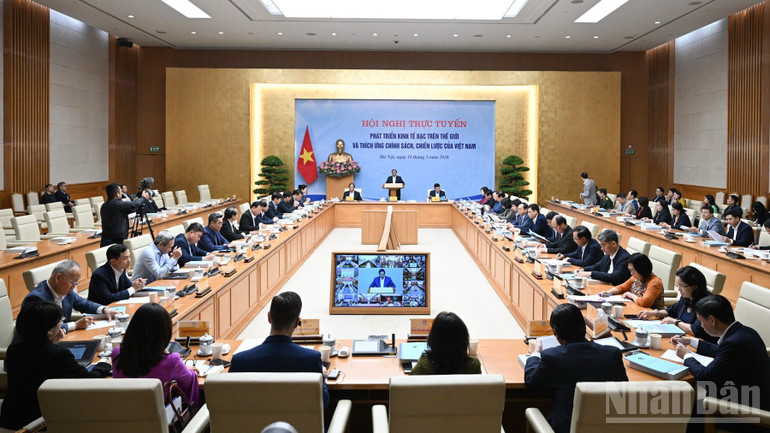
Given current demands, we need to reach a consensus: the elderly are not a burden, but a valuable resource for national development. Emphasizing that this conference is a forum for implementing and exchanging views on several issues related to the silver economy, the Prime Minister requested delegates to focus on discussing several major topics: International experiences and how Vietnam is proactively adapting its policies and strategies; assessing the current implementation of the National Strategy on the Elderly to Adapt to Population Aging; proposing several models for developing the silver economy suitable to Vietnam's circumstances, linked to promoting digital transformation, green transformation, circular economy, and innovative entrepreneurship…
We need guidance and support to encourage retirees to continue their entrepreneurial endeavors and contribute to the nation. This is crucial in the current context where all resources need to be mobilized for national development. For the country to achieve double-digit growth, all sectors and fields must experience double-digit growth. We need solutions to shift the burden of an aging population into an opportunity for economic development, transforming challenges into opportunities, while simultaneously ensuring social security, harnessing the immense potential of the elderly, and guaranteeing social progress, equity, and profound humanistic values.

With that in mind, the Prime Minister urged the delegates to speak frankly, substantively, get straight to the point, and offer specific proposals and recommendations.
According to the Vietnam Association of the Elderly, in the context of an irreversible global trend of population aging, which is rapidly occurring in Vietnam, the "silver economy" is an integral part of the national economy, an inevitable trend, a necessity, and an important political task for the entire political system and society. The elderly are the subjects, objects, centers, and driving forces behind this development. Successfully developing the "silver economy" will significantly contribute to achieving the Party's Resolution of the 14th National Congress on the goal of achieving double-digit national growth in the coming years.
Regarding the term "silver economy": Population aging is becoming one of the emerging global challenges, while also being a crucial driving force of development in the 21st century. The silver economy is understood as a system of economic activities, products, and services aimed at meeting the needs of the elderly. The characteristic of the silver economy is its focus on market opportunities arising from the aging process, catering to the needs of a growing elderly population. Therefore, the silver economy is a "unique part" of the overall economy related to the production, consumption, and trade of goods and services relevant to the elderly.
Based on theoretical understanding gained through research and scientific conferences, combined with practical experience from both domestic and international sources, we can initially recognize that "silver economy" is a new term, linked to the global trend of population aging. It implies a type of economic development based on state mechanisms and policies adapted to population aging, relying on social resources to connect businesses, philanthropists, and the community to jointly protect, care for, and promote the role of the elderly. The elderly are both the target of the "silver economy" and the driving force behind it, contributing to Vietnam's economic growth and aiming for double-digit growth in the new era, as outlined in the Resolution of the 14th National Congress of the Communist Party of Vietnam.
In the context of Vietnam's rapidly aging population, the elderly are benefiting from excellent policies and regulations that increase average life expectancy, improve quality of life, and allow them to contribute to society with their children and grandchildren, living happily, healthily, and contentedly.
However, population aging also poses many difficulties and challenges, firstly the inability to meet the increasing social welfare needs while the national budget is limited; the shortage of labor due to the end of the "golden age of population," the perception that "the elderly are a burden" to their children and society; the healthcare system does not yet adequately cover the medical needs of the elderly; and the nursing home system is still spontaneous and fragmented.
To fundamentally and sustainably address the aforementioned issues, the entire political system and society as a whole need to be involved, from removing institutional bottlenecks to changing perceptions and transforming behaviors, with the motto "working together to ensure that the elderly live peacefully and happily."
Source: https://nhandan.vn/thuc-day-phat-trien-kinh-te-bac-thich-ung-tinh-trang-gia-hoa-dan-so-post947623.html




![[Image] Shipbuilders exposed to steel and record-breaking heat.](https://vphoto.vietnam.vn/thumb/1200x675/vietnam/resource/IMAGE/2026/06/04/1780545781745_ndo_br_img-5402-4683-jpg.webp)











![[Image] Shipbuilders exposed to steel and record-breaking heat.](https://vphoto.vietnam.vn/thumb/402x226/vietnam/resource/IMAGE/2026/06/04/1780545781745_ndo_br_img-5402-4683-jpg.webp)
![[Photo] General Secretary and President To Lam attends the 14th Congress of the Vietnam Trade Union](https://vphoto.vietnam.vn/thumb/402x226/vietnam/resource/IMAGE/2026/06/04/1780543339765_anh-man-hinh-2026-06-04-luc-10-22-07.png)



















![[Video] Sunset at Lap An Lagoon – Where the sun sets over the fishing nets](https://vphoto.vietnam.vn/thumb/1200x675/vietnam/resource/IMAGE/2026/05/31/1780192137701_beach-landscape-sea-water-nature-grass-745871-pxhere-com.jpeg)




























Comment (0)