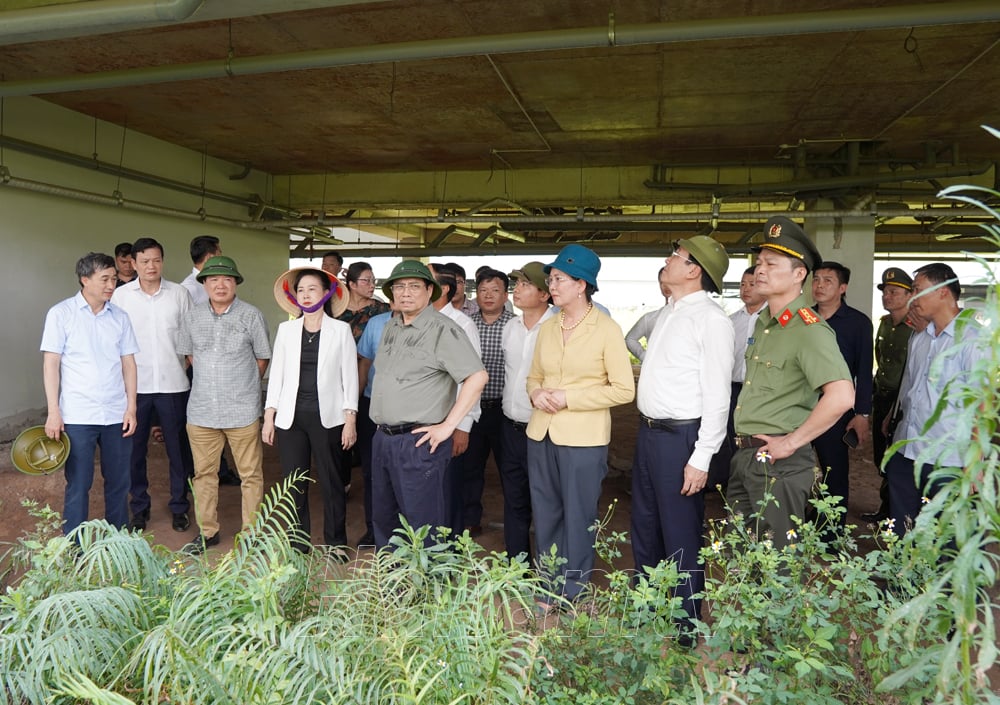
Politburo member and Prime Minister Pham Minh Chinh inspects the construction area of Viet Duc Hospital Co-op 2 in Ha Nam. (Photo: hanamtv.vn)
Ho Chi Minh's thoughts on practicing thrift and preventing and combating waste.
During his lifetime, President Ho Chi Minh paid great attention to the issue of practicing thrift and combating waste. Many times, in his writings and speeches, he reminded cadres, party members and the people to pay close attention to preventing and combating extravagance and waste, and to use money, time and effort rationally and effectively. In President Ho Chi Minh's thought, thrift and diligence are the qualities of a revolutionary; a revolutionary must constantly practice and set an example of thrift and diligence, and prevent and combat waste. In the first session of the Government Council of the Democratic Republic of Vietnam (now the Socialist Republic of Vietnam), President Ho Chi Minh clearly stated: "I propose launching a campaign to re-educate the people's spirit by implementing: THRIFT, FRUGALITY, INTEGRITY, AND RIGHTEOUSNESS" (1) .
President Ho Chi Minh clearly stated that saving means not being extravagant, wasteful, or reckless. He also did not endorse an extreme understanding and practice of saving. Saving does not equate to stinginess or miserliness, nor does it mean "treating money as worthless," or "not doing what is worthwhile or spending what is necessary." He emphasized the importance of saving. Saving time, human effort, and resources, and concentrating resources on production, will promote production development and social progress. When everyone saves, every household saves, wealth will be accumulated for national construction, contributing to the victory of the revolutionary cause led by the Party.
The opposite of saving is wastefulness. President Ho Chi Minh analyzed the harmful effects of wastefulness. He pointed out, "Corruption is harmful; but wastefulness is sometimes even more harmful: It is more harmful than corruption because wastefulness is very widespread..." (2) . Because corruption may only be concentrated in a few people, but wastefulness is very widespread, everyone is at risk of contracting this disease, wastefulness of public and wastefulness of private resources both have the potential to deplete social resources. President Ho Chi Minh pointed out the origin of wastefulness: "Due to individualism , people are afraid of hardship and difficulties, falling into corruption, embezzlement, wastefulness, and extravagance" (3) . “Waste has many causes. Either because of careless planning. Or because of careless calculations during plan implementation. Or because of formalism, extravagance, and ostentation. Or because of a lack of spirit of protecting public property. In short, it is because of a lack of sense of responsibility, a lack of awareness of valuing the resources and manpower of the State and the people” (4) .
President Ho Chi Minh reminded cadres: “You must cherish public property: All the food, clothing, and supplies of you are the sweat and tears of the people. You must be thrifty, preserve, and not waste” (5) . He believed that waste is an enemy that we must confront and resolutely fight to eliminate. “Corruption, waste, and bureaucracy are an ‘ enemy in the heart .’ If soldiers and people strive to fight against foreign invaders but forget to fight against internal enemies , then they have not fulfilled their duty. Therefore, soldiers and people must enthusiastically participate in that movement” (6) .
Not only did he criticize wastefulness and call on cadres, party members, soldiers, and the people to actively and enthusiastically practice thrift and combat wastefulness, but President Ho Chi Minh himself was a shining example of cultivating revolutionary ethics, practicing diligence, thrift, integrity, and righteousness. From meals and clothes to the work of the Party and the country, he was always simple, thrifty, and humble; a life dedicated to serving the Fatherland and the people. In his Testament ( 1969), he instructed: "After I have passed away, do not organize lavish funeral ceremonies, so as not to waste the time and money of the people" (7) .
The Party's guidelines and policies, and the State's laws and regulations on practicing thrift and preventing and combating waste.
Throughout the Vietnamese revolutionary leadership, the Party has consistently upheld the spirit of practicing thrift and preventing and combating waste. Particularly since the implementation of the Doi Moi (Renovation) policy, the Central Committee, the Politburo , and the Secretariat of various terms have issued numerous directives, resolutions, and conclusions on practicing thrift and preventing and combating waste.
Resolution No. 04-NQ/TW, dated August 21, 2006, of the 3rd Central Committee Meeting of the 10th Party Congress, "On strengthening the Party's leadership over the work of preventing and combating corruption and waste," noted that corruption and waste still occur seriously in many sectors, at many levels, and in many fields with a wide scope and complex nature, causing negative consequences in many aspects, diminishing the people's trust, and is one of the major threats to the survival of the Party and our regime; therefore, the Resolution emphasized: "Preventing and combating corruption and waste is an extremely important task in the cause of building and protecting the Fatherland of our Party, State and people" (8) . The Resolution proposed 10 solutions to prevent and combat corruption and waste.
On May 25, 2012, the 11th Central Committee issued Conclusion No. 21-KL/TW, "On continuing to implement the Resolution of the Third Plenum of the 10th Central Committee." The Resolution affirmed the need to continue seriously and comprehensively implementing the goals, viewpoints, and solutions outlined in the Resolution of the 3rd Plenum of the 10th Central Committee, focusing on both combating corruption and waste, with a resolute, persistent, continuous, and lawful spirit, promptly overcoming limitations and weaknesses to create significant changes in this work. The Resolution also outlined six tasks and solutions, emphasizing the role and responsibility of Party committees, Party organizations, government agencies, and heads of agencies, organizations, and units, as well as the need to continue improving the institutional framework for socio-economic management to prevent and combat corruption and waste.
Based on the actual situation, on December 21, 2012, the Party Central Committee issued Directive No. 21-CT/TW "On promoting thrift and combating waste," which clearly stated that waste remains a serious problem, causing public concern, especially in the context of the country's economy and people's lives still facing many difficulties. The Directive outlined eight key tasks requiring Party committees, Party organizations, the government, the Vietnam Fatherland Front, and people's organizations to focus on implementing.
On December 25, 2023, the Politburo issued Directive No. 27-CT/TW "On strengthening the Party's leadership over the work of practicing thrift and combating waste." The Directive noted that, alongside achievements, the understanding of practicing thrift and combating waste is not yet profound or complete; at times and in some places, organization is not good, and compliance is not strict; some agencies, units, localities, and a portion of cadres and Party members have not set a good example in practicing thrift and combating waste; the situation of waste and loss remains significant, with some cases being very serious. Policies and laws, especially those concerning financial management, credit, public assets, public investment, land, and bidding, are incomplete and inadequate. The implementation of conclusions and recommendations from inspection, examination, and auditing agencies related to this issue is still slow. The work of propaganda and mobilization of cadres, civil servants, public employees and people to practice thrift and combat waste has not been given due attention (9) . From that situation, Directive No. 27-CT/TW of the Politburo guides Party committees and Party organizations to seriously implement 5 groups of tasks and solutions and thoroughly understand the spirit of the Directive to each Party branch, to each cadre and Party member. The Party's XIII Congress documents clearly state: "The work of preventing and combating corruption and waste... has not made clear progress..., handling corruption and waste is still limited... Corruption and waste... are still serious and complex... increasingly sophisticated, causing public outrage" (10) .
To institutionalize the Party's policy, the Standing Committee of the 10th National Assembly issued the Ordinance on practicing thrift and combating waste in 1998; the National Assembly passed the Law on Practicing Thrift and Combating Waste in 2005 and 2013. Article 56 of the 2013 Constitution stipulates: "Agencies, organizations, and individuals must practice thrift, combat waste, and prevent and combat corruption in socio-economic activities and state management" (11) .
The Prime Minister issued Decision No. 2544/QD-TTg on December 30, 2016, "On promulgating the Government's overall program on practicing thrift and combating waste for the period 2016-2020" and Decision No. 1845/QD-TTg on November 2, 2021, "On promulgating the Government's overall program on practicing thrift and combating waste for the period 2021-2025". In these decisions, the Prime Minister requested that practicing thrift and combating waste be identified as one of the key, ongoing tasks of all levels, sectors, localities, businesses, and the people, while emphasizing the responsibility of leaders in directing, managing, and organizing implementation; ensuring specific assignment and delegation of responsibilities, and clearly defining the implementing agencies. Most recently, on December 17, 2024, the Prime Minister issued Decision No. 1579/QD-TTg establishing the Steering Committee for Waste Prevention and Control. The Steering Committee is tasked with assisting the Prime Minister in researching, advising, recommending, and proposing directions and solutions to address important, inter-sectoral issues related to the implementation of the National Strategy on Waste Prevention and Control, the Government's overall program on practicing thrift and combating waste, and other important tasks and solutions in preventing and combating resource waste; and assisting the Prime Minister in directing and coordinating among ministries, ministerial-level agencies, government agencies, and relevant organizations in addressing important, inter-sectoral issues related to the implementation of the National Strategy on Waste Prevention and Control, the Government's overall program on practicing thrift and combating waste, and other important tasks and solutions in preventing and combating resource waste.

Construction of the 500 KV circuit 3 power line - Photo: Archival material
Issues and solutions for building and practicing thrift, preventing and combating waste.
As society develops and people's material and spiritual lives improve significantly, along with economic development and a substantial increase in average income, wastefulness also tends to increase in many places and at many times. Previously, when discussing wastefulness, we often referred to and criticized the waste of time, money, and effort. However, today, the manifestations of wastefulness are much more diverse, encompassing the waste of resources, the waste of opportunities, and more. Unnecessary spending, excessive shopping, or poor financial and asset management lead to financial losses. Working without a plan, procrastinating, or working inefficiently results in wasted time and effort. Over-exploitation of natural resources, energy, or raw materials leads to environmental pollution or resource depletion. Failure to fully utilize available capabilities, talents, or resources for development leads to wasted opportunities. Whether it's wasted time, effort, money, resources, or opportunities, whether it's individual or organizational waste, it all leads to negative consequences.
Wastefulness causes numerous immediate and long-term harms. It not only results in economic losses but also seriously impacts society and the environment. Wastefulness leads to financial losses, weakens social productivity, and diminishes the financial potential of individuals, organizations, and even nations. Wastefulness negatively affects public trust and causes public outrage. It is one of the factors that increases social stratification and inequality. Furthermore, wastefulness negatively impacts the environment. The irrational use of resources can lead to resource depletion, ecosystem destruction, and significant consequences for future generations. General Secretary To Lam pointed out the serious consequences of waste: "...causing a decline in human resources, financial resources, reducing production efficiency, increasing the burden of costs, depleting resources, and widening the gap between rich and poor. Moreover, waste also causes a decline in people's trust in the Party and the State, creating an invisible barrier in socio-economic development, and missing opportunities for national development" (12) . Thus, waste not only negatively impacts economic development, but also affects all areas of social life. All efforts to build and develop the country will not achieve the expected results if this "internal enemy" is not completely resolved.
To effectively combat wastefulness, it is necessary to build and practice a culture of saving and preventing waste. This is linked to the efficient use of time, labor, capital, assets, natural resources, and other resources. A culture of saving not only contributes to improving the quality of life but also helps protect natural resources, create positive values and standards for the community.
Building and practicing a culture of frugality and preventing waste is an urgent requirement today. Only when the awareness of the importance of practicing frugality and preventing waste permeates the entire society, and all citizens consciously practice frugality and prevent waste, will a culture of frugality and waste prevention truly exist. In other words, practicing frugality and preventing waste only becomes a culture when it becomes a habit, a way of life, a standard of conduct, and a model for social behavior.
In his article " Combating Waste ," General Secretary To Lam outlined four solutions for preventing and combating waste. The fourth solution is to "build a culture of preventing and combating waste; making the practice of saving and combating waste 'conscious,' 'voluntary,' 'everyday necessities like food, water, and clothing'." This is a crucial solution; only when the practice of saving and combating waste becomes a culture will there be a conscious and widespread transformation throughout society.
To build and practice a culture of frugality and prevent and combat waste, the following points should be emphasized:
Firstly, it is necessary to raise awareness and educate officials, Party members, and the entire society, especially the younger generation, about the importance of saving and preventing waste.
Agencies, units, businesses, and society as a whole need to regularly monitor and inspect the practice of saving and combating waste. Saving and combating waste must become a value and standard of workplace culture, public service culture, and business culture. Leaders and managers must be role models in practicing saving and preventing waste. Political and social organizations should also study incorporating the practice of saving and preventing waste into the standards for their members...
Integrate the content of building and practicing a culture of saving and preventing waste into the national education program, tailored to each educational level. Schools, families, and society should cooperate in educating children to develop habits and awareness of saving from a young age. Children should be educated about the importance of saving, avoiding waste, and spending wisely. Schools should organize extracurricular activities related to saving and environmental protection to help children gradually develop a sense of self-awareness in practicing saving. In each family, parents and grandparents must also be role models in practicing saving. Saving should also become a standard of conduct within each family.
Press and media agencies should actively promote and spread the culture of saving and preventing waste throughout society. They should strongly criticize wasteful behaviors and manifestations, while promptly commending good examples and good deeds in practicing the culture of saving. Diversifying forms of information and propaganda, and effectively utilizing new media, will ensure that news about saving and preventing waste is not only timely and accurate, but also lively and engaging for the public.
Secondly, we need to create a social environment that encourages a frugal lifestyle.
Values and norms are formed, maintained, and strengthened within a social environment. These values and norms guide and regulate the behavior of individuals and communities. Living in a social environment that values frugality, encourages reuse, and promotes rational resource use will form the basis for developing habits and fostering self-awareness in individuals' thinking and actions towards these values and norms. A widespread community communication campaign on resource conservation, along with the involvement of organizations and associations, will help reinforce this habit. Communities, agencies, and businesses should establish clear rules to encourage their members to practice frugality in the use of time, public assets, and resources. Ministries and departments should research and launch emulation movements to promote a culture of frugality and prevent waste, linking it to their respective functions and responsibilities. Organize a widespread campaign throughout society on practicing thrift and preventing and combating waste.
Third, publicly highlight the practical benefits of saving money .
Individuals will find it easier to voluntarily practice saving when they clearly see the direct benefits of such actions. It is necessary to quantify the benefits of saving and publicly disclose them. What specific benefits will an organization, unit, or business gain from promoting saving practices, and for its members? Similarly, what benefits will individuals gain from saving in their daily lives, both for themselves and for the community? By publicly disclosing these positive results, people will be motivated to maintain the habit of saving.
Fourth, promote the application of technology to manage and optimize resources for development.
The application of technology can help management agencies determine standards, norms, and regulations that are appropriate to the actual situation. Technology can help individuals and organizations monitor and control the use of time, effort, assets, energy, etc., thereby promptly detecting and preventing waste. In addition, technology helps increase transparency in the supply chain, minimizing excess or waste in the operation and circulation of goods. Technology not only helps improve the efficiency of resource utilization for development but also reduces waste.
Fifth, improve the legal system, including the Law on Practicing Thrift and Combating Waste.
The culture of saving and preventing waste will become more effective when supported by a legal framework. The article " Combating Waste " by General Secretary To Lam clearly states that one of the causes of waste is the quality of lawmaking and improvement, which does not meet the practical requirements of the reform process, leading to difficulties and obstacles in implementation, causing losses and waste of resources. Therefore, it is necessary to continue improving the legal system, thoroughly addressing the situation of overlapping, even contradictory, and unrealistic legal documents, and insufficient deterrent measures. The Law on Practicing Thrift and Combating Waste needs to be reviewed and amended to ensure greater comprehensiveness, clarity, and suitability to the actual situation, while also ensuring consistency and uniformity with other laws and codes such as the Law on Public Investment, the Law on State Budget, the Law on Management and Use of Public Assets, the Law on Public Debt Management, the Law on Management and Use of State Capital Invested in Production and Business at Enterprises, the Law on Land, the Law on Water Resources, the Law on Minerals, the Law on Auditing, the Law on Construction, the Law on Planning, the Law on Urban Planning, the Law on the Vietnamese Sea, and the Labor Code...
Realizing the profound guiding messages of General Secretary To Lam to unlock and optimize resources in the new era requires all levels, sectors, and the entire society to urgently and decisively implement many tasks simultaneously, including practicing thrift and preventing and combating waste. When practicing thrift and preventing and combating waste becomes a culture, a value, and a standard, each individual and organization will consciously share and voluntarily implement it. This is also the process by which we spread and promote the cultural values and human strength of Vietnam, contributing to the successful achievement of the goal of rapid and sustainable national development.
--------------
(1) Ho Chi Minh: Complete Works , National Political Publishing House, Hanoi, 2011, Vol. 4, p. 7
(2) Ho Chi Minh: Complete Works, op. cit ., vol. 7, p. 345
(3) Ho Chi Minh: Complete Works, op. cit ., vol. 15, p. 547
(4) Ho Chi Minh: Complete Works, op. cit ., vol. 14, p. 141
(5) Ho Chi Minh: Complete Works, op. cit. , vol. 9, p. 221
(6) Ho Chi Minh: Complete Works, op. cit ., vol. 7, pp. 362-363
(7) Ho Chi Minh: Complete Works, op. cit ., vol. 15, p. 623
(8) See: Resolution No. 04-NQ/TW, dated August 21, 2006, 3rd Central Committee Meeting of the 10th Party Congress
(9) Directive No. 27-CT/TW, dated December 25, 2023, of the Politburo of the 13th Party Congress
(10) Documents of the 13th National Congress of Delegates , National Political Publishing House, Hanoi, 2021, Vol. I, pp. 92, 93
(11) Constitution of the Socialist Republic of Vietnam , National Political Publishing House, Hanoi, 2014, p. 27
(12) Prof. Dr. To Lam: “Fighting waste”, Communist Party Electronic Magazine , October 13, 2024
Source: https://tapchicongsan.org.vn/web/guest/chinh-tri-xay-dung-dang/-/2018/1082002/thuc-hanh-tiet-kiem%2C-phong%2C-chong-lang-phi-trong-ky-nguyen-moi.aspx


![[Image] Nearly 125,000 Hanoi students completed the Literature exam for the 10th grade entrance exam.](https://vphoto.vietnam.vn/thumb/1200x675/vietnam/resource/IMAGE/2026/05/30/1780117233041_ndo_br_thiet-ke-chua-co-ten-2-png.webp)










































































Comment (0)