


Ho Chi Minh's thoughts on developing the teaching staff.
During his lifetime, President Ho Chi Minh always highly valued the key role of teachers in the revolutionary education cause. He affirmed: “Without teachers, there is no education... without education, without cadres, there is no talk of economy and culture” (2) and “if there are no teachers to educate the children of the people, how can we build socialism?” (3) . This means that without teachers, there is no education, and without education, no glorious revolutionary cause can be accomplished. This is an affirmation of the decisive role of teachers in the education cause and the destiny of the nation.
According to President Ho Chi Minh, a good teacher is the most glorious teacher, even if their name is not published in newspapers or they are not awarded medals. But good teachers are silent heroes, always silently contributing to the country and society. Although "Without bronze statues or stone monuments, there is nothing glorious" (4) , President Ho Chi Minh affirmed that teachers contributing to the cause of "cultivating people" is also the "most glorious" honor and responsibility of a revolutionary soldier: "The task of teachers is very heavy but very glorious" (5) . It is precisely because of the important position, role and task of the teaching staff in the education cause that President Ho Chi Minh paid special attention to the work of building the teaching staff.
Firstly , President Ho Chi Minh requested the building of a team of teachers with moral qualities. He instructed: “Teachers must pay attention to both talent and virtue; talent is culture and expertise, virtue is politics. If you want students to have virtue, then teachers must have virtue… Therefore, teachers must be exemplary, especially for children” (6) , “If you want to teach children to become good people, first of all, you must be good people” (7) .
Secondly, besides cultivating moral qualities, President Ho Chi Minh also required teachers to improve their talents, constantly cultivate, study, and continuously improve their knowledge, expertise, and teaching skills. He always affirmed that virtue and talent are a unified whole, mutually supporting each other, in which virtue is the foundation of talent, virtue helps to guide talent to develop and develop in the right direction . On the other hand, he also emphasized that if a person only has virtue but no talent, it is like a Buddha who does no harm, but also does no benefit to mankind. "Having talent but no virtue is a failure. Having virtue but only knowing the alphabet, how can one teach?" (8)
Thirdly, to fulfill his glorious mission, President Ho Chi Minh required teachers to reform their own thinking before participating in the educational process. At that time, Vietnam had just gained independence, emerging from an education system under the feudal regime and nearly a hundred years of French colonial rule. Under such an education system, teachers were merely tutors who "earned a living" by tapping on children's heads. Those who went to school were trained to become henchmen and servants for the French colonialists. Schools were not established to provide Vietnamese youth with a good and genuine education, to broaden their intellect and develop their thinking, but on the contrary, to make them even more ignorant, leading to intellectual stagnation. This was completely contrary to the purpose of education in its true sense. Therefore, President Ho Chi Minh emphasized that teachers in the new social regime must also have new ideas, "must strive to cleanse the remaining enslaving educational influence of colonialism… And need to build the idea: Teaching and learning to serve the Fatherland, serving the people" (9) . To do that, President Ho Chi Minh instructed the teaching staff: "…must grasp the weapons of Marxism-Leninism, which could not be obtained in the old society, which is honest self-criticism and criticism" (10) . The correct worldview and methodology of Marxism-Leninism will guide the construction and development of Vietnamese education according to the scientific - national - mass motto.
From President Ho Chi Minh's perspective, building a team of teachers must be linked to the goals of the revolution and national culture. Teachers not only teach literacy but also "cultivate the next generation of citizens and cadres" (11) . He affirmed: "You have a very important task: Cultivating the next generation of citizens and cadres. If you do well, the next generation will have a good influence. If you do not do well, it will have a bad influence on the next generation." Therefore, President Ho Chi Minh required that the comprehensive development of the political, professional and moral aspects of teachers be given importance, in order to create a strong teaching force with "intelligence and talent," worthy of the role of building the future of the country.
Building a team of teachers during the revolutionary stages
Our Party has applied Ho Chi Minh's thought in the process of building the teaching staff through many stages with important milestones: the major educational reforms in 1950, 1956, and 1979, and the fundamental and comprehensive innovations since the Sixth Party Congress (December 1986). Each stage has aimed at improving the quality of educational human resources to meet the development requirements of the country, contributing to the realization of the goal of a prosperous people, a strong nation, and a just, democratic, and civilized society. With an innovative mindset, the Vietnam Labor Party's Resolution No. 142-NQ/TW, dated June 28, 1966, "On the training and fostering of scientific, technical, and economic management cadres," clearly stated the solution: Strengthening the training and fostering of teaching staff and improving the curriculum and teaching content, as this is a decisive factor in improving the quality of cadre training; improving cadre training methods, linking learning with labor and production. In that spirit, subsequent Party documents have emphasized the urgency of building a team of educators, especially Resolution No. 29-NQ/TW, dated November 4, 2013, of the 8th Central Committee Meeting of the 11th Party Congress, "On fundamental and comprehensive reform of education and training," which affirmed that teachers are the key players in determining the quality of education. Therefore, the development of teachers and educational administrators to meet the requirements of educational and training reform is a key task and solution of Resolution No. 29-NQ/TW. This is a concrete realization of President Ho Chi Minh's thoughts during his lifetime about building a large team of teachers with high moral character, who truly love their profession, are wholeheartedly dedicated to the cause of education, constantly improve their skills and abilities, and serve as shining examples for learners to follow.
With a strategic vision, in the current revolutionary period, Resolution No. 71-NQ/TW, dated August 22, 2025, of the Politburo on breakthroughs in education and training development, was issued as one of the strategic resolutions, guiding a comprehensive revolution in education, including strong institutional reforms with special and superior preferential policies for the teaching staff. The Party affirms that teachers are the driving force and determine the quality of education and training; valuing the honor of teachers and honoring them in society.
Institutionalizing the Party's viewpoint, a series of legal documents containing regulations on the rights and obligations of teachers have been issued (12) . These documents play an important role, both as a basis for recognizing the legal status of teachers in the "nurturing of people" activity and as a legal framework for subjects in society to fulfill their responsibilities to properly and fully perform the necessary functions to ensure the quality of teaching, contributing to promoting the construction of a learning society in Vietnam. In addition, the legal documents also recognize many preferential policies to take care of the material and spiritual lives of teachers. The Education Law of 2019 and related regulations allow teachers to receive salaries and allowances from the state budget, with a salary coefficient and professional preferential allowance (from 30% to 70% depending on the difficult area). The Law on Teachers of 2025 stipulates that teachers' salaries are ranked highest in the civil servant salary framework system; Simultaneously, special allowance schemes, such as responsibility allowances, preferential treatment for disadvantaged areas, seniority allowances, etc., are being expanded to improve teachers' income and stabilize their lives. In particular, flexible retirement policies for preschool teachers (allowing them to retire up to 5 years early without a reduction in pension) and policies to encourage high-quality human resources (allowing teachers with high academic ranks and degrees to work longer than the retirement age) are being legalized to create a "special" mechanism to attract talent to the education sector.
In recent years, significant achievements have been made in building a strong teaching staff. The number and quality of teachers and lecturers have improved significantly, better meeting the demands of educational reform. The percentage of qualified teachers has steadily increased, reaching over 90% across all levels from primary to high school. Teacher training programs have been reformed, focusing on practical knowledge and skills to meet the demands of modern teaching. Training and professional development for teachers and educational administrators have been prioritized in both quantity and quality, fulfilling the requirements of the "nurturing of human resources" endeavor. Policies to attract talented students to the teaching profession have been implemented effectively and in accordance with regulations. The planning of the network of educational institutions and the adjustment of staffing create favorable conditions for the arrangement and use of the teaching staff, contributing to solving the shortage of teachers in some localities (12) , basically meeting the needs and requirements of the teaching staff of localities and regions. With the right investment in regimes and policies, the teaching staff has the conditions to develop their expertise and improve the quality of teaching. The development in scale and level of the teaching staff contributes significantly to helping Vietnam maintain and improve the achievements of universal education, expand learning opportunities, and at the same time affirm the position of a country with a developed education system in Southeast Asia. Vietnamese students continuously achieve high results in international Olympic competitions, Vietnam's PISA assessment score is among the top in the region, reflecting the teaching capacity and dedication of teachers in the process of reforming educational methods. Many new, learner-centered teaching models have been widely implemented in schools. Young, dynamic teachers with strong IT skills are gradually contributing to digital transformation in education – a crucial trend today.
However, despite the achievements, the application of Ho Chi Minh's ideology on teacher development and the implementation of teacher building still face certain limitations. The teaching staff is both insufficient in number and imbalanced across subjects and regions. The shortage of high-quality teachers in subjects, especially specialized subjects like computer science, foreign languages, music, and fine arts, remains widespread, directly impacting teaching quality and the holistic development of students. Furthermore, there are still instances of insults to the honor and dignity of educational administrators and staff, and physical abuse of education; corruption and negative practices in education and training are causing public concern (school violence, grade manipulation, degree buying, etc.). A segment of teachers dedicate little time to self-study and scientific research, and lack the commitment to innovating teaching methods to improve teaching quality. The work of building, perfecting and implementing policies for the teaching staff, especially salary policies, has not been truly synchronized and effective. The teacher training and professional development program lacks strategic vision and is not synchronized. This leads to a situation where many teachers do not meet the requirements in terms of knowledge, pedagogical skills, and foreign language proficiency, leading to confusion in organizing teaching and learning according to the competency-based development orientation for learners. The 13th Party Congress noted: "The teaching staff and education management staff, in some aspects, are still inadequate in terms of quality, quantity, structure and remuneration policies" (13) .
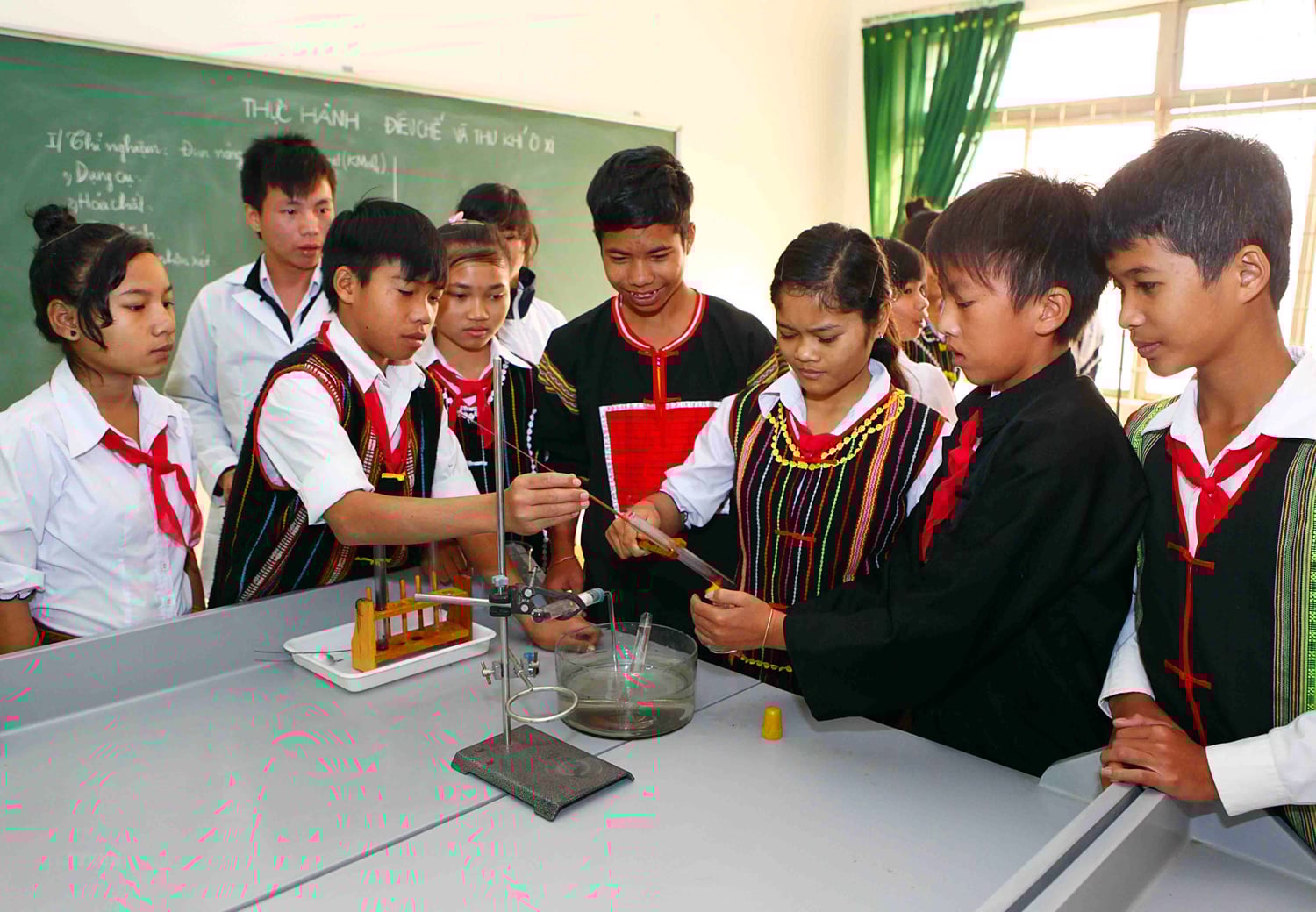
Solutions for developing the teaching staff in the current period.
In the current period, implementing fundamental and comprehensive educational reforms is a central and extremely important task. For this endeavor to be effective, a thorough understanding and creative application of Ho Chi Minh's educational thought, especially the strategy of "building a team of teachers," is crucial. Therefore, several solutions need to be implemented:
Firstly, strengthen the Party's leadership and the State 's management : Consistently implement the viewpoint on developing the teaching staff in accordance with the spirit of the Party's 13th National Congress Resolution and the Party and State's guidelines and policies to continuously improve quality and rationalize the structure of the teaching staff. Complete the legal framework related to the development of the teaching staff, especially reviewing, amending, and supplementing legal documents to create a basis for improving the quality of teachers and implementing fundamental and comprehensive educational reforms. Promptly issue guiding documents for the 2025 Law on Teachers to create a unified legal framework for the recruitment, management, and utilization of the teaching staff, as well as regulations on the number and standards of teachers for all levels of education. Implement the arrangement, placement, utilization, appointment, rotation, and transfer of teachers in accordance with regulations on staffing levels and teacher standards, addressing localized teacher shortages and surpluses, and ensuring the principle: "Where there are students, there must be teachers."
Secondly, improve moral qualities and the responsibility of setting a good example : Building a team of educators with high moral character and professional responsibility, serving as shining examples in accordance with Ho Chi Minh's ideology. Each educator needs to proactively cultivate and improve their moral character according to Ho Chi Minh's thought, such as integrity, honesty, and placing the interests of the country above personal interests. The process of self-cultivation must be regular and continuous. Strengthen propaganda and education on the noble role and responsibility of educators in society under the light of Ho Chi Minh's ideology. Build a cultured and democratic working environment to enable educators to develop their abilities. Strengthen inspection and supervision of adherence to exemplary conduct, linked to studying and following Ho Chi Minh's thought, morality, and style. Building a standard educational environment through strengthening the implementation of the Code of Conduct in schools, strictly handling cases of violations of professional ethics, and contributing to building a healthy educational environment.
Third, Developing intellectual capacity and improving professional skills ( modern thinking , abilities , and skills) is The core solution to meet the requirements of fundamental and comprehensive educational reform is to focus on cultivating solid professional knowledge, modern pedagogical skills, and innovative thinking among the teaching staff. Teachers need to shift their mindset from information transmitters to knowledge creators and facilitators, focusing on promoting the proactive and creative role of learners. Emphasis should be placed on developing skills in designing lesson plans that stimulate critical thinking, systems thinking, and the ability to solve practical problems for students. Equipping and training teachers in the use of information technology, artificial intelligence (AI), and digital learning platforms in teaching, classroom management, and student assessment is crucial to optimizing educational effectiveness. Creating conditions and mechanisms to encourage teachers to participate in scientific research, improve teaching methods, and independently develop their professional content is also essential.
Each teacher needs to be equipped with a comprehensive knowledge base, not only mastering theory but also possessing a deep and holistic understanding of the subject matter, while expanding interdisciplinary knowledge to effectively integrate it into their lessons. Focus on regular training and professional development to enhance management and teaching skills to meet the training standards for preschool, primary, and lower secondary school teachers as stipulated in Government Decree No. 71/2020/ND-CP dated June 30, 2020, "Regulations on the roadmap for raising the training standards of preschool, primary, and lower secondary school teachers." Standardize the teaching staff at all levels. Actively implement educational quality accreditation and publicly disclose the results. Seriously and effectively conduct annual evaluations of teachers' training and professional development to leverage strengths and address weaknesses, ensuring the quality of graduates.
Fourth, implement synchronized policies and incentive schemes to create motivation and encourage teachers to work with peace of mind, dedicate themselves, and be creative. In accordance with the spirit of Resolution No. 45-NQ/TW, dated November 24, 2023, "On continuing to build and promote the role of intellectuals to meet the requirements of rapid and sustainable national development in the new period" and Resolution No. 71-NQ/TW, dated August 22, 2025, "On breakthroughs in education and training development," it is necessary to improve the mechanisms and policies on salaries, allowances, and professional incentives; promote policies to attract talented students to the teaching profession; and at the same time, build a transparent evaluation and reward mechanism linked to work efficiency and professional qualities. The development and improvement of policies must ensure consistency and uniformity, contributing to enhancing the social status and material and spiritual well-being of the teaching staff.
Fifthly, Strengthen the inspection, evaluation, and monitoring of the quality of the teaching staff.
The organization shall conduct periodic, objective, and substantive evaluations of the training, professional development, and teaching activities of the teaching staff; linking evaluation results to planning, appointments, rewards, disciplinary actions, and remuneration policies. It shall promote educational quality accreditation, publicly and transparently disclose accreditation results, ensure accountability, and create motivation for the teaching staff to continuously learn, train, and improve their capabilities and qualities to meet the requirements of fundamental and comprehensive educational and training reform in the new era.
----------------------------
(1) Ho Chi Minh: Complete Works , National Political Publishing House, Hanoi, 2011, vol. 11, p. 528
(2) Ho Chi Minh: Complete Works , op. cit ., vol. 10, p. 345
(3) Ho Chi Minh: Complete Works , op. cit ., vol. 14, p. 403
(4) Ho Chi Minh: Complete Works , op. cit., vol. 10, p. 345
(5) Ho Chi Minh: Complete Works , op. cit ., vol. 14, p. 747
(6) Ho Chi Minh: Complete Works , op. cit ., vol. 12, p. 270
(7) Ho Chi Minh: Complete Works , op. cit ., vol. 12, p. 78
(8) Ho Chi Minh: Complete Works , op. cit ., vol. 12, p. 269
(9) Ho Chi Minh: Complete Works , op. cit ., vol. 10, p. 185
(10) Ho Chi Minh: Complete Works , op. cit. , vol. 12, p. 266
(11) For example, the Law on Teachers in 2025, the Law on Education in 2019, the Law on Vocational Education in 2014, the Law on Higher Education in 2012, Decision No. 732/QD-TTg, dated April 29, 2016, of the Prime Minister approving the project “Training and fostering teachers and educational management staff to meet the requirements of fundamental and comprehensive reform of general education in the period 2016 - 2020, orientation to 2025”, Decision No. 1299/QD-TTg, dated October 3, 2018, of the Prime Minister, on the implementation of the Project “Building a culture of behavior in schools in the period 2018 - 2025”
(12) During the period 2021 - 2025, the whole country was allocated an additional 94,714 positions, of which in 2021 alone approximately 30,000 positions were added (including 20,000 teacher positions for new subjects at primary and secondary levels and 10,000 kindergarten teacher positions for provinces in remote, difficult areas and ethnic minority areas (excluding the 5 Central Highlands provinces and 14 provinces and cities that were allocated 20,300 kindergarten teacher positions in 2019)
(13) Documents of the 13th National Congress of Delegates , National Political Publishing House, Hanoi, 2021, Vol. I, p. 83
Source: https://tapchicongsan.org.vn/web/guest/van_hoa_xa_hoi/-/2018/1185602/tu-tuong-ho-chi-minh-ve-phat-trien-doi-ngu-nha-giao-va-su-van-dung-cua-dang-trong-giai-doan-hien-nay.aspx














![[Photo] Prime Minister Pham Minh Chinh holds a phone call with the CEO of Russia's Rosatom Corporation.](/_next/image?url=https%3A%2F%2Fvphoto.vietnam.vn%2Fthumb%2F1200x675%2Fvietnam%2Fresource%2FIMAGE%2F2025%2F12%2F11%2F1765464552365_dsc-5295-jpg.webp&w=3840&q=75)













































Comment (0)