

Decrees, circulars, and guiding documents for the implementation of the 2024 Land Law have been issued, but in practice, many difficulties still remain in their application.
Practical application still faces obstacles.
Mr. Nguyen Toan Thang, Director of the Department of Natural Resources and Environment of Ho Chi Minh City, assessed that the early effective date of the 2024 Land Law presents both opportunities and challenges for localities in implementing, developing, and promulgating legal documents under the authority of the province and city.
To date, 16 out of 16 guiding documents for the implementation of the 2024 Land Law have been issued, including 9 Decrees. The Department of Natural Resources and Environment of Ho Chi Minh City is leading and advising the City People's Committee on 10 legal documents; 4 departments (including Planning and Investment, Construction, Agriculture and Rural Development, and Labor, War Invalids and Social Affairs) are advising on 5 legal documents.
According to Mr. Thang, the Land Law, decrees, circulars, and guiding documents are already in place. However, "in practice, there are still many things that colleagues understand differently or have questions about." The Department is developing a plan to disseminate, implement, and provide training on the Land Law and its guiding decrees throughout the city.
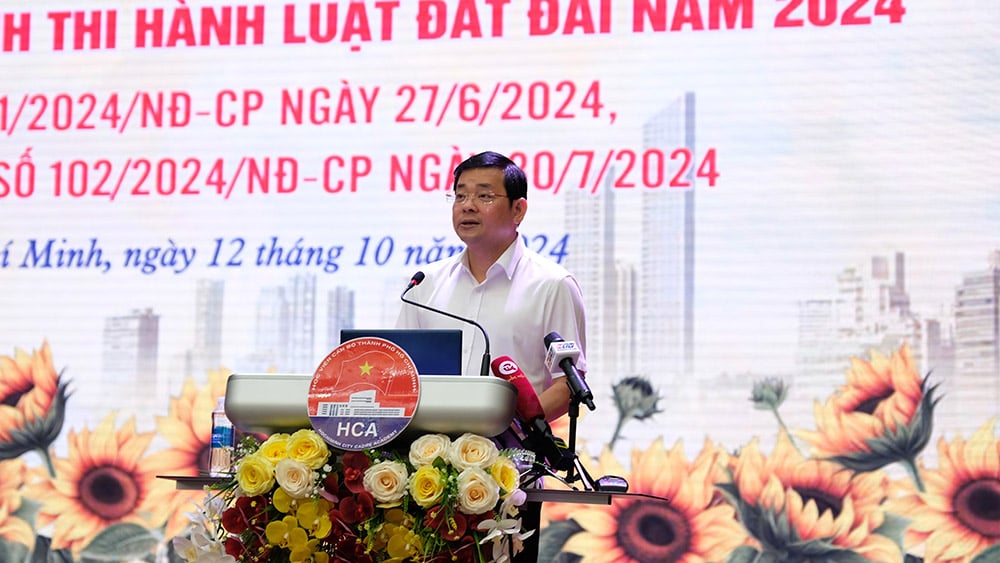 |
| Mr. Nguyen Toan Thang, Director of the Department of Natural Resources and Environment of Ho Chi Minh City. Photo: Trong Tin |
A representative from the Land Management Department ( Department of Natural Resources and Environment) stated that the agency is currently processing procedures for land allocation, leasing, and conversion of land use purposes for cases exempt from land use fees, but is encountering many obstacles.
Clause 3 of Article 157 stipulates that in cases of exemption from land use fees and land rent, no procedures for determining land prices are required, and no land use fees or land rent need to be calculated. Land users are also not required to submit an application for exemption or reduction of land use fees or land rent.
According to this person, previously, the law stipulated that the competent authority to decide on the exemption of land use fees and land rent was the Director of the Tax Department for organizations, and the Head of the Tax Sub-Department for individual households.
However, there are currently three procedures. The first is land allocation, land leasing, and land-use conversion in cases where land prices are determined according to the land price table; the second is based on specific land prices; and the third is auction.
“In the sample Decisions 04A, 04B, and 04C issued with Decree 102/2024 , the guidance states that in cases where land use fees are calculated based on the land price table, the specific land price must be recorded according to the decision; for specific land prices, the land management agency is responsible for calculating land use fees and land lease fees; however, there is no guidance on cases of exemption from land use fees. It is also unclear which agency has the authority to issue decisions on this exemption,” this person questioned.
In response, Ms. Doan Thi Thanh My, The Head of the Land Department ( Ministry of Natural Resources and Environment ) said One of the very new points of the 2024 Land Law is that if a land user is exempted from land use fees, they do not have to go through the necessary procedures and the competent authority does not have to determine the land use fee.
"The specific circumstances for exemption are clearly stipulated in Article 18 of Decree 102. In such cases, we can determine the eligibility simply by looking at the categories specified in the regulations. Therefore, we don't need to waste any extra paper from government agencies," she said.
Projects that have been revoked due to slow implementation will be made public.
One of the issues receiving much attention is Article 81 of the 2024 Land Law, which stipulates the cases of land reclamation due to violations of land law.
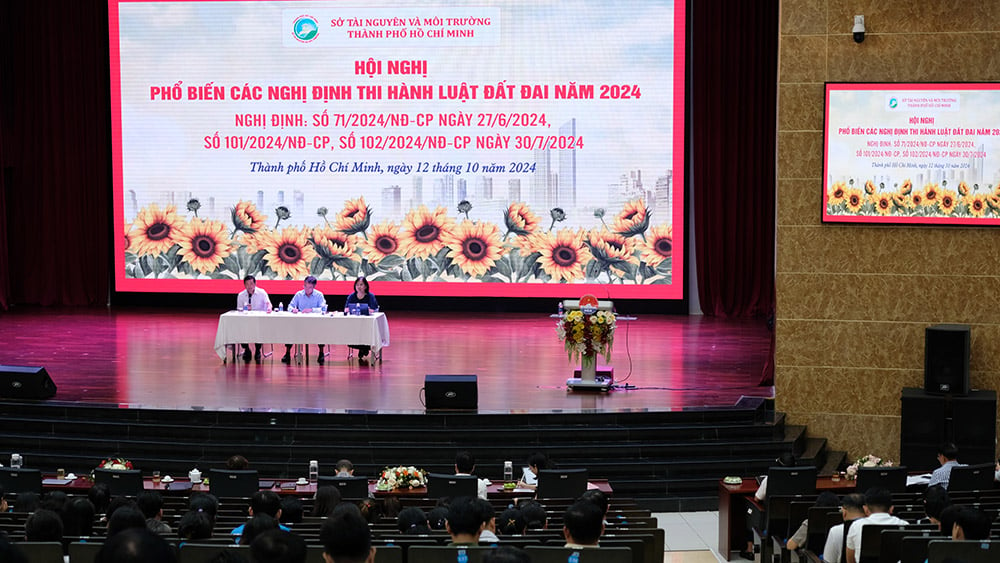 |
| Many officials in Ho Chi Minh City's Department of Natural Resources and Environment have reported that there are still many obstacles in the practical application of the regulations. Photo: Trong Tin. |
Specifically, if land allocated, leased, permitted for conversion of use, recognized as having land use rights, or acquired through transfer of land use rights for investment projects is not used after an extension, the State will reclaim the land without compensation for the land, assets attached to the land, and remaining investment costs.
Other cases of land reclamation include land users failing to fulfill their financial obligations to the State; land used for annual crops and aquaculture not being used for 12 consecutive months; and land used for perennial crops not being used for 18 consecutive months...
However, a key exception to the Law is that these provisions will not apply to cases of force majeure.
Ms. Doan Thi Thanh My stated that Article 31 of Decree 102 stipulates the force majeure circumstances to be applied in handling the above cases.
Specifically, there are 7 cases of force majeure and objective obstacles as stipulated by civil law that directly affect land use, including: Natural disasters, environmental catastrophes; Fires, epidemics; War, national defense and security emergencies; Other cases as stipulated by law on emergency situations;
In addition, this applies in cases where competent state agencies apply temporary emergency measures, seize or freeze land use rights and assets attached to the land in accordance with the law, and subsequently the land user is allowed to continue using the land;
Administrative decisions and actions of competent state agencies that constitute objective obstacles, not due to the fault of the land user, and directly impact land use; other cases are decided by the Prime Minister based on proposals from the provincial People's Committee or the Minister of the relevant specialized ministry.
The decree also clearly stipulates the responsibility of the provincial People's Committee to organize the review, handling, and public announcement on the provincial People's Committee's electronic portal of investment projects that have not put the land into use for 12 consecutive months or are 24 months behind schedule in land use compared to the schedule stated in the investment project. This includes projects that have been extended; and projects that are behind schedule in land use due to force majeure.
At the same time, provincial People's Committees must provide information for public disclosure on the electronic portal of the Ministry of Natural Resources and Environment or the land management agency under the Ministry of Natural Resources and Environment.
Mr. Dao Trung Chinh, Director of the Department of Land Planning and Development (Ministry of Natural Resources and Environment), particularly noted this point.
He said that recently, many Departments of Natural Resources and Environment, while handling land procedures, sent official letters to the remaining 62 Departments of Natural Resources and Environment, and he suggested that they should not do that.
"Comrades should continue to send the list of violating investors to the Ministry of Natural Resources and Environment, and when the Departments of Natural Resources and Environment process the procedures, they only need to send a letter to the Ministry to obtain the information," Mr. Chinh added.
Source: https://baodautu.vn/batdongsan/thuc-thi-luat-dat-dai-2024-van-thay-vuong-d227295.html

![[Image] A brilliant symphony and explosive power in the skies of Da Nang.](https://vphoto.vietnam.vn/thumb/1200x675/vietnam/resource/IMAGE/2026/05/31/1780196945787_anh-man-hinh-2026-05-31-luc-10-08-51.png)
























![[Video] Sunset at Lap An Lagoon – Where the sun sets over the fishing nets](https://vphoto.vietnam.vn/thumb/340x192/vietnam/resource/IMAGE/2026/05/31/1780192137701_beach-landscape-sea-water-nature-grass-745871-pxhere-com.jpeg)













































































Comment (0)