

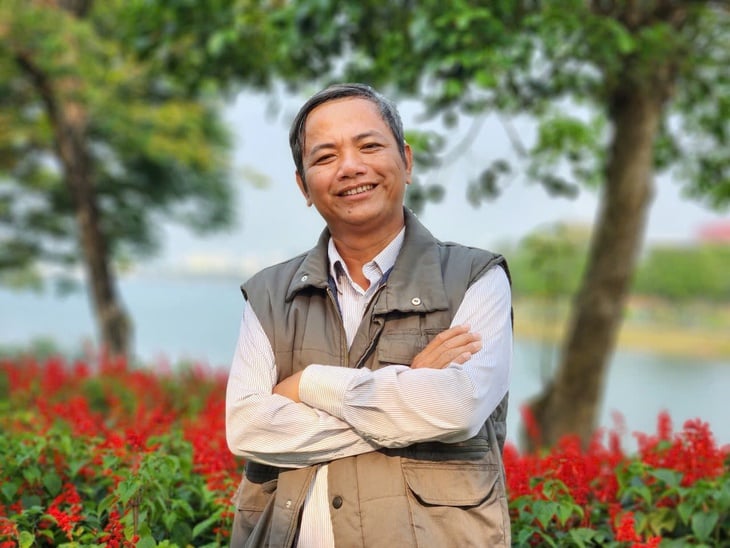
Writer and journalist Phi Tan - Photo: Provided by the author
"Hue: Ancient Stories, Old Cities" is a collection of essays expressing the thoughts and feelings of writer and journalist Phi Tan, a native of Hue, about the scenery, nature, people, and distinctive cultural values of the ancient capital city as time flows by.
There are rivers, lagoons, and seas such as the Perfume River, the O Lau River, and the Tam Giang Lagoon; a land of love with purely Hue memories such as clam rice, Dong Khanh ao dai (traditional Vietnamese dress), "soft rain on Hue," or the fruits and vegetables of the old garden with Tram mushrooms, the messenger of autumn in Hue...
Touching my memories, the memories of Hue, and yours.
For Phi Tan, writing is an immeasurable joy, a true return to childhood, to loved ones, to his homeland, the land he affectionately calls his beloved.
His beloved homeland is Hue, where the rivers flow passionately through the long years, depositing fertile alluvial plains laden with flowers and fruits, forming the brilliant cultural sediments of the former imperial capital, before flowing out to Tam Giang lagoon and then to the open sea.
In the first chapter, "Rivers, Lagoons, and Seas," Phi Tan takes the reader on a journey to explore the rivers of Hue.
The Perfume River possesses a magnificent, elegant beauty, yet is also gentle and serene. He called the Perfume River "a city girl" whom he "could only gaze upon in silent admiration."
Besides the Perfume River, readers will also find other rivers and waterways that were intertwined with Phi Tan's life, from the O Lau River, the Bo River, the An Cuu River, to the coastal fishing villages and the Tam Giang lagoon.
Phi Tân seems to be saying that each river is like a lifeline, connecting the past and the present, so that beautiful memories of Hue, its street corners, its rain, its sunsets, come alive in the reader's mind.
Reading the book, readers sense the author's love for Hue, not loud or ostentatious, but quiet and resilient, like the rivers that silently flow through the city, no matter how much time passes.
In his article "The Ferry Crossing the Perfume River ," Phi Tan presents his perspective on Hue: "Now, every time I pass by Kim Long Street, I still search for traces of the old ferry crossings and realize that Hue is there, a small and gentle city like the ferry crossings along the Perfume River, but to explore the depths of Hue is… as deep as the Perfume River itself, and I don't know how long it would take to get there!"
And he confided to the readers: "When you read this book, you are touching my memories, the memories of Hue, and perhaps your own memories as well. I hope you will also be filled with happiness like me! Because memories are not simply nostalgia, but the eternal love of a lifetime."
Hue, a city as gentle as the ferry docks along the Perfume River.
In writing about Hue, Phi Tan not only recounts old stories and memories of a bygone era but also portrays the beauty of the landscape and people, along with the cultural values that have been passed down through many generations.
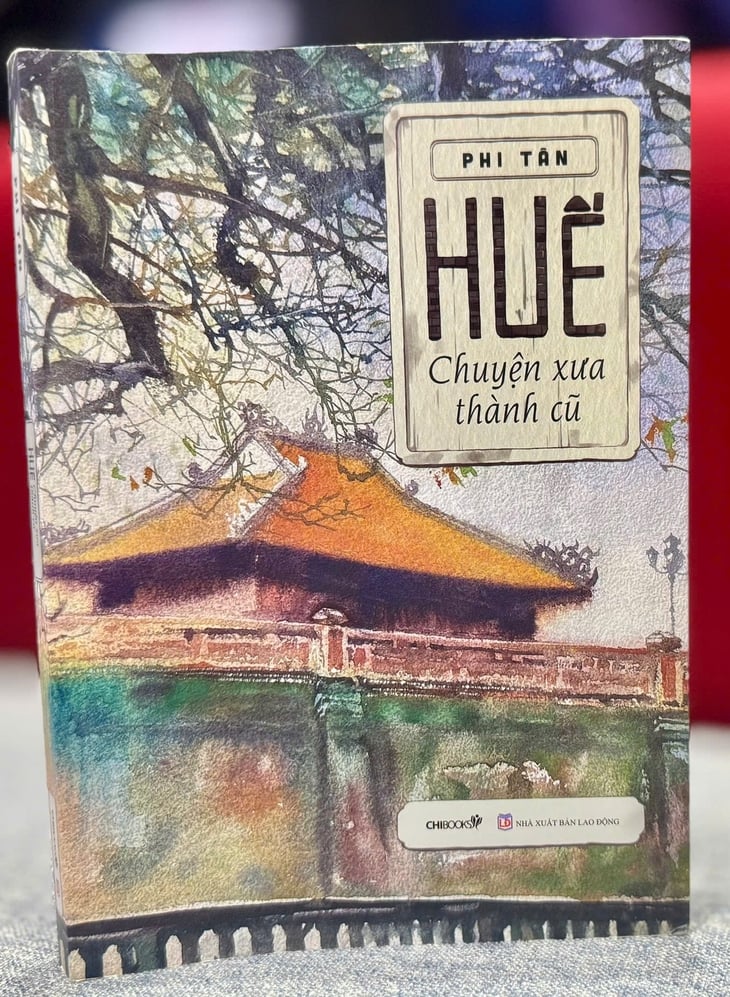
Hue Ancient Stories - Photo: HO LAM
He mentioned clam rice, a specialty dish of Hue.
According to Phi Tan, clam rice is the most flavorful of Hue's famous dishes, encompassing a wide range of tastes from salty and bland to sour, spicy, sweet, and savory.
There were stir-fried clams, raw vegetables with taro stems, mint, coriander, basil, basil, starfruit, and mung bean sprouts;
Then there are crispy fried peanuts with their shells on, roasted pork cracklings, shrimp paste, chili peppers, MSG...
"The clam flavor in a bowl of clam rice is only fleeting. But the creators of this dish from the capital city were truly sophisticated to include a bowl of clam broth as an accompaniment."
It is the clam broth that truly lets diners enjoying clam rice know the authentic taste of the clams from the Perfume River.
"Those vendors selling clam rice in the mist, those delicious bowls of sweet clam rice at lunchtime, or those stalls selling clam rice in the late afternoon... they're all equally delicious!" - wrote writer Phi Tan.
Then, when writing about the purple Dong Khanh ao dai, considered a symbol of Hue women, Phi Tan recalled her former teacher: "Our teacher, a former Dong Khanh student, cherished the ao dai on the podium, bringing a cool, gentle Hue charm to her students in the windy, sandy Tam Giang region of my hometown."
Author Phi Tân was born in 1973 in Điền Lộc, Phong Điền, Thừa Thiên Huế . He currently works at Thừa Thiên Huế Radio and Television Station.
Some of his published works include: essays " By the O Lau River" (2021); "Coming to Hue for a Meal" (2021); "My Father's Fairy Tale" (2023)... Among them , "Coming to Hue for a Meal" was awarded the Outstanding Work of the Year 2022 by the Thua Thien Hue Writers Association.
Source: https://tuoitre.vn/thuong-lam-to-com-hen-ngot-lanh-ta-ao-dai-dong-khanh-hien-diu-20250411190102152.htm
![[Photo] Prime Minister Pham Minh Chinh presides over a meeting on private sector economic development.](/_next/image?url=https%3A%2F%2Fvphoto.vietnam.vn%2Fthumb%2F1200x675%2Fvietnam%2Fresource%2FIMAGE%2F2025%2F12%2F20%2F1766237501876_thiet-ke-chua-co-ten-40-png.webp&w=3840&q=75)





















































Comment (0)