


That's when the hearts of those of us far from home begin to stir, yearning for a return to childhood, to the fragrant rice cakes made by our grandmother and mother. Even though I'm no longer a child, I still feel excited whenever Tet (Lunar New Year) arrives. These simple, rustic rice cakes have become deeply ingrained in my memory, a gift that anyone far from home can proudly recall.
 |
| Rice flour cakes evoke childhood memories. |
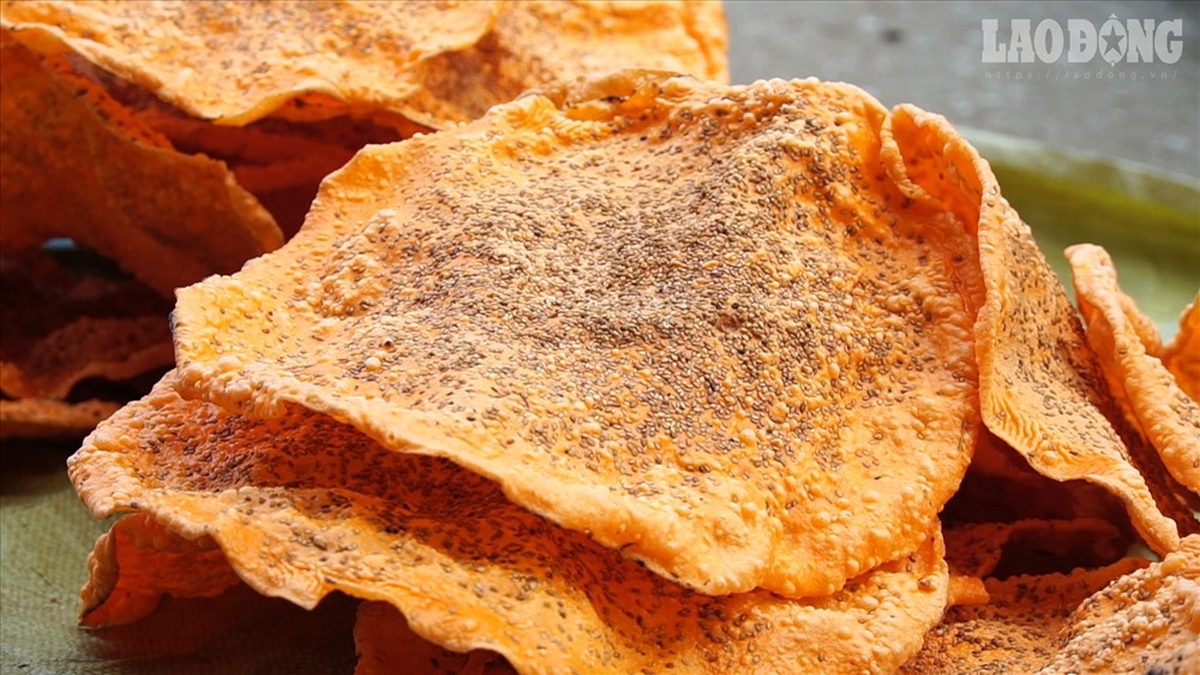
My grandmother said that she never knew exactly when printed rice cakes originated, but she saw these square cakes proudly displayed on the ancestral altar during Tet (Lunar New Year) when she was growing up. The ingredients were as simple and rustic as the land of our homeland: glutinous rice flour, tapioca flour, mung beans, and granulated sugar. Around the 25th or 26th of the twelfth lunar month, my mother would be busy preparing. She would run around the neighborhood buying the best dried mung beans, tidy up the mills and sieves, and clean the wooden molds that had been waiting all year.
In my memory, Tet (Vietnamese New Year) is a harmonious "art of coordination" involving the whole family. My mother nimbly washes the sticky rice, grinds the beans, and carefully roasts them over a fire until the rice turns a waxy yellow and the beans are crispy without burning. The task of making sugar syrup is usually left to my older sister, because she has a "magical touch" knowing how to control the heat to achieve the perfect consistency. Most special of all is the image of my father. His strength is concentrated in his strong hands, wielding a large wooden pestle to grind the sugar mixture until it's finely powdered. His steady pounding is like the slow rhythm of time, compressing love and patience into each smooth, fine powder.
Before molding the cakes, my mother skillfully sprinkled a thin layer of tapioca starch to make them easier to remove from the mold and to give them a smoother surface. This process required extraordinary meticulousness: the dough had to be pressed with just the right amount of force; if too tight, the cake would be hard, if too loose, it would crumble easily. Those old wooden molds, to me at the time, held a whole sky of hopes and dreams. Some bore the characters for "Happiness" and "Longevity," wishing for peace; others depicted phoenixes and carp, symbolizing prosperity and abundance. Through my mother's hands, each cake was not just for eating, but also a work of art, encapsulating heartfelt devotion offered to our ancestors.
In our tiny house during the last days of the year, white flour clung to our clothes and hair everywhere, but it was an indescribable joy of the traditional Tet holiday atmosphere. We waited together for the first batch of cakes to come out of the oven. My mother usually reserved this batch for my sister and me, because she said, "The first cakes of the season are always the most fragrant; you have to eat them while you're still craving them to fully appreciate their deliciousness." The golden mung bean cake, still piping hot, with a light bite, the sweet flavor slowly melted on my tongue, lingering in my memory even now.
Decades have passed, life has changed with countless luxurious imported treats, but I'm so glad that my village still keeps the flame alive for those old wooden molds. For me, rice cakes are not just food; they represent my mother's sweat and my father's hard work, toiling under the sun and rain to carefully cultivate each fragrant grain of sticky rice. On a late afternoon at the end of the year, sipping a cup of spicy ginger tea and biting into a rice cake that melts slowly on my tongue, I feel spring and family love blossoming in my heart.
Cao Van Quyen
Source: https://baodaklak.vn/van-hoa-du-lich-van-hoc-nghe-thuat/van-hoc-nghe-thuat/202602/thuong-nho-banh-in-a905081/









![[Photo] A large number of people offer incense and visit the Ho Chi Minh Memorial Church.](https://vphoto.vietnam.vn/thumb/1200x675/vietnam/resource/IMAGE/2026/02/21/1771668099014_ndo_br_12-resize-7721-jpg.webp)





































Comment (0)