

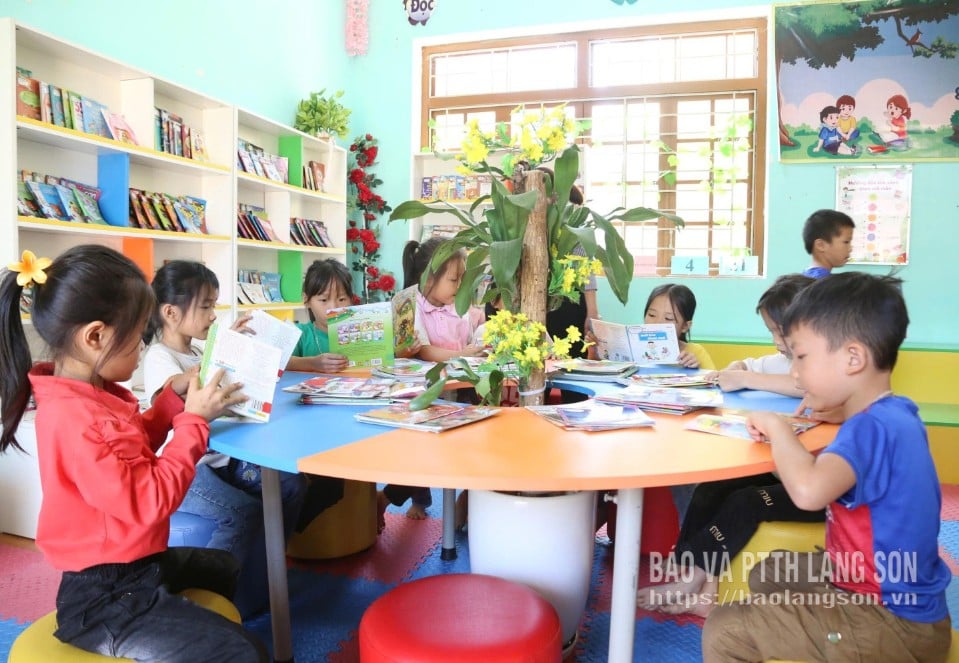
Students of Lien Hoi Ethnic Boarding Primary and Secondary School read books at the "Dream Library," which was built at the school starting from the 2023-2024 school year.
The province currently has 11 ethnic boarding schools and 84 ethnic semi-boarding schools, serving approximately over 20,000 ethnic minority students annually. The boarding schools alone house over 4,000 students who study, train, and live together, receiving full support as stipulated by regulations. This network of schools has covered the entire area, ensuring that students in remote villages have access to a stable and long-term educational environment.
Along with improving the network, in recent years the education sector has effectively utilized resources from national target programs and social mobilization to reinforce school buildings and upgrade essential facilities for teaching and student care. The system of 84 ethnic boarding schools, during the 2021-2025 period, has seen upgrades and improvements to its infrastructure, including the construction and renovation of 161 classrooms, 114 subject-specific classrooms, and the investment in 1,267 teaching equipment. At boarding schools, specifically during the 2023-2025 period, six schools will undergo repairs and upgrades with a total budget exceeding 25 billion VND, focusing on classrooms, dormitories, living areas, and auxiliary facilities, meeting the teaching requirements of the 2018 General Education Program.
“The system of ethnic boarding and semi-boarding schools is a crucial pillar in the development of education in mountainous and border regions. To continue effectively implementing education in ethnic minority areas, the department has advised the Provincial People's Committee on a plan to maintain and develop this school system, ensuring that all students, even those in the most remote villages, have access to a fair and quality educational environment.” Mr. Hoang Quoc Tuan, Director of the Department of Education and Training |
A notable milestone was the simultaneous groundbreaking ceremony on November 9th for four boarding schools in the communes of Khuất Xá, Kiên Mộc, Quốc Khánh, and Mẫu Sơn. This is an important step in the project to build 11 boarding schools in 11 border communes across the province. The projects are expected to have a total of approximately 371 classrooms, providing learning spaces for nearly 12,800 primary and secondary school students. Upon completion, the new school system will enable students in disadvantaged areas to receive continuous and stable education, reducing the need for long daily commutes.
Furthermore, to create the best conditions for children to attend school, the education sector has proactively mobilized and integrated various resources to invest in infrastructure, especially for boarding schools. Every year, schools receive additional support in building new classrooms, renovating dormitories, kitchens, toilets, and providing clean water, as well as supplementing essential equipment for daily life and learning. The process of selecting students eligible for boarding school benefits is carried out in accordance with regulations, ensuring transparency and prioritizing students in particularly disadvantaged areas and those far from schools, thereby creating favorable conditions for their long-term education.
The reality on the ground shows that each investment item has yielded practical results. At Kien Moc Ethnic Boarding Primary School II, nearly 100 students currently attend the main school, 100% of whom are from the Dao ethnic group. Thanks to the government's investment, the classrooms are all sturdy and well-ventilated. In particular, at the beginning of 2025, a kitchen facility worth over 760 million VND was put into use, ensuring nutritious and safe lunches for students. Ms. Nong Thi Vui, the school principal, shared: "The new kitchen has helped the school reduce difficulties in organizing meals for students; the children are better cared for, and the teachers can focus on teaching with peace of mind."
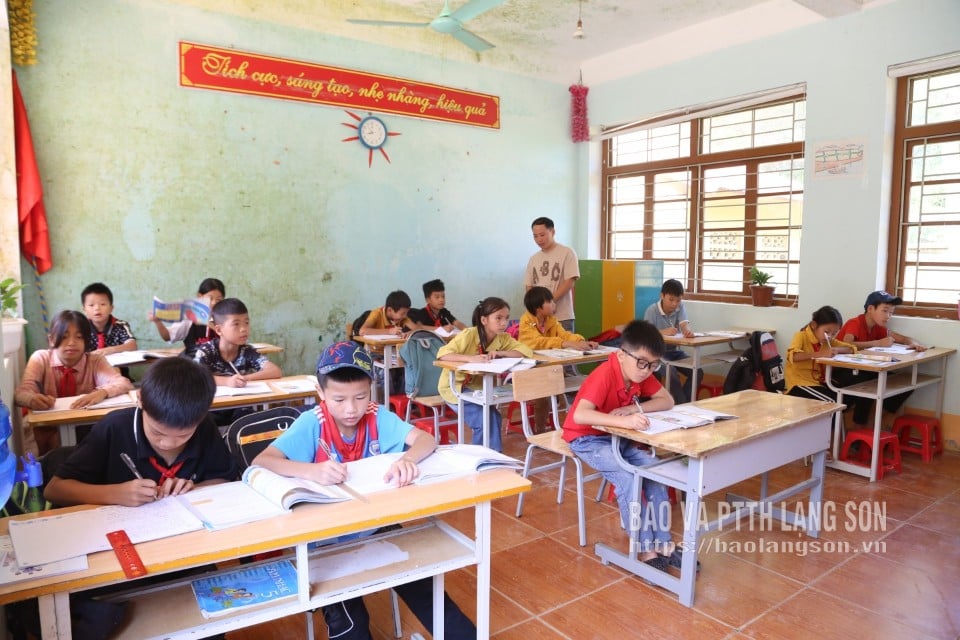
A lesson at Lien Hoi Ethnic Boarding Primary and Secondary School (Diem He commune).
Improvements in infrastructure at ethnic boarding and semi-boarding schools have laid a crucial foundation for enhancing the quality of education in mountainous regions. Students learn in a stable and safe environment, with meals and accommodation provided, thus maintaining attendance and minimizing dropout rates. In the 2024-2025 school year, semi-boarding schools recorded 100% of primary school students completing their primary education, 94.5% continuing on to lower secondary school, and no students dropping out. In boarding schools, continuous learning and comprehensive support have resulted in consistently high graduation rates for lower secondary and upper secondary school students, with many schools achieving 100%; over 90% of students continue on to university, college, or vocational training after graduation.
Mr. Hoang Quoc Tuan, Director of the Department of Education and Training, affirmed: The system of ethnic boarding and semi-boarding schools is an important pillar in the development of education in mountainous and border areas. To continue effectively implementing education in ethnic minority areas in the province, the department has advised the Provincial People's Committee on a plan to maintain and develop this school system, with a focus on supporting the living conditions of students. This ensures that all students, even those in the most remote villages, have access to a fair and quality education environment, and creates favorable conditions for teachers to work with peace of mind.
In the coming period, with the completion of the multi-level boarding school projects, along with continued investment in the modernization of semi-boarding schools, education in the mountainous regions will have the opportunity to take another solid step forward. The attention given today is crucial preparation for students to confidently move towards the future and contribute back to their homeland later. When schools are well-equipped, teachers can teach with peace of mind, and students receive attentive care, the belief in change in the mountainous regions of the province will be further strengthened.
Source: https://baolangson.vn/tiep-suc-hoc-sinh-vung-cao-den-truong-5067354.html















![[Photo] A vibrant celebration of generations of Nhan Dan Newspaper staff](https://vphoto.vietnam.vn/thumb/1200x675/vietnam/resource/IMAGE/2026/03/11/1773228432744_cb-75-nam-7-7034-jpg.webp)




























































Comment (0)