 |
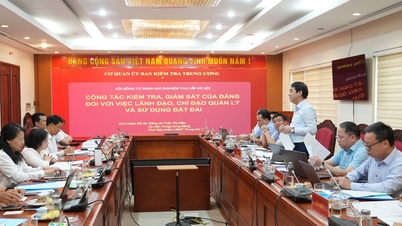
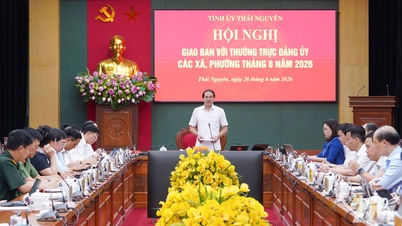
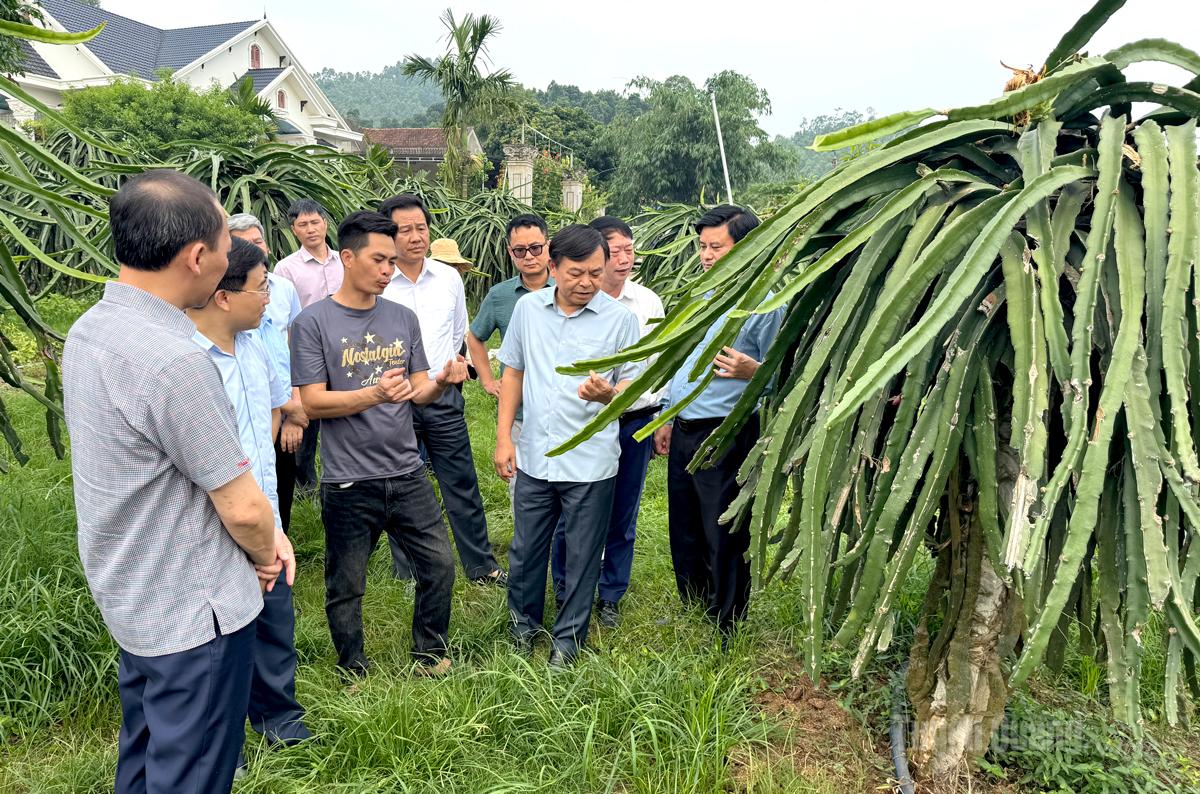
| The working group of the National Target Program Steering Committee inspected the disbursement progress in Tuyen Quang . |
From the story of capital bottlenecks at the grassroots level...
In Nam Dan commune, out of a total of 16 billion VND allocated under the National Target Program for 2025, only a meager 74 million VND has been disbursed so far, reaching a rather modest rate of 0.5%.
Comrade Nguyen Quang Hung, Chairman of the People's Committee of Nam Dan commune, explained: A series of key infrastructure projects in the area are currently stalled due to bureaucratic obstacles. For example, three inter-village electricity supply projects (Coc Chu - Gi Thang; Na Chan - Nam Lu - Doan Ket; Lung Chang - Nam Cha), despite having completed the work and been inspected, are still facing difficulties in completing the legal procedures to disburse funds. Similarly, the project to build a new central market is also stalled awaiting approval for scale adjustments. Furthermore, the construction of new classrooms and auxiliary facilities for Nam Dan Secondary School, costing nearly 10.8 billion VND, is also temporarily suspended for project adjustments. This means that funds cannot be disbursed.
The disbursement rate of the National Target Program in Nam Dan commune was low, but it was even lower in Tan Long commune. Despite the limited allocated funds, disbursement will be difficult. According to a report from the Tan Long Commune People's Committee, in 2025, the former Tan Tien commune was approved over 3 billion VND to build a community cultural center from the National Target Program for New Rural Development. However, due to the merger of Tan Tien commune into Tan Long, the project was halted. The lack of construction means that over 3 billion VND of allocated funds cannot be disbursed.
The situations in Nam Dan and Tan Long are not isolated cases. During the administrative restructuring and the implementation of the two-tiered government model, many projects were either not implemented or, if implemented, required adjustments to scale and investment levels, preventing localities from disbursing funds. Furthermore, many projects were undertaken at a slow pace by contractors, resulting in no work completed and therefore no payments made.
According to reports up to mid-June, the total capital for the three national target programs for the 2021-2025 period, extended into 2026, is over 2,265 billion VND, but only over 452 billion VND has been disbursed, reaching 20.5% of the plan.
The low disbursement rate inadvertently creates significant cumulative pressure during the final months of the year if the set plan is to be completed. Comrade Ngo Van Thuong, Deputy Chief of the National Target Program Coordination Office, explained: The low disbursement rate is currently concentrated in two specific funding streams: the Program for Socio -Economic Development in Ethnic Minority and Mountainous Areas, and the Sustainable Poverty Reduction Program.
According to data from the Provincial Ethnic Affairs Committee, the total capital for the program extending into 2026 is over 1,508 billion VND, but currently only over 327.6 billion VND has been disbursed (21.72%). Notably, 11 localities in the province have a disbursement rate below 10%, including the communes of Tat Nga, Po Ly Ngai, Hong Thai, Meo Vac, Giap Trung, Thang Tin, Phu Luong, Thuong Nong, Nam Dan, Nam Dich, and Tan Long.
 |
| The student dormitory project at Nam Dan Secondary School in Nam Dan commune is being expedited. |
Identify bottlenecks
According to reports from the relevant agencies, namely the Department of Ethnic Minorities and Religion and the Department of Agriculture and Environment, the slow flow of funds into national target programs stems from both objective and subjective factors. This has created a series of intertwined "bottlenecks".
First and foremost, delays caused by administrative restructuring and fund transfer procedures are the biggest procedural obstacles. In the past period, the merger of administrative boundaries and the transfer of project owners between local government levels took a considerable amount of time, only being substantially completed by the end of November 2025. As a result, many project files and handovers between the old and new units were incomplete, causing significant difficulties in data reconciliation. This pressure increased further after the National Assembly's Resolution No. 257/2025/QH15 allowing the transfer of funds to 2026, requiring units to spend nearly four more months, until March 31, 2026, to complete the data review with the State Treasury. Having to dedicate the entire first quarter of the year solely to handling these paperwork procedures has slowed down the disbursement rate.
Besides procedural obstacles, on-site barriers and pressure on local human resources are also directly hindering progress. Surveys in localities show that the scarcity and price fluctuations of construction materials such as sand, gravel, and stone have caused difficulties for many contractors, leading to slow construction and failure to meet the signed deadlines.
Meanwhile, from a management perspective, pressure weighs heavily on the grassroots level due to the overwhelming number of reporting points, comprising over 124 communes and wards, along with numerous provincial-level units. The current staff at the commune level responsible for transportation, construction, or project accounting are both insufficient in number and lack experience in managing complex finances. In many places, due to staff shortages, officials have to take on too many responsibilities, making it difficult to closely and consistently monitor and supervise project progress.
According to the Department of Ethnic Minorities and Religion, the current reorganization of villages, hamlets, and residential areas will require a review and reassessment of villages and hamlets according to criteria to qualify for the program, which will take some time.
Difficulties stem from overlapping mechanisms for capital integration, as well as a hesitant attitude towards implementation. Despite clear policies, the appraisal processes and criteria for each national target program still differ significantly, causing confusion at the grassroots level. When implementation capacity is limited and faced with specific financial management regulations, some implementing officials develop a sense of apprehension, fear of making mistakes, and excessive caution, prolonging investment preparation and project approval times.



Conversely, coordination and direction in some areas have not been truly decisive; many units, communes, and towns still lack strong sanctions to deal with contractors who are delaying payments. Even for projects with basic work completed and eligible for payment, many contractors still maintain the habit of accumulating documents for a single acceptance upon completion of the entire project, rather than disbursing funds according to the progress, directly affecting the overall disbursement picture of the entire province.
 |
| Tan Long Commune Kindergarten was built with funding from the National Target Program for New Rural Development. |
Clear the waterway
With 2026 already halfway through, the pressure to achieve growth in the final months of the year is immense.
During a working session with the province at the end of May, Deputy Minister of Agriculture and Environment Nguyen Hoang Hiep emphasized: Every dollar of public investment, once unlocked, will act as a catalyst to activate social resources, create jobs, and promote breakthroughs in rural and disadvantaged areas.
Given the urgency of the situation, the Provincial Party Committee and the Provincial People's Committee have identified accelerating the disbursement of funds for the 2025-2026 period as a top political priority. In a recent meeting of the Provincial People's Committee on accelerating the disbursement of national target program funds for the 2021-2025 period, extending into 2026, Mr. Do Hung Duc, Member of the Provincial Party Committee and Vice Chairman of the Provincial People's Committee, requested that localities tighten discipline using the "six clear principles." The province will use actual disbursement results as a strict criterion for evaluating leaders and severely punishing cases of stagnation. Managing agencies, localities, and professional officials must directly monitor the situation on the ground to identify problems and resolve difficulties on the spot. The province has also established an online reporting system to update progress on the 15th of each month, facilitating flexible management. To expedite disbursement, the province requires localities to: give absolute priority to essential projects under the Ethnic Minority Area Program, while streamlining intermediate steps for final settlement of completed projects. According to the Department of Ethnic Minorities and Religion and the Department of Agriculture and Environment, localities have reviewed and completed procedures for disbursing funds for 590 completed projects; and payments for 383 approved projects. This is based on resolving outstanding issues for 399 projects currently under construction.
Comrade Tran Viet Hung, Director of the Provincial Project Management Board No. 1 for Investment and Construction, affirmed: The Board has inspected the projects and given contractors specific deadlines. The stance is that if progress is not accelerated, the contractor will be replaced in accordance with State regulations.
The decisive leadership of the province and the coordinated efforts of the managing agencies and localities are the solution to the current disbursement problem. Once the "bottlenecks" are removed and the hesitant mindset is dispelled, the national target program's capital flow will further support comprehensive development goals, contributing to the province's growth targets in 2026 and subsequent years.
Text and photos: Doan Thu
Focus on resolving difficulties.
 |
| Comrade Nguyen Van Dung Member of the Provincial Party Committee, Director of the Department of Ethnic Minorities and Religions |
In the past period, agencies, units, and investors have completed some tasks as a basis for disbursing funds, and the disbursement progress has shown positive changes. However, compared to the directives and requirements of the Provincial People's Committee, the disbursement progress of investors is still slow, with a cumulative figure of only 21% of the planned capital as of June 15th; some communes still have low disbursement rates. In the coming period, the Department will regularly and promptly monitor the disbursement progress, difficulties, and obstacles faced by communes, agencies, units, and investors using funds from the program to urge and resolve issues in order to accelerate implementation. At the same time, it will monitor, compile, and report on the implementation progress monthly as directed by the Provincial People's Committee. The Department maintains four working groups to monitor the disbursement of funds by communes, focusing on implementation during June, July, and August. Simultaneously, it closely coordinates with investors to review and complete all legal procedures, focusing on resolving difficulties and obstacles to accelerate the disbursement process.
Creating momentum for growth
 |
| Comrade Bui Manh Tuyen Deputy Director of the Department of Finance |
To achieve the economic growth target of 10.17%, public investment, especially capital from National Target Programs (NTPs), plays a crucial role in promoting investment, creating jobs, and spreading development momentum to localities. However, the disbursement of NTP funds in the first few months of the year has been slow.
The Department of Finance regularly coordinates closely with other departments, agencies, and localities to review and monitor the progress of each project, promptly advising the Provincial People's Committee on resolving difficulties and obstacles that arise. At the same time, it requires project owners to develop detailed disbursement plans on a monthly and quarterly basis; expedite the verification and final settlement of completed projects and the acceptance and completion of payment documents for the work already performed.
In addition, the plan will continue to review and reallocate capital from projects that have completed their expenditure tasks or are unlikely to be implemented to projects with good progress and high capital needs; and hold heads of departments accountable for disbursement results. Training courses and professional guidance will also be strengthened to improve the capacity of grassroots officials. The overarching goal is to disburse 100% of the National Target Program's capital, maximize investment efficiency, and contribute to achieving the province's socio-economic development targets and double-digit growth goals in 2026.


Expedite the disbursement of funds.
 |
| Comrade Truong Trung Son Chairman of the People's Committee of Minh Ngoc Commune |
In the first six months of 2026, Minh Ngoc commune focused on implementing national target programs, with a total of over 9 billion VND of national target program funds transferred from 2025 to 2026. To accelerate implementation progress, the People's Committee of the commune continued to direct specialized agencies to review all ongoing projects, works, and tasks; develop a specific disbursement roadmap for each funding source and project, clearly defining the responsibilities of each department and individual in charge. For construction investment projects, the focus was on resolving difficulties related to investment procedures, payment documents, and acceptance of completed work to expedite the disbursement of remaining funds.
For projects supporting production development, sustainable poverty reduction, and development in ethnic minority areas, specialized agencies are strengthening guidance and support for beneficiaries to complete dossiers, accelerate project implementation, ensure that funds are used for the right purposes, and achieve practical results; strengthening inspection and supervision, and regularly evaluating implementation results to promptly address any difficulties and obstacles that arise.
Overtime and extra shifts on the construction site.
 |
| Mr. Ta Anh Dung Representatives from Irrigation Construction Joint Stock Company I (Bac Ninh) |
The Irrigation Construction Joint Stock Company I is currently constructing the Mien River embankment and road project in Ha Giang 2 ward, spanning over 3 km with a total investment of over 181 billion VND. The company is concentrating its workforce and machinery to simultaneously implement various components such as embankment foundations, retaining walls, foundation excavation, rock chipping, concrete pouring for foundations, and the construction of retaining walls. To date, the construction volume has reached over 50% of the contract value; with underwater components reaching over 95% and retaining walls reaching 80%. Currently, the contractor is accelerating the casting of paving slabs and paving the embankment slopes. Determined to complete the project on schedule (planned completion in 2026), the company has deployed 10 excavators operating continuously on both banks of the Mien River and mobilized nearly 100 workers to work overtime and in shifts to speed up construction progress.
Source: https://baotuyenquang.com.vn/kinh-te/dau-tu/202606/tiep-suc-tang-truong-cd06505/


































![[Image] Ho Chi Minh City: Ma Lang area, Chicken-Rice Market about to change its appearance](https://vphoto.vietnam.vn/thumb/1200x675/vietnam/resource/IMAGE/2026/06/25/1782377698627_ndo_br_m1-jpg.webp)