

'Smart border gates' will help businesses reduce customs clearance costs, port and terminal fees, transportation costs, etc., by 30-40%.
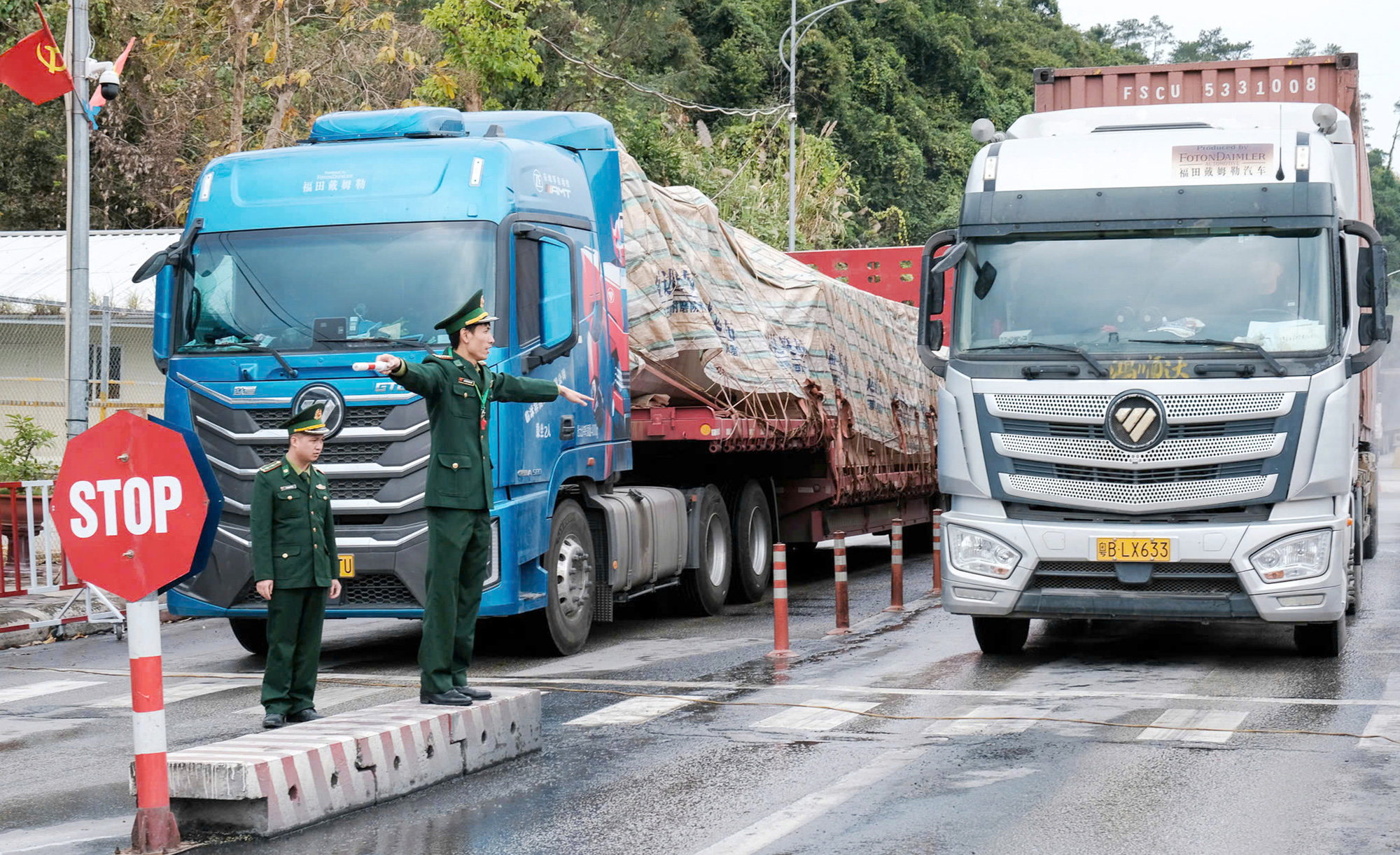
Authorities at the Huu Nghi International Border Gate guide import and export vehicles crossing between Vietnam and China - Photo: HA QUAN
According to calculations, logistics costs could decrease by over 4,900 billion VND in 2027 and by over 9,800 billion VND in 2030... thanks to "smart border gates".
Mr. Hoang Khanh Duy, deputy head of the Dong Dang - Lang Son Border Economic Zone Management Board (Lang Son province), affirmed this when discussing with Tuoi Tre newspaper the pilot project for "smart border gates" with an estimated budget of nearly 8,000 billion VND, approved by the Prime Minister on August 17, 2024.
Mr. Duy said: The "smart border gate" model has received new investments in both infrastructure and information databases between Vietnam and China. Thanks to this, the transportation of goods is completely contactless and uninterrupted, ensuring the normal operation of border gates even in emergencies such as epidemics or natural disasters.
* Why is it necessary to build "smart border gates" at a considerable cost, instead of using the traditional customs clearance model, sir?

Mr. Hoang Khanh Duy
- Traditional import and export methods have reached near-maximum customs clearance efficiency at this border gate, approximately 1,350 vehicles per day, which is significantly lower than demand. Furthermore, the prolonged customs clearance time increases costs and reduces the competitiveness of Vietnamese export goods.
The "smart border gate" model involves the synchronized deployment of infrastructure and information databases between the two countries, enabling contactless and uninterrupted goods transportation, applying unmanned transport methods along fixed routes, and automated container cranes, based on satellite positioning and 5G technology.
"Smart border crossings" have command centers that support the exchange of information regarding cross-border goods transportation and ensure uninterrupted customs clearance 24/7.
The "smart border gate" is a joint project between Vietnam and China, building a dedicated, independent, and self-contained route for the import and export of goods, separate from the current freight transport routes.
Ensuring a balance between maintaining traditional customs clearance methods and implementing "smart border gate" clearance contributes to improving customs clearance capacity and efficiency, effectively resolving congestion at border areas.
To facilitate the establishment of customs inspection, control, and quarantine procedures, we will initially continue discussions with the Chinese side to expand the range of goods subject to import and export.
* With an investment of nearly 8,000 billion VND, the "smart border gate" will certainly not lack infrastructure to serve import and export activities, sir?
- The construction of "smart border gates" must certainly be linked to expanding the infrastructure of ports and yards in the border area to serve the preliminary processing, packaging, and processing of goods, ensuring quality and increasing the value of exported goods, while also developing related services such as insurance, banking, and telecommunications...
In the long term, this model will form a supply chain of warehousing, logistics, trade, and ancillary services at border crossings. It will promote and encourage concentrated production and strengthen linkages between businesses and individuals involved in exporting to China.
In other words, the "smart border gate" model involves new investments in both infrastructure and information databases between Vietnam and China.
* Will the construction of "smart border gates" help shorten customs clearance times and reduce costs for businesses as expected?
- If implemented through "smart border gates," the time it takes for a truckload of goods exported to China, which would previously be 4-5 days, will be shortened to about one day as the time for goods delivery and receipt is reduced.
Once implemented, the "smart border gate" will help increase the volume of goods cleared through the Huu Nghi international border gate by approximately 2,500 - 3,000 vehicles/day, reducing customs clearance costs, warehousing/transportation costs, and service fees at border gates on both sides by 30 - 40%, equivalent to about 4.5 million VND/vehicle.
We expect to reduce logistics costs by over VND 4,900 billion in 2027 and over VND 9,800 billion in 2030, ensuring the smooth flow of goods, preventing supply chain disruptions in the event of natural disasters or epidemics, improving product quality, and increasing state budget revenue.
* But sir, "smart border gates" are only a necessary condition; Vietnamese products must also meet other necessary conditions before they can be exported?
- That's right. When implementing the "smart border gate" model, Vietnamese goods exported will have to meet more fully the requirements and conditions of China, especially the regulations in Orders 248 and 249.
"Smart border gates" also accelerate the transformation of businesses' production and export methods towards formal and professional channels; minimizing economic risks associated with informal trade.
The "smart border gate" model will utilize electric-powered unmanned aerial vehicles (IGVs) to reduce the extraction and use of gasoline, oil, and natural gas, limit emissions that pollute the environment, and meet the requirements of sustainable development.
* So, the implementation of "smart border gates" also faces many difficulties that the implementing units must confront, sir?
- "Smart border crossings" are a new concept, and the initial implementation presents some challenges. Regarding exports, some of Vietnam's key agricultural products are not yet on the list of items permitted for official export to China, and are subject to strict technical and tariff controls.
Vietnamese agricultural products and food exported to China must meet requirements regarding food safety, inspection, testing, traceability, packaging, labeling, certification, etc.
We also determined that it is necessary to focus investment on technical infrastructure, transportation, and resolving legal procedures to meet the requirements for the pilot operation of "smart border gates". Ensuring parity with the Chinese side in the pilot operation of "smart border gates" requires the efforts of many sectors and fields.
In addition, some tasks related to the development of "smart border gates" that fall outside the authority of the Lang Son Provincial People's Committee require guidance from central ministries and agencies.
A task force needs to be established to promptly address any obstacles.
On August 17th, the Prime Minister approved the pilot project to build "smart border gates" at the dedicated goods transport routes in the area of border markers 1119 - 1120 and 1088/2 - 1089, belonging to the Huu Nghi (Vietnam) - Huu Nghi Quan (China) international border gate pair, to be implemented from the third quarter of 2024 to the end of the third quarter of 2029.
The Prime Minister instructed the People's Committee of Lang Son province to implement the project and coordinate its execution with central ministries and agencies such as the Ministry of Finance, the Ministry of Foreign Affairs, the Ministry of Planning and Investment, the Ministry of National Defense, and the Ministry of Public Security...
Speaking to Tuoi Tre newspaper, many transportation and export businesses expressed their hope that "smart border gates" will help expedite customs clearance and reduce logistics costs.
Ms. Tran Thi Hang, representative of Thai Viet Trung Transport Joint Stock Company, a business that at times needs to clear 50-60 trucks of goods per day, believes that "smart border gates" will certainly help shorten the time for customs clearance of goods.
However, relevant authorities such as border guards, customs, tax authorities, and quarantine agencies need to establish task forces or command centers to promptly support businesses in resolving any issues. "Smart border gates" also need to effectively handle risks such as software errors, power outages, and internet connection failures," Ms. Hang said.
The planning procedures will be completed soon.
According to Mr. Hoang Khanh Duy, the relevant agency is advising on the implementation of a "Mechanism for Regular Meetings and Exchanges" between the People's Committee of Lang Son province and the People's Government of the Guangxi Zhuang Autonomous Region (China), based on the agreement signed in November 2024.
The Management Board of the Dong Dang - Lang Son Border Economic Zone, together with relevant agencies, organized conferences to implement the "smart border gate" model with a delegation from the Guangxi Border Gate Office (China) in Lang Son City in October 2024.
The Lang Son provincial government is also implementing a project to expand the dedicated road for import and export of goods in the area of border markers 1119-1120 from 4 lanes to 8 lanes, and is simultaneously carrying out procedures to adjust the project to 14 lanes to synchronize with the infrastructure on the Chinese side.
The People's Committee of Lang Son province has also organized the implementation of tasks related to the construction and adjustment of 6 planning schemes, such as the partial adjustment of the detailed construction plan for Tan Thanh border gate in Van Lang district.
The planning documents will finalize the adjustment procedures in January 2025. The locality has also issued a directive to implement a plan to attract investment from non-state budget sources to develop infrastructure for wharves, equipment, and smart escort vehicles, etc.
"Initially, the focus will be on investing in technical infrastructure, transportation, and resolving legal procedures to meet the requirements for piloting the smart border gate," Mr. Duy said.
Source: https://tuoitre.vn/tiet-kiem-ngan-ti-dong-voi-cua-khau-thong-minh-20241224093144233.htm


![[Photo] General Secretary To Lam visits the exhibition space showcasing books, photo exhibitions, and achievements of digital transformation in journalism.](/_next/image?url=https%3A%2F%2Fvphoto.vietnam.vn%2Fthumb%2F1200x675%2Fvietnam%2Fresource%2FIMAGE%2F2025%2F12%2F19%2F1766110879215_1766110240024-jpg.webp&w=3840&q=75)
![[Photo] Enchanting ancient rose garden on the mountainside in Nghe An](/_next/image?url=https%3A%2F%2Fvphoto.vietnam.vn%2Fthumb%2F1200x675%2Fvietnam%2Fresource%2FIMAGE%2F2025%2F12%2F19%2F1766109900916_vuon-hong-chin-do-thu-hut-du-khach-toi-check-in-o-ha-noi-3-20162778-1671624890024-1671624890104198100259.jpeg&w=3840&q=75)































![[INFOGRAPHIC] Overview of the Hoa Phat Dung Quat Rail and Special Steel Production Plant Project](https://vphoto.vietnam.vn/thumb/402x226/vietnam/resource/IMAGE/2025/12/19/1766111183203_z7339170069817-126a3e5a095f62e606a0be41015c1b80.jpeg)




































Comment (0)