


Having had the opportunity to chat with the distinguished artisan Kray Sức in Tà Rụt commune, I learned that, in the minds of the Pa Kô ethnic people since ancient times, it has been ingrained in their beliefs that glutinous rice varieties like Ra Dư, if planted in paddy fields, will never germinate or grow. These varieties must be grown on high hills or mountain slopes; even in harsh weather conditions, they thrive. If fertilizer is applied, by the end of the season, you'll only be able to harvest the leaves, not a single grain.
Perhaps due to the belief that growing black glutinous rice and Ra Du rice on hillside fields without fertilizer results in low yields, coupled with the demanding soil and weather conditions required for cultivation, fewer Pa Ko ethnic families have been growing them over time. Instead, they focus on growing wet rice, cassava, and corn, which yield higher productivity and economic value, to improve their lives.
Due to growing and developing in special conditions, the black glutinous rice variety, also known as Ra Du rice, has a fragrant, sticky texture and is rich in nutrients. In the past, the Pa Ko ethnic group considered black glutinous rice a remedy for intestinal diseases; it was used for young children recovering from illness or for women after childbirth… Black glutinous rice and Ra Du rice were always present in the kitchens of the Pa Ko people whenever honored guests visited or during important family and village ceremonies.
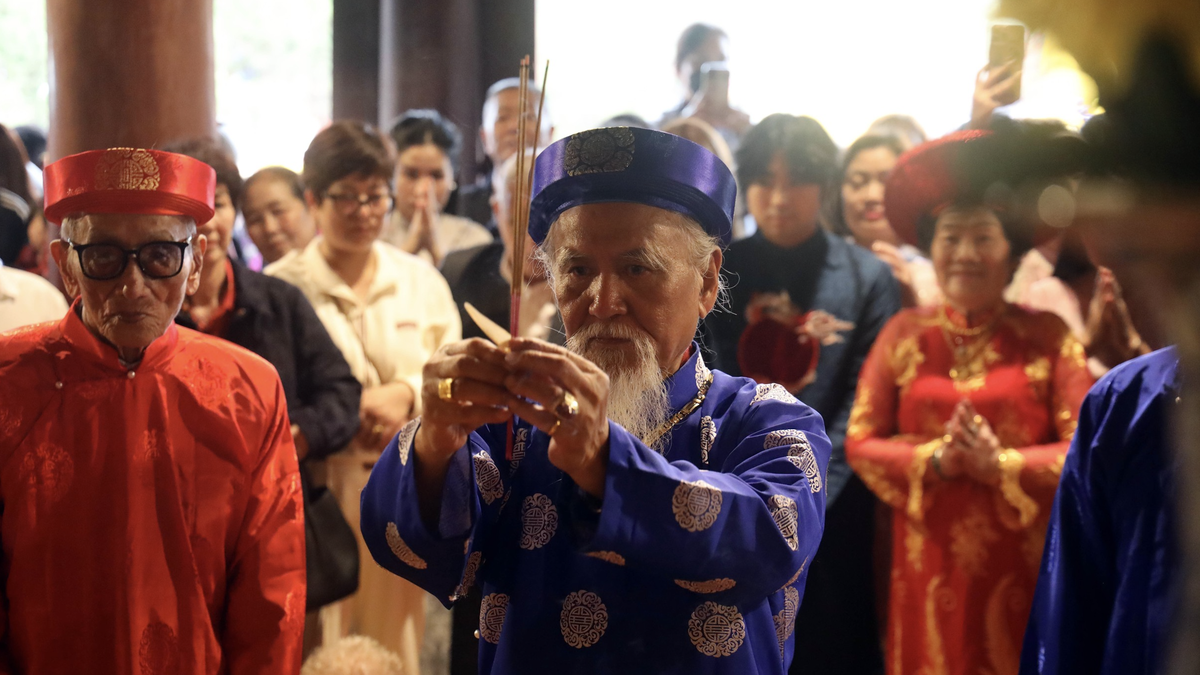
During festivals such as Puh Boh (field guarding ceremony), Aya (harvest festival), Ariêu Ping (grave digging ceremony), Kăl năng Mương (offering thanks to the earth god)... various types of cakes like peng a chooih, peng tamăr, peng a koat, and herbal rice wine made from black glutinous rice and Ra dư rice are indispensable, creating a distinctive feature in the festival system of the Pa Kô ethnic group.
 |
| Black glutinous rice plants bear heavy grains in fields lacking water - Photo: SH |
Faced with the reality that many locally grown, high-quality, and economically valuable crop varieties such as black glutinous rice and Ra Du rice are degenerating and disappearing, the former Dakrong district has focused on implementing solutions to preserve and develop black glutinous rice and Ra Du rice varieties, contributing to the preservation of valuable genetic resources and opening up new directions in the production of distinctive products.
Specifically, through the production development support funds of Program 135, from 2019-2021, the former Dakrong district supported 11 households in the former Ta Long commune to build a model of growing black glutinous rice on fields that frequently lacked water; and supported people in building a pilot model of growing black glutinous rice on an area of 0.25 hectares next to the Ky Xay irrigation project (A Deng village, former A Ngo commune). The black glutinous rice variety yielded 40 quintals/hectare.
According to Nguyen Huu Lap, Head of the Economic Department of La Lay commune, there are currently about 3.2 hectares of Ra Du rice and 0.4 hectares of black glutinous rice grown in A Deng village. In the future, La Lay commune will encourage people to strengthen the preservation of black glutinous rice and Ra Du rice varieties to safeguard the valuable genetic resources of these rice types. La Lay commune will also seek ways to gradually link with localities that have large areas of black glutinous rice and Ra Du rice cultivation, such as Dakrong and Ta Rut communes, to build brands for black glutinous rice and Ra Du rice, aiming to enhance the value of these products in the near future.
Sy Hoang
Source: https://baoquangtri.vn/xa-hoi/202602/tim-huong-bao-ton-giong-lua-nep-than-lua-ra-du-01536b1/
















































![[Image] National Conference on studying, understanding, and implementing Resolutions No. 79 and No. 80 of the Politburo](https://vphoto.vietnam.vn/thumb/402x226/vietnam/resource/IMAGE/2026/02/25/1771990845625_anh-man-hinh-2026-02-25-luc-10-40-34.png)






























Comment (0)