


Thang Long Imperial Citadel is where the thousand-year-old spirit of the capital's mountains and rivers resides. In the past, it was the site of numerous court ceremonies and rituals. From the beginning of the 19th century, Thang Long ceased to be the capital, and the court ceremonies and activities of Thang Long also disappeared. Scientists have overcome difficulties in obtaining documentation to rediscover the "ceremonial music" of Thang Long, gradually restoring many artifacts and contributing to the development of the cultural industry.
Turning the pages of a fragrant manuscript, we restore the beauty of the past.
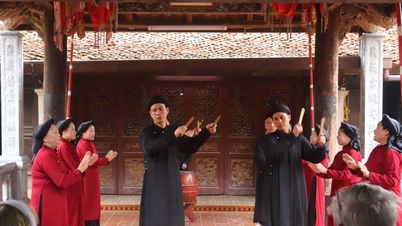
Although it's only the beginning of summer, the Thang Long- Hanoi Heritage Conservation Center has already prepared activities for the Dragon Boat Festival. In ancient court rituals, the Dragon Boat Festival was one of the major festivals, elaborately organized by the court, with the meaning of reminding people to prevent illness, and the king bestowing fans – a blessing – upon his subjects and the people.
The Dragon Boat Festival at Thang Long Imperial Citadel encompasses many aspects, but the most complex are the court rituals involving offering fans to the emperor and the emperor bestowing fans upon his officials. To recreate these rituals as authentically as possible, those "playing" the roles of the officials must undergo thorough training before presenting the ceremony to the public.
According to Nguyen Thanh Quang, Director of the Thang Long-Hanoi Heritage Conservation Center: “The city of Hanoi has committed to UNESCO to preserve and promote the intangible cultural values alongside the tangible values of the Thang Long Imperial Citadel. The Thang Long-Hanoi Heritage Conservation Center has researched many different rituals and activities; from there, it has successfully reconstructed and re-enacted rituals such as: the Kitchen God Ceremony, the Lantern Festival Ceremony, the Spring Ox Ceremony, the Calendar Ceremony, the Summer Opening Ceremony, the Offering of Gifts and the Giving of Fans on the Dragon Boat Festival. Recently, the Center successfully reconstructed the Changing of the Guard Ceremony of the soldiers guarding the citadel gate.”
The city of Hanoi has committed to UNESCO the preservation and promotion of intangible cultural values alongside the tangible values of Thang Long Imperial Citadel. The Thang Long-Hanoi Heritage Conservation Center has researched various rituals and activities, successfully reconstructing and reenacting them: the Kitchen God Ceremony, the Lantern Festival Ceremony, the Spring Ox Ceremony, the Calendar Ceremony, the Summer Opening Ceremony, the Offering of Gifts and the Giving of Fans on the Dragon Boat Festival. Recently, the Center successfully reconstructed the Changing of the Guard Ceremony of the soldiers guarding the citadel gate.
The Thang Long Imperial Citadel is increasingly affirming its status as a world heritage site through research, conservation, exploitation, and promotion of its values, and is recognized by UNESCO as a model for heritage preservation. UNESCO has approved Hanoi's restoration of the Kinh Thien Palace - the royal court space of the Le Dynasty. However, the tangible heritage values are only "half" of the problem.
Professor Nguyen Quang Ngoc, Vice President of the Vietnam Historical Science Association, stated that throughout a thousand years of history, countless activities and rituals of various dynasties took place within the palaces. Researching, introducing, and reconstructing these court rituals and activities is extremely necessary; it is the essence of the heritage and a way for the public to better understand the cultural values of the ancient royal court.
Vietnam has many ancient capitals, but the intangible cultural heritage of the royal court mainly remains in Thang Long and the former capital of Hue. However, Thang Long lost its role as the capital at the beginning of the 19th century, and royal court rituals also disappeared. The system of documents on royal court rituals and activities is very limited, making research on the intangible cultural heritage of the Thang Long royal court an extremely difficult undertaking.
Overcoming those obstacles, scientists researched information from many sources, piecing it together to gradually create a complete "picture." The Spring Ox Tribute ritual is one of the typical rituals.
As someone directly involved in researching and reconstructing this ritual, Master Dinh Thi Nguyet stated: “The Spring Ox Procession is a particularly important ritual, possessing both courtly and folk characteristics as it became a major festival for the people of the capital city. The ceremony symbolizes bidding farewell to winter and welcoming spring; at the same time, the procession of the ox and the deity Cau Mang reflects the spirit of encouraging agriculture. The imagery of the deity Cau Mang and the Spring Ox is very complex and meticulous, but lacks source materials. The Center has researched, compared, and contrasted many sources from the Le Dynasty, foreign sources, and sources from the Nguyen Dynasty, as well as sources from some culturally similar countries, applying the measurement method according to the feng shui ruler of the Nguyen Dynasty; and simultaneously, relying on the heavenly stems, earthly branches, yin and yang, and the five elements to construct the imagery of the Spring Ox and the deity Cau Mang. These pieces of the puzzle have helped the Center reconstruct the rituals as close to history as possible and have been supported by scientists.”
After completing the documentation, the Thang Long-Hanoi Heritage Conservation Center, in collaboration with the Thang Long Cultural Heritage Association and several theaters, organized rehearsals for the reconstruction and presented it to the public for the first time in 2019.
This is also the solution the Center applies to some other rituals in conditions of limited documentation. In addition to domestic historical sources, records and images from Western merchants and missionaries also provide much important documentation.
Promoting the cultural industry
Besides its architectural and artistic value, the value of a temple or pagoda also lies in its cultural and spiritual activities, the objects of worship, and the rituals and ceremonies associated with it. With palaces and pavilions, if they lack intangible values, even the most beautiful architecture is soulless. Many countries around the world have transformed restoration activities into cultural industry products. A prime example is the changing of the guard ceremony at Gyeongbokgung Palace (Seoul), a daily event eagerly awaited by tourists in South Korea.
In Vietnam, many court rituals recreated in the ancient capital of Hue have been exploited in tourism activities. For Thang Long Imperial Citadel, the reenactment of court rituals also attracts a large number of tourists and locals, especially during major festivals such as Lunar New Year, Dragon Boat Festival, and Mid-Autumn Festival, some of which have become trademarks associated with the image of Thang Long Imperial Citadel.
The restoration of heritage sites not only helps locals and tourists better understand the culture and history of Thang Long-Hanoi, but also breathes new life into the heritage. Programs showcasing intangible cultural heritage through theatrical performances have created a tourism attraction at the Thang Long Imperial Citadel Heritage Site, contributing to bringing the heritage closer to the public.
According to the Chairman of the Vietnam Historical Science Association, Associate Professor, Dr. Tran Duc Cuong: “The restoration of heritage sites not only helps people and tourists better understand the culture and history of Thang Long-Hanoi, but also brings new life to the heritage. Programs showcasing intangible cultural heritage through theatrical performances have created a tourism attraction at the Thang Long Imperial Citadel Heritage Site, contributing to bringing the heritage closer to the public.”
Due to difficulties, the Thang Long-Hanoi Heritage Conservation Center has mainly been able to reconstruct and reenact some of the ceremonial activities of the Le Trung Hung period. The Thang Long court culture treasure trove contains many other rich activities, each dynasty having its own differences. For example, the group of rituals includes the Nam Giao Altar Ceremony, the Xa Tac Altar Ceremony, and the Ancestral Temple Ceremony.
That's not to mention rituals such as: the investiture ceremony, the imperial decree, receiving foreign envoys, the imperial examination system (court examination), and awarding prizes to new graduates... If fully restored, these rituals and ceremonies would be a "magnet" attracting tourists. Recently, the Hanoi City Party Committee issued Action Program No. 08-CTr/TU to implement Resolution No. 80-NQ/TW dated January 7, 2026, of the Politburo on the development of Vietnamese culture. In this program, the restoration of the Kính Thiên Palace at Thăng Long Imperial Citadel is a key focus and will be implemented before 2030.
Recently, the Hanoi City Party Committee issued Action Program No. 08-CTr/TU to implement Resolution No. 80-NQ/TW dated January 7, 2026, of the Politburo on the development of Vietnamese culture. Among its key objectives, the restoration of the Kính Thiên Palace at the Thăng Long Imperial Citadel is a priority and will be implemented before 2030.
According to Nguyen Viet Chuc, Director of the Thang Long Institute of Cultural Research, the research and restoration process of Thang Long's intangible cultural heritage is lagging behind its tangible value. The need to rediscover Thang Long's intangible cultural heritage is more urgent, so that when the Kinh Thien Palace and other structures are restored, we can showcase the corresponding intangible cultural heritage.
To further improve the rediscovery of Thang Long's "ceremonial music," the Chairman of the Vietnam Folk Arts Association, Professor and Doctor Le Hong Ly, proposed: "We need to organize systematic and thorough research on the Thang Long Imperial Citadel; systematize cultural documents, from official documents and documents from missionaries to folk documents..."
Based on these studies and collections, select appropriate activities for restoration and reconstruction. The key here is experimentation, avoiding perfectionism, and gradually adapting to the conditions at each point in time; then, supplement and refine the process. Some rituals and ceremonies should be fully exploited to develop tourism in particular and the cultural industry in general.”
Source: https://nhandan.vn/tim-lai-le-nhac-thang-long-post961170.html


![[Photo] General Secretary and President To Lam presides over a working session with the Central Policy and Strategy Committee on the development of the materials industry.](https://vphoto.vietnam.vn/thumb/1200x675/vietnam/resource/IMAGE/2026/05/21/1779359935432_a3-bnd-3129-1412-jpg.webp)
![[Photo] National Assembly Chairman Tran Thanh Man working with the Standing Committee of the Law and Justice Committee](https://vphoto.vietnam.vn/thumb/1200x675/vietnam/resource/IMAGE/2026/05/21/1779378929214_ndo_br_1-4610-jpg.webp)












![[Video] Some solutions for saving electricity during hot weather](https://vphoto.vietnam.vn/thumb/402x226/vietnam/resource/IMAGE/2026/05/22/1779408223092_dung00-00-12-14still001-png.webp)








































Comment (0)