

Understanding the "quiet phase" in children.
At Ha Bau Kindergarten, 90% of the children are from ethnic minority groups. In the 2024-2025 school year, the 4-5 year old class will welcome many new children aged 3 and 4.
The first day of school was also the first time the children were exposed to the Vietnamese language. The language barrier made the classroom atmosphere unstable in the first few days. The teacher spoke, but the students didn't understand. They reacted instinctively, such as crying, running, or trying to leave the classroom.
Ms. Truc, a new teacher at the school, quickly found herself caught up in the whirlwind of pressure, juggling childcare, comforting children, and maintaining minimal order in the classroom.
In response to this situation, the school's management team regularly visited the classrooms to coordinate with teachers in stabilizing the children, while also closely monitoring them to find appropriate support. Applying knowledge gained from training activities within the framework of the TALK project implemented by the VVOB organization, the school decided to apply the theory of "bilingual development" with four distinct stages.
In the initial stage, children are free to use familiar language from their family. This is followed by a "quiet period," where children are given space to listen and observe, gradually becoming familiar with Vietnamese. After that, they begin to use short phrases, imitating intonation and familiar sentence patterns. Finally, children actively use the new language in learning activities, although natural mistakes may still occur.
In this process, the "silent period" is emphasized as a crucial transition, helping children build a foundation in listening comprehension before they can express themselves.
According to studies on second language acquisition, children typically need a natural receptive phase in which listening and observation play a central role before actually developing the ability to speak.
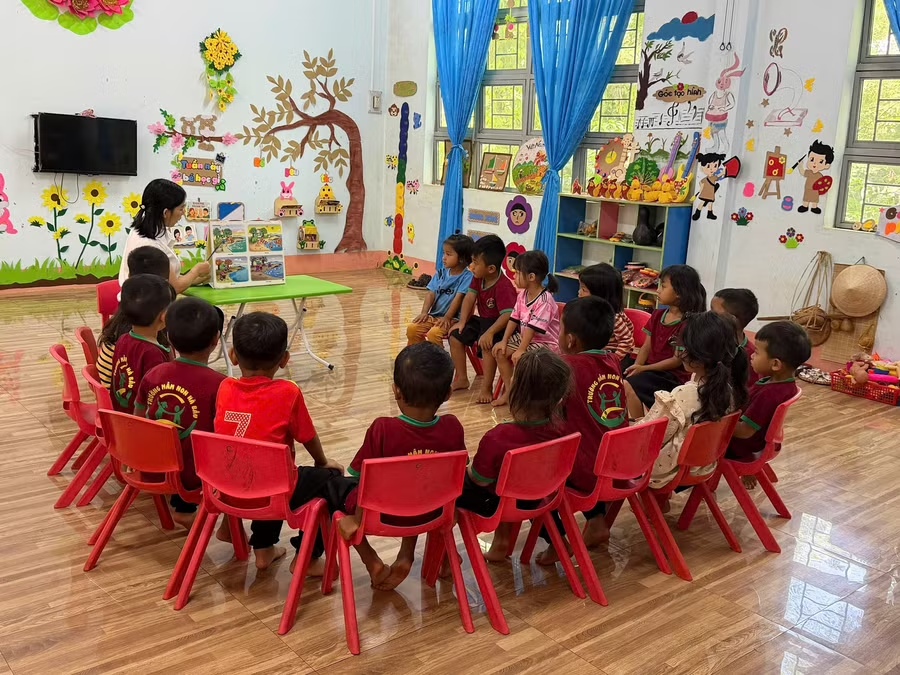
Following that direction, Ms. Truc began adjusting the way she organized her classes. Learning activities were designed based on things that were more familiar to the children. Instead of pressuring them to answer immediately, she spent time sitting with them, patiently demonstrating, repeating, and describing simple actions such as putting away toys, arranging chairs, or naming a few familiar objects in the classroom, so that the children gradually understood and followed along.
From there, children play while listening to the teacher call out the names of objects, imitating the actions and gradually developing reflexes with the new language. Although many children are not yet ready to speak, they already know how to reach for objects as instructed by the teacher, or smile and nod when called by name.
Positive signs respond to heartfelt efforts.
After nearly a week, the class began to show the first positive changes as the children learned to sit in the correct positions as instructed, paid attention to the teacher, and participated in activities with greater concentration. The classroom atmosphere became stable and orderly, the children gradually got used to the common routine, became less shy, and showed a greater connection with the teacher and their friends.
After two months, the changes became even more apparent as the children no longer cried or ran out of the classroom on their own, but actively participated in class activities. They began to imitate familiar gestures and utter simple words to express their needs.
Those first hesitant sounds of Vietnamese marked a significant turning point in breaking down the language barrier between teacher and student.
For Ms. Truc, this change brought a sense of relief and boosted her confidence in her work. "In the beginning, I felt quite stressed, but when the children started to understand and follow instructions, I gained more motivation to continue," she shared.
From the school's perspective, a representative from the school administration stated: "When children are approached at an appropriate pace, they become more proactive in communication and enthusiastically participate in group activities."
That joy also spread to the parents, and the change was clearly felt. Ms. Hang, a parent of a student in the class, excitedly shared: "After 3 months of school, my child is no longer afraid to go to class. At home, my child has started to tell stories, say simple words, and likes to show off what they have learned in class to their parents."
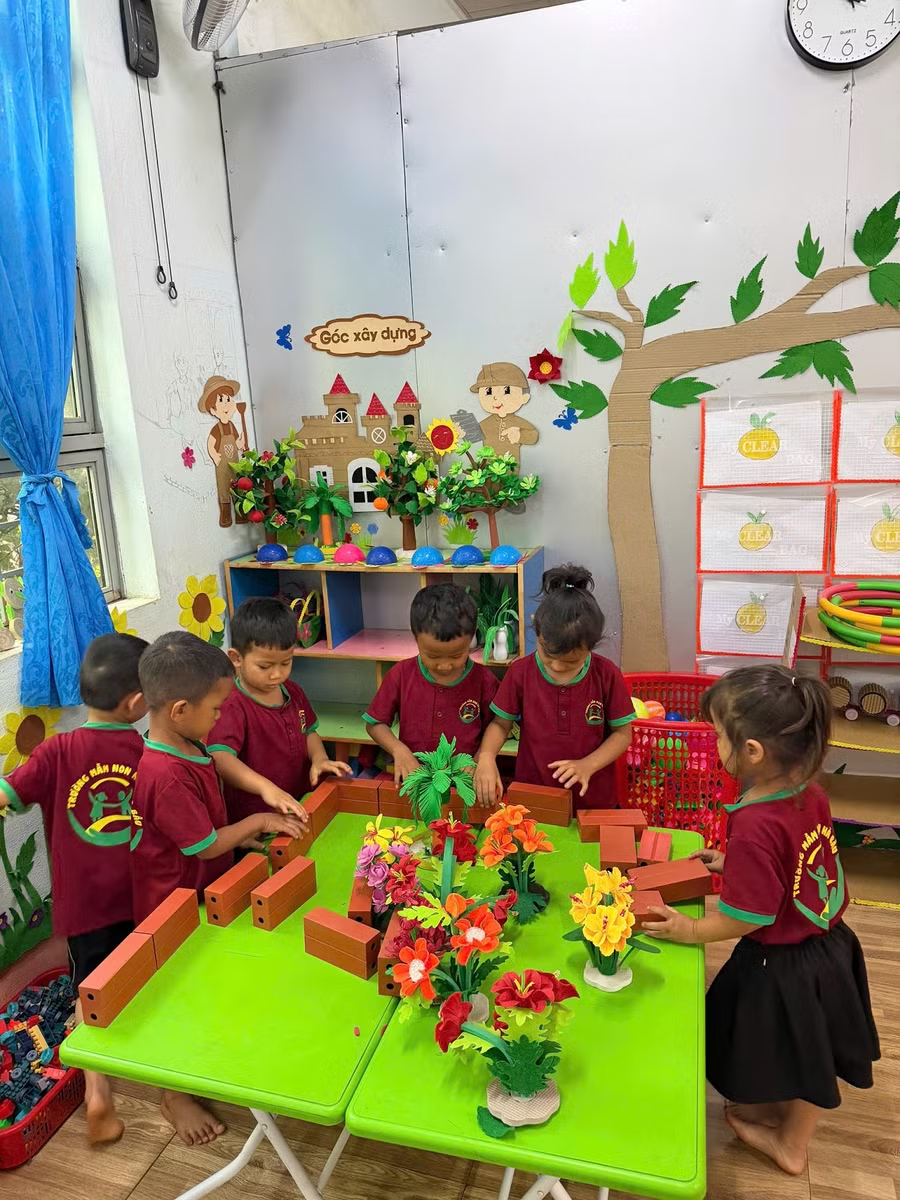
Understanding the stages of children's language development is crucial in how teaching is organized. When "quiet periods" are seen as an essential part of the process of acquiring a new language, teachers can release pressure and instead focus on observing, guiding, and supporting their children.
From there, the changes will be steady and perfectly aligned with each child's individual developmental rhythm.
VVOB is a non-profit organization from Belgium, operating in Vietnam since 1992. Since 2014, VVOB in Vietnam has focused entirely on education .
The TALK project (“Preschool teachers apply knowledge and teaching skills to create a language-rich learning environment for children”) is being implemented from 2022-2026 in Quang Tri, Tuyen Quang, and Gia Lai provinces, aiming to support preschool teachers and administrators through training, coaching, reflection, and other activities.
Source: https://giaoducthoidai.vn/ton-trong-tre-de-khoang-lang-thanh-tieng-noi-tu-tin-post778751.html











































































































Comment (0)