

On the morning of February 15th, the National Assembly held group discussions on the draft Resolution of the National Assembly on piloting a number of policies to remove obstacles in science , technology and innovation activities.
Speaking at the group meeting, General Secretary To Lam stated that Resolution 57 was issued at the end of 2024, but to be implemented effectively, it would require amending the Law on Science and Technology at the earliest in mid- or late 2025. Therefore, Resolution 57 cannot be implemented this year and cannot be formalized in legal documents.
Therefore, the General Secretary stated that he had proposed a resolution to remove obstacles for science and technology, because the process of amending the law would take years.
"The title of today's resolution is 'removal,' but as the delegates pointed out, it's not just about removing obstacles, but also about promoting and encouraging," the General Secretary said.
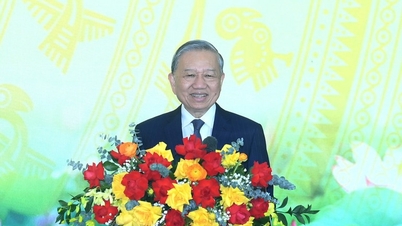
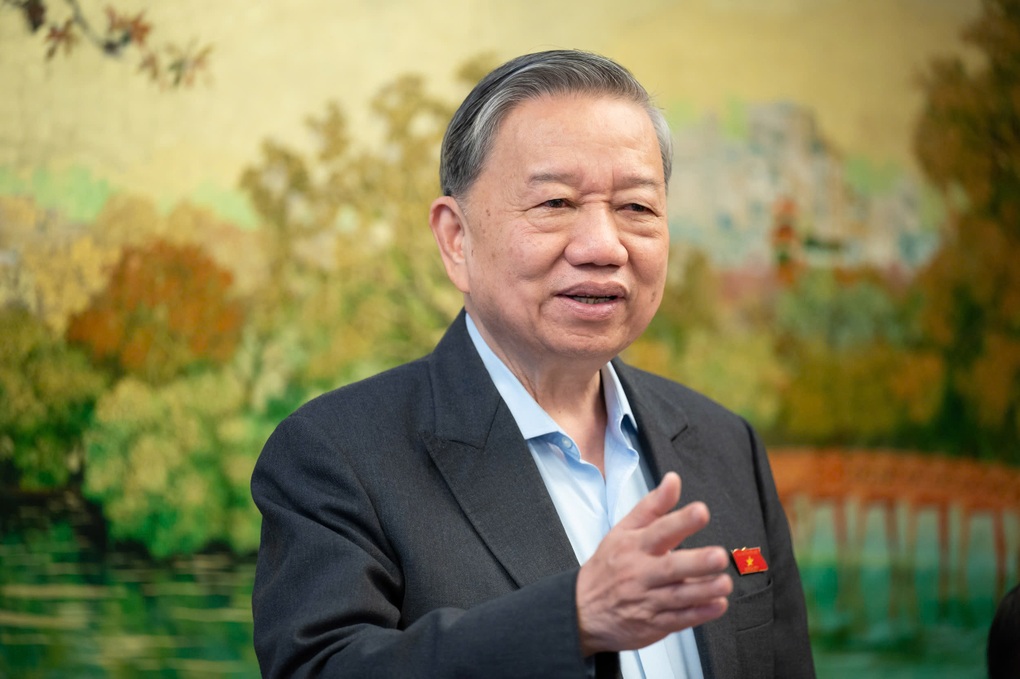 General Secretary To Lam speaks at the group meeting on the morning of February 15 (Photo: Pham Thang).
He argued that the scope of these issues is too vast, and touching on anything is difficult due to regulations. This is also a lesson in institutional reform, and this resolution is an urgent way to remove institutional obstacles.
According to the General Secretary, the National Assembly is holding an extraordinary session this time to address urgent issues.
Based on feedback from localities, ministries, and businesses, the Government presented a number of issues, outlining three groups of focused, directional issues. The General Secretary argued that if all issues were raised freely, not all could be addressed, and going into too much detail might prevent the resolution from being reached and lead to failure.
"The spirit is to run while lining up, keeping the lines neat and orderly, but still having to run first," he said.
According to the General Secretary, everyone recognizes the value and necessity of developing science and technology, but why hasn't it been developed? Because of many difficulties and problems; simply amending the Law on Science and Technology is not enough.
"The Bidding Law also has problems. The Bidding Law allows us to buy cheap goods, which turns it into a dumping ground for science and technology, even giving us outdated technology. We must take shortcuts and seize opportunities. Science and technology may be behind, but we must take shortcuts and seize opportunities. If the world is already developed and we don't know how to follow, we will lag behind," the General Secretary emphasized.
According to the General Secretary, even if someone gives something away for free, accepting it means falling into their trap. The Bidding Law only focuses on money and low prices, but if we invest at low prices, when will we ever catch up with the rest of the world?
He argued that some economies have failed to develop science and technology recently because they are facing capital constraints and are struggling to recoup their investment in order to improve and apply new scientific and technological advancements.
"If we fall into this trap again, we'll be doomed. That's the problem with the bidding process; the fault lies with the bidding officials who pushed things into this situation, and we must extricate ourselves from it," the General Secretary said.
Speaking about the importance of developing science and technology, the General Secretary stated that science and technology is a "wild land" to be explored; whoever enters it and succeeds will achieve great success. Therefore, there must be priority policies to accomplish these tasks.
The process of formulating Resolution 57 (Resolution 57-NQ/TW on breakthroughs in the development of science, technology, innovation, and national digital transformation) has received strong support from the scientific community and the people, but to implement it concretely and directly, the participation of all levels of the population and scientists is necessary, according to the General Secretary.
"It's true that to truly implement these principles, there's still another stage, more difficulties, and more challenges to overcome. To achieve results, we must innovate our thinking and methods, and look directly at reality to find solutions," General Secretary To Lam emphasized.
Regarding tax payments, according to the General Secretary, the government has granted tax exemptions and reductions, yet has collected more taxes.
"At the Government meeting, I was moved to hear about tax exemptions, tax reductions, and lower interest rates on loans. If people don't borrow money for production and business, the economy won't develop. Even with low interest rates, many people are borrowing. We must create regulations that encourage borrowing, not just focus on collecting as much as possible," the General Secretary said.
Dantri.com.vn

![[Photo] Prime Minister Pham Minh Chinh presides over the conference announcing the establishment of the International Finance Centre in Vietnam.](/_next/image?url=https%3A%2F%2Fvphoto.vietnam.vn%2Fthumb%2F1200x675%2Fvietnam%2Fresource%2FIMAGE%2F2025%2F12%2F21%2F1766309817714_ndo_br_dsc-3400-jpg.webp&w=3840&q=75)


![[Photo] Prime Minister Pham Minh Chinh presides over a meeting on private sector economic development.](/_next/image?url=https%3A%2F%2Fvphoto.vietnam.vn%2Fthumb%2F1200x675%2Fvietnam%2Fresource%2FIMAGE%2F2025%2F12%2F20%2F1766237501876_thiet-ke-chua-co-ten-40-png.webp&w=3840&q=75)
















































































Comment (0)