

On the morning of April 14th, at the Party Central Headquarters, the Central Steering Committee for summarizing the implementation of Resolution No. 18-NQ/TW, dated October 25, 2017, of the 12th Central Committee on "Some issues concerning the continued reform and restructuring of the organizational apparatus of the political system to be streamlined, effective, and efficient" (Resolution 18) held its third meeting.
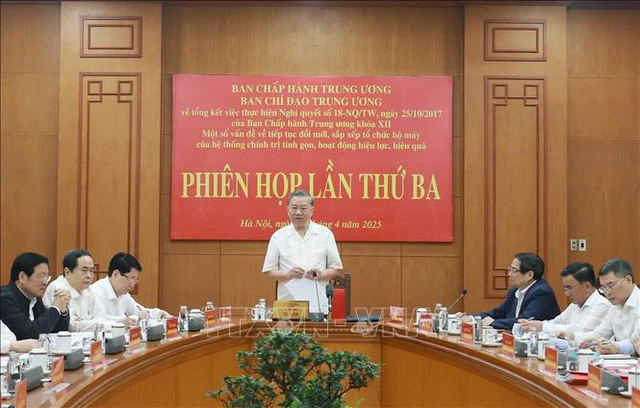
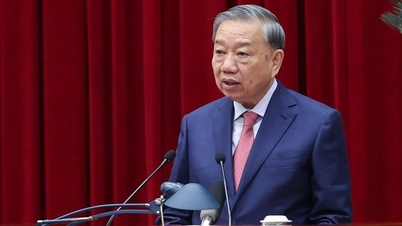
General Secretary To Lam , Head of the Central Steering Committee for summarizing the implementation of Resolution No. 18, chaired the meeting. Photo: VNA
The third meeting of the Central Steering Committee on summarizing the implementation of Resolution No. 18 was held to discuss and approve the Steering Committee's plan on the rearrangement and merger of provincial and commune-level administrative units and the establishment of a two-tiered political system at the local level.
General Secretary To Lam, Head of the Central Steering Committee for summarizing the implementation of Resolution No. 18, chaired the meeting.
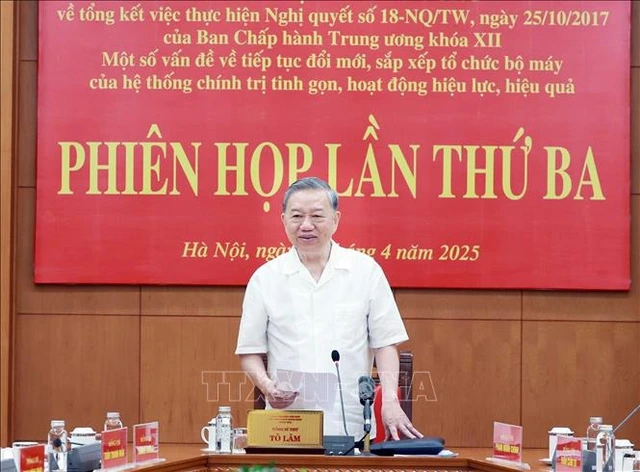
General Secretary To Lam, Head of the Central Steering Committee for summarizing the implementation of Resolution No. 18, delivered a directive speech at the meeting.
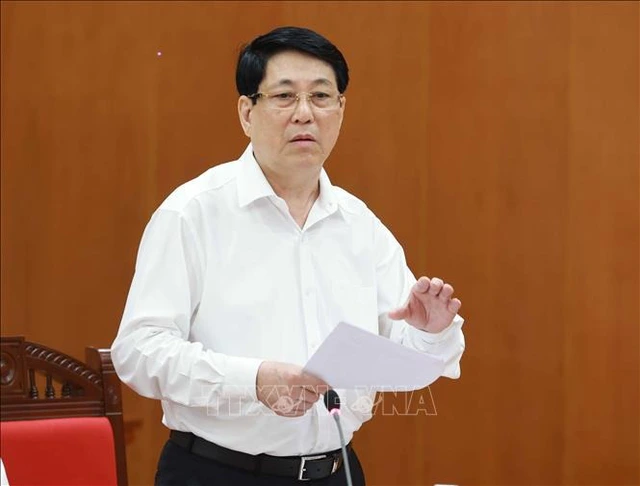
Politburo member and President Luong Cuong delivered a speech at the session.
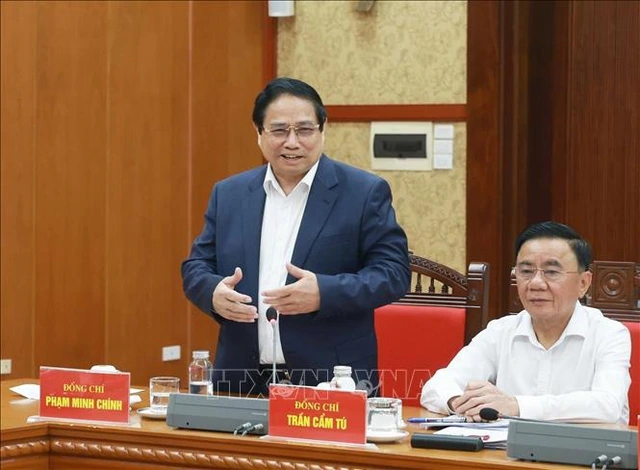
Politburo member and Prime Minister Pham Minh Chinh delivered a speech at the session.
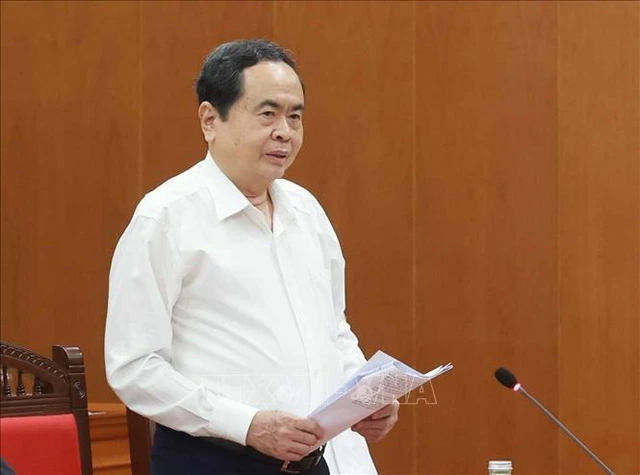
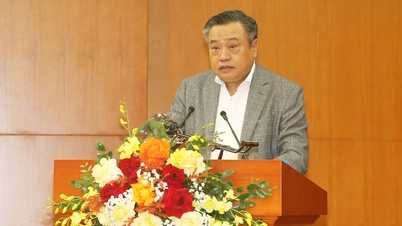
Politburo member and National Assembly Chairman Tran Thanh Man delivered a speech at the session.
The Central Committee of the Party agreed to merge the remaining 34 provinces and cities.
Previously, on April 12, 2025, on behalf of the Central Committee of the Party, General Secretary To Lam signed and promulgated Resolution 60 - Resolution of the 11th Conference of the Central Committee of the 13th Party Congress (11th Central Committee Conference).
According to Resolution 60, the 11th Central Committee Conference adopted several specific contents to continue implementing tasks and solutions to improve and enhance the efficiency and effectiveness of the organizational structure of the political system as follows:
Regarding the organization of a two-tiered local government structure: The principle of organizing a two-tiered local government is approved: provincial level (provinces, centrally-administered cities), and commune level (communes, wards, special zones under provinces and cities); the operation of district-level administrative units will cease from July 1, 2025, after the Resolution amending and supplementing several articles of the 2013 Constitution and the Law on Organization of Local Government 2025 (amended) comes into effect.
The number of provincial-level administrative units after the merger is agreed to be 34 provinces and cities (28 provinces and 6 centrally-administered cities); the names and political-administrative centers of the reorganized provincial-level administrative units will be determined according to the principles stated in the Government Party Committee's submission and plan. The merger of commune-level administrative units is also agreed to ensure a reduction of approximately 60-70% in the number of commune-level administrative units nationwide compared to the current number.
The proposed list of names for provinces, cities, and political-administrative centers of 34 provincial-level administrative units (attached to Resolution No. 60-NQ/TW, dated April 12, 2025)
Provincial-level administrative units that did not undergo mergers
1. Hanoi City
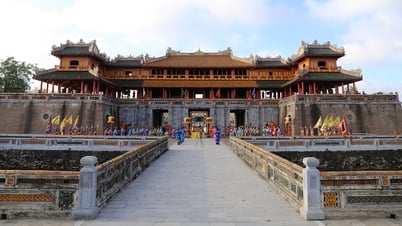
2. Hue City
3. Lai Chau Province
4. Dien Bien Province
5. Son La Province
6. Lang Son Province
7. Quang Ninh Province
8. Thanh Hoa Province
9. Nghe An Province
10. Ha Tinh Province
11. Cao Bang Province
It is expected that provincial-level administrative units will be merged or consolidated.
1. The provinces of Tuyên Quang and Hà Giang were merged and named Tuyên Quang province, with the political and administrative center located in the present-day Tuyên Quang province.
2. The provinces of Lao Cai and Yen Bai were merged, taking the name Lao Cai province, with the political and administrative center located in the present-day Yen Bai province.
3. The provinces of Bac Kan and Thai Nguyen were merged and named Thai Nguyen province, with the political and administrative center located in the present-day Thai Nguyen province.
4. The provinces of Vinh Phuc, Phu Tho, and Hoa Binh were merged; the province was named Phu Tho, with the political and administrative center located in the present-day Phu Tho province.
5. The provinces of Bac Ninh and Bac Giang were merged, retaining the name Bac Ninh province, with the political and administrative center located in the present-day Bac Giang province.
6. The provinces of Hung Yen and Thai Binh were merged, taking the name Hung Yen province, with the political and administrative center located in the present-day Hung Yen province.
7. Merge Hai Duong province and Hai Phong city, naming it Hai Phong city, with the political and administrative center located in the present-day Hai Phong city.
8. The provinces of Ha Nam, Ninh Binh, and Nam Dinh were merged; the province was named Ninh Binh, with the political and administrative center located in the present-day Ninh Binh province.
9. The provinces of Quang Binh and Quang Tri were merged, taking the name Quang Tri province, with the political and administrative center located in the present-day Quang Binh province.
10. The province of Quang Nam and the city of Da Nang were merged, taking the name Da Nang city, with the political and administrative center located in the present-day city of Da Nang.
11. The provinces of Kon Tum and Quang Ngai were merged and named Quang Ngai province, with the political and administrative center located in the present-day Quang Ngai province.
12. The provinces of Gia Lai and Binh Dinh were merged, taking the name Gia Lai province, with the political and administrative center located in Binh Dinh province.
13. The provinces of Ninh Thuan and Khanh Hoa were merged, taking the name Khanh Hoa province, with the political and administrative center located in the present-day Khanh Hoa province.
14. The provinces of Lam Dong, Dak Nong, and Binh Thuan were merged; the province was named Lam Dong, with the political and administrative center located in the present-day Lam Dong province.
15. The provinces of Dak Lak and Phu Yen were merged, taking the name Dak Lak province, with the political and administrative center located in the present-day Dak Lak province.
16. Merge Ba Ria - Vung Tau province, Binh Duong province and Ho Chi Minh City; take the name Ho Chi Minh City, with the political and administrative center located in the present-day Ho Chi Minh City.
17. The provinces of Dong Nai and Binh Phuoc were merged and named Dong Nai province, with the political and administrative center located in the present-day Dong Nai province.
18. The provinces of Tay Ninh and Long An were merged, retaining the name Tay Ninh province, with the political and administrative center located in Long An province.
19. The city of Can Tho, Soc Trang province, and Hau Giang province were merged; the name was adopted as Can Tho city, with the political and administrative center located in the current Can Tho city.
20. Merge Ben Tre province, Vinh Long province, and Tra Vinh province; take the name Vinh Long province, with the political and administrative center located in the present-day Vinh Long province.
21. The provinces of Tien Giang and Dong Thap were merged, taking the name Dong Thap province, with the political and administrative center located in Tien Giang province.
22. The provinces of Bac Lieu and Ca Mau were merged, taking the name Ca Mau province, with the political and administrative center located in the present-day Ca Mau province.
23. The provinces of An Giang and Kien Giang were merged, taking the name An Giang province, with the political and administrative center located in the present-day Kien Giang province.
Source: NLDO
Source: https://baotayninh.vn/tong-bi-thu-to-lam-chu-tri-hop-ve-sap-xep-sap-nhap-don-vi-hanh-chinh-cap-tinh-cap-xa-a188814.html






























































Comment (0)