

The above statement was made by the General Secretary during a meeting with representatives of teachers and education administrators on the occasion of Vietnamese Teachers' Day, this morning, November 18th.
General Secretary To Lam affirmed that education has always been a top national priority and the future of the nation; therefore, the Party and the State always give high priority to this field.
Against the backdrop of a world undergoing epochal changes, competition for the quality of human resources is identified as a core development opportunity. The General Secretary therefore raised three major issues for the education sector.
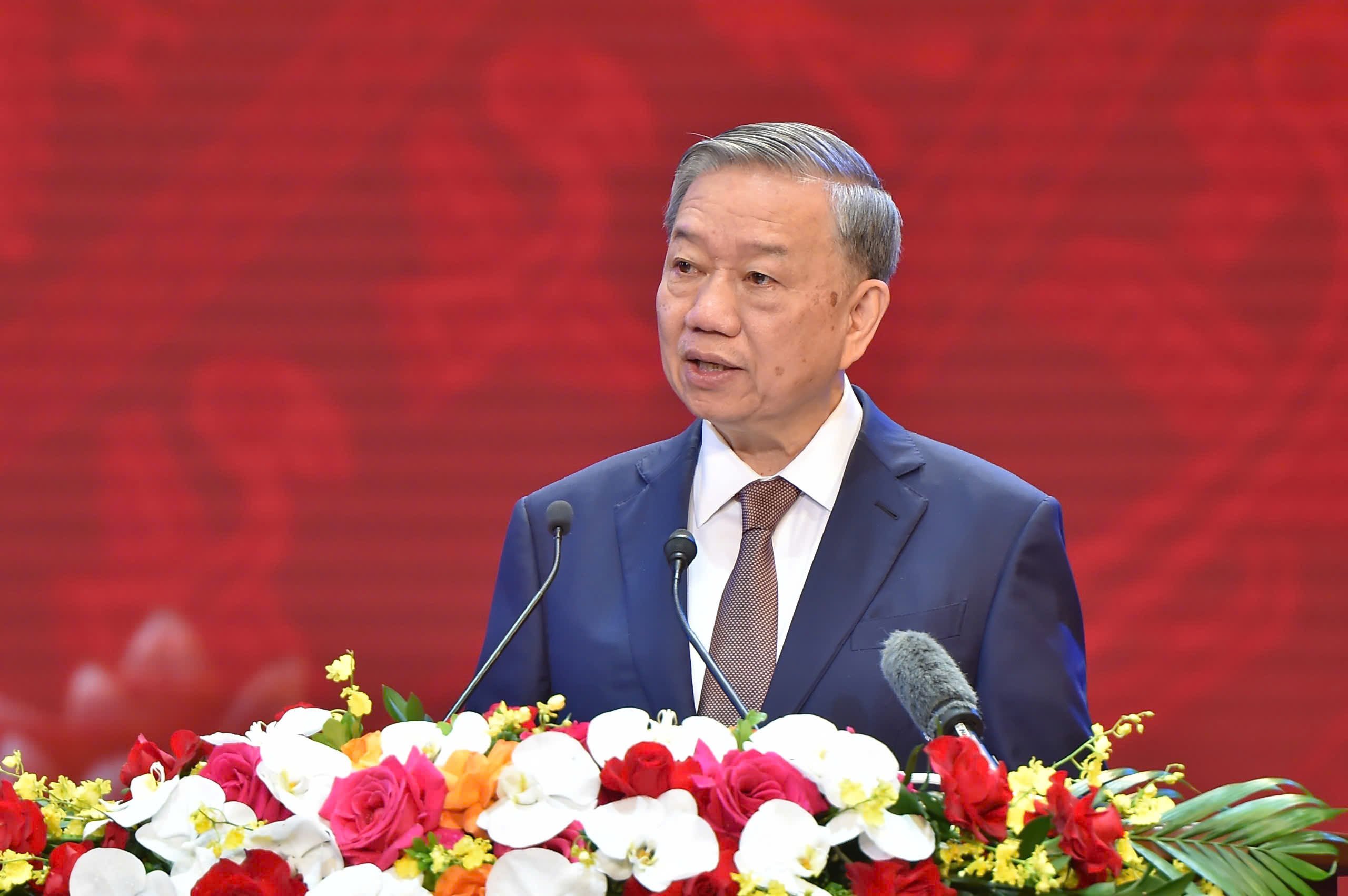
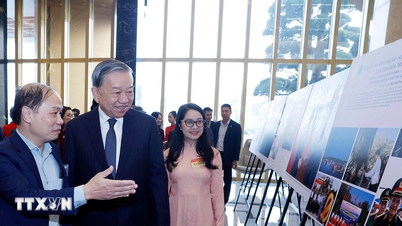
General Secretary To Lam delivered a speech at the event.
Firstly, the highest priority today is to complete the reform process and create human resources for national construction and defense in the era of national progress. This is a difficult and challenging task, but the "popular education" movement has strengthened our firm belief that we will succeed with a clear objective, intelligent policies, and innovative approaches.
The education sector must prioritize the development of individuals with good character, lifestyle, legal knowledge, and civic awareness; strongly innovate the content and methods of education towards simplification, modernization, increased practical application, emphasis on real-world learning, and avoidance of the pursuit of superficial achievements. For higher education, there needs to be a strong shift from primarily focusing on equipping students with knowledge to teaching skills, learning methods, and critical thinking.
"We must strive to improve Vietnam's education ranking on the regional and international map. Specifically, by 2030, Vietnam should be among the top three ASEAN countries in terms of the number of international publications and the impact index of scientific research works, with a university in the top 100 in the world," the General Secretary instructed.
Over the past three years, with approximately 18,000 international publications annually, Vietnam has been among the top 50 leading countries in this activity. Regarding university rankings, the highest position achieved by a higher education institution in Vietnam is within the top 400-500 globally, according to THE.
Secondly, the General Secretary pointed out several things that the education sector needs to do immediately, such as finding solutions to completely eradicate illiteracy; launching a "digital literacy campaign" to popularize digital transformation knowledge among the entire population. The education sector needs to focus on reviewing and definitively resolving the shortage of schools and classrooms in some large cities, industrial zones, densely populated areas, and mountainous regions; reinforcing school buildings and classrooms, while ensuring housing for teachers in remote areas and ethnic minority regions.
At the same time, the education sector needs to ensure that the state budget allocates at least 20% of total expenditure to education, in accordance with the Party's Resolution. There should be mechanisms and preferential policies to attract non-state resources to invest in the development of education and training. Relying on the people, mobilizing their strength, and organizing the people to participate in education should be done with the lowest possible cost and maximum effectiveness.
Thirdly , it is necessary to develop the teaching force both in quality and quantity. The General Secretary requested the Education sector to research mechanisms and policies to address the shortage of teachers, attract talented individuals, develop a team of leading experts and scientists, and build a healthy learning environment.
At the same time, the education sector needs to research breakthrough solutions to develop a team of leading experts and scientists who can work in the education sector while also contributing to other fields and sectors. It is essential to build a truly healthy learning environment with close and regular coordination between schools, families, the government, and local political and social organizations; clearly defining the responsibilities of schools, families, and society.
The General Secretary emphasized that we are standing at a historical threshold to fulfill the aspirations of the great President Ho Chi Minh, and that these aspirations can only be successfully realized when we successfully complete the task of reforming education and training. This glorious responsibility demands tremendous efforts, a strong breakthrough, and the concerted efforts of the entire Party, the entire people, and the entire army, first and foremost and most directly from the team of teachers and education management officials under the leadership of the Party.
"I believe that, with a country and a people with a tradition of valuing learning and respecting talent; a dedicated team of teachers who love their profession, are ready to sacrifice and commit to their work; and with the decisive and coordinated involvement of the entire political system, the entire education sector will overcome all difficulties and challenges, and successfully implement educational and training reforms," the Party leader said.
Earlier, the General Secretary acknowledged the achievements of the education sector in recent years, such as completing universal education for 5-year-old children; the quality of general education (both mass and advanced) has improved; and the number of international scientific publications has increased significantly. In addition, the General Secretary also stated that it is necessary to "frankly acknowledge" the areas that have not been achieved. For example, educational reform has been underway for decades, but fundamentally, it has not yet brought about a real qualitative change and has not met expectations.
Educational methods have not fostered the active participation and creativity of learners, nor have they focused on developing skills and qualities; the effectiveness of educational investment has not been commensurate with the policy of education being a top national priority. Furthermore, the shortage of schools and classrooms in some large cities, industrial zones, densely populated areas, and mountainous regions, as well as illiteracy and relapses into illiteracy in remote areas, are serious concerns. The teaching staff remains insufficient in number, a portion lacks professional competence, is not actively embracing innovation, and a small number still exhibit ethical violations that negatively impact public opinion.
The General Secretary also pointed out long-standing shortcomings that have not been definitively resolved, such as the fact that the quality of education at all levels is generally still heavily focused on theory and lacks practical application; tens of thousands of graduates with bachelor's and master's degrees cannot find jobs, causing great waste.
Source: https://vtcnews.vn/tong-bi-thu-to-lam-phan-dau-tang-hang-giao-duc-viet-nam-ar908051.html

![[Photo] Prime Minister Pham Minh Chinh presides over a meeting on private sector economic development.](/_next/image?url=https%3A%2F%2Fvphoto.vietnam.vn%2Fthumb%2F1200x675%2Fvietnam%2Fresource%2FIMAGE%2F2025%2F12%2F20%2F1766237501876_thiet-ke-chua-co-ten-40-png.webp&w=3840&q=75)






































































Comment (0)