

Moving towards waiving building permits for individual houses.
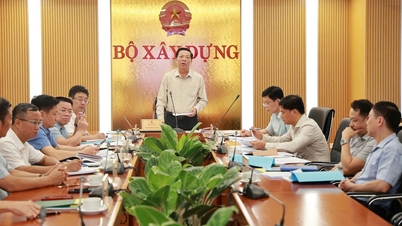
At a recent meeting on construction permit issuance in the city, Mr. Bui Xuan Cuong, Vice Chairman of the Ho Chi Minh City People's Committee, directed relevant departments and agencies to review and improve the legal framework related to construction permits, ensuring consistency and suitability to practical management. The focus is on perfecting the current architectural management regulations, which have many shortcomings, especially regarding height and setback requirements for individual houses. Furthermore, the Ho Chi Minh City People's Committee leadership also directed a review of regulations on the collection, collection methods, and management of construction permit fees, ensuring they are consistent with the conditions after administrative unit reorganization and updated according to new legal regulations expected to take effect from July 1st.
A highlight in Ho Chi Minh City's management and direction regarding the construction sector is the study of options to simplify and eventually exempt individual houses from construction permits in certain eligible cases, thereby reducing processing time and easing pressure on licensing agencies. Simultaneously, the entire process of receiving and processing applications will be transferred to an electronic environment. Wards, communes, and special zones will no longer accept paper applications, but will receive, process, and monitor them online, while also connecting data with the Ho Chi Minh City Department of Construction and the Ministry of Construction to facilitate supervision and inspection.

In addition to accelerating the resolution of long-standing stalled projects, administrative procedures for construction permits have also been directed to be shortened as much as possible.
Photo: Dinh Son
According to architect Khuong Van Muoi, former Chairman of the Ho Chi Minh City Architects Association, the city has been continuously accelerating the handling of long-standing legal obstacles in real estate projects. To date, out of a total of 838 projects, more than half have been resolved, and plans for the remaining projects and businesses have been approved. Furthermore, the city is also actively addressing issues in commercial housing projects to prioritize the issuance of ownership certificates to homebuyers and alleviate difficulties for businesses. Many long-standing cases have been resolved after specialized meetings of the task force.
Simultaneously, administrative procedure reforms in the construction sector are also being accelerated with the aim of minimizing intermediaries and reducing costs and time for citizens and businesses. One of the most关注ed aspects currently is the policy of exempting construction permits for cases that already have a detailed 1/500 scale plan, urban design, or fully meet architectural management requirements. This is a direction consistent with the modern management trends of many countries.
Shift from pre-audit to post-audit
Architect Tran Tuan believes that Ho Chi Minh City's completion of the architectural management regulations issued under Decision 56 of 2022 is absolutely necessary and urgent because this decision contains many unreasonable provisions. For example, previously, building height permits were based on road width, but now they are based on coefficients, so some roads that previously allowed 7-story buildings now only allow 2-3 stories. "The regulations on coefficients, building height, and setbacks are meant to ensure ventilation, but subsequent builders react negatively because they are at a disadvantage compared to the previous regulations," architect Tran Tuan said.
Furthermore, when Decision 56 was issued, local authorities reacted differently, each interpreting it differently and applying it differently. Many places lacked 1/2,000 scale planning projects, or their old projects hadn't been updated with the land use coefficient, so they didn't know how the coefficient was calculated, or the coefficient was too low, limiting construction to only 2-3 stories. In particular, houses on main roads are now allowed to be built much lower than before, causing public outcry. Local authorities want to resolve this issue for the people, but fear repercussions, so things remain stalled. Therefore, when the architectural management regulations are revised and improved, they will become the standard for applying exemptions from construction permits.
Ho Chi Minh City People's Committee Vice Chairman Bui Xuan Cuong directed that, as an immediate step, a "guidebook" on granting building permits for individual houses should be developed. This guide should standardize the process, required documents, steps for processing and adjusting permits, and post-licensing inspections. This document will be widely publicized through various information channels, making it easily accessible to the public and increasing transparency in construction management. This aims to limit the situation where each locality applies different interpretations: some still base permits on old planning regulations, while others temporarily suspend accepting applications due to a lack of legal basis, causing localized bottlenecks in individual house construction procedures in recent times.
Supporting the city's policy, a former leader of the Ho Chi Minh City Department of Construction analyzed that requiring a construction permit after a project has already undergone a series of planning, design, fire safety, and environmental assessments is unnecessary and should be eliminated immediately. For many years, the construction permit application process has been one of the most time-consuming and laborious procedures for citizens. In many cases, applications require multiple revisions and frequent trips between agencies. For individual houses, especially in areas with clear planning, waiving the construction permit requirement would significantly reduce costs and shorten the construction preparation time. Instead of waiting weeks, even months, for a permit, people could proceed with construction faster if they meet the planning and technical standards.
According to experts, a notable aspect of this reform is the shift in management methods. Previously, regulatory agencies exercised strict control from the outset through a multitude of permits. Now, the trend is towards simplifying initial procedures, strengthening post-inspection, and severely punishing violations. With the synchronized digitization of planning, land, and construction data, technology-based management will be far more effective than the traditional "request-and-grant" mechanism. Citizens have the right to proactively build according to the plan, while regulatory agencies focus on compliance checks. Illegal construction or violations of the plan will be severely punished. This approach reduces bureaucratic hurdles while increasing the responsibility of investors. Therefore, waiving construction permits for eligible cases not only reduces the administrative burden but also creates a positive market sentiment and unlocks social resources.
If Ho Chi Minh City successfully implements this reform model, it could become a model to be replicated in many other localities, contributing to promoting urban development in a more transparent, modern, and efficient direction.
Source: https://thanhnien.vn/tphcm-cat-giam-manh-thu-tuc-cap-phep-xay-dung-185260521213521942.htm




























































































Comment (0)