

According to the report, in the first quarter, the city's GRDP reached 457,600 billion VND, an increase of 7.51% compared to the same period in 2024. Budget revenue reached 151,098 billion VND, equivalent to 29% of the projected amount. The city actively accelerated the disbursement of public investment, implementing key infrastructure projects, especially those commemorating the 50th anniversary of the Liberation of the South and the reunification of the country.
Regarding the disbursement of public investment capital, the plan requires over 67,395 billion VND, but only 4,556 billion VND has been disbursed so far, reaching 5.4%. The city requests that investment procedures be expedited to ensure timely capital allocation.
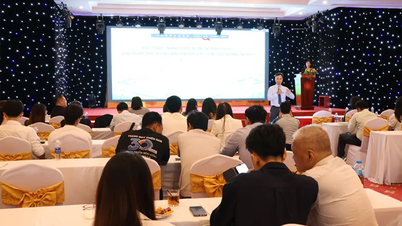
At the meeting, National Assembly Deputy Tran Hoang Ngan, Assistant to the City Party Secretary, requested the city to quickly resolve obstacles and related issues; and at the same time proposed solutions to accelerate construction projects, especially key projects that will create momentum for other sectors and fields.
Although the city's economy showed many positive signs in the first quarter, the slow disbursement of public investment will significantly affect the city's overall growth target for this year. This is because public investment plays a major role in driving investment capital across society.
Mr. Ngan stated that the reorganization of the three provincial-level administrative units – Ho Chi Minh City, Binh Duong, and Ba Ria - Vung Tau – is currently underway. Resolution 98, if continued to be applied, will be a significant driving force for the development of the Ho Chi Minh City region after the merger. The city needs to submit proposals emphasizing the need to implement Resolution 98 for the Ho Chi Minh City region, to avoid disrupting or affecting the implementation of projects and works.
Mr. Ngan also suggested that the city should focus on two things in the coming period: public investment and personnel allocation. Public investment creates an important foundation for the city to make breakthroughs in the era of national development. Doing a good job of public investment, ensuring smooth and synchronized infrastructure, will attract private sector and foreign investment. Personnel arrangement is also a decisive issue in the coming time. The city needs to strive to select the best officials to handle the work.
Vice Chairman of the Ho Chi Minh City People's Committee, Nguyen Van Dung, stated that the city is focusing its efforts on many major tasks, facing significant work pressure. The city continues to review and finalize documents to be sent to the Ho Chi Minh City National Assembly Delegation to address difficulties and obstacles, including a unified proposal to continue applying Resolution 98 to create momentum for the Ho Chi Minh City region after the merger of Binh Duong and Ba Ria - Vung Tau. Simultaneously, he requested that the delegates propose to the National Assembly adjustments to some contents of Resolution 98 in the upcoming session.
According to Mr. Dung, the city is highly determined to reorganize its administrative apparatus so that officials can quickly begin their work immediately after the merger and reorganization, avoiding any disruption or impact on citizens and businesses.
Resolution 98, effective August 1, 2023, replaces Resolution 54, allowing the city to apply 44 specific mechanisms and policies in various fields such as infrastructure investment, finance and budget, construction and planning, attracting strategic investors, organizational structure, etc.
Mr. Ngan stated that the upcoming National Assembly session will amend a series of laws to facilitate mergers and streamlining. During this process, if the resolution on special mechanisms is not halted, it will help ensure that existing policies are not affected and will even have a ripple effect.
For example, in Binh Duong province, Resolution 98 can be applied to implement PPP projects on existing roads, and TOD (Transit-Oriented Development) can be used in metro construction. In particular, given the large geographical area and heavy workload, officials in all localities will benefit from increased income, creating motivation for them to strive during this challenging period. "We hope that the special mechanism will be maintained in some other localities after the merger so that ongoing work is not disrupted," Mr. Ngan said.
After reorganization, Ho Chi Minh City covers an area of over 6,772 square kilometers, has more than 13.7 million people, and 190 subordinate administrative units, forming a new megacity in the Southeast region. The city will have a very significant influence, contributing nearly 24% of the country's GDP.
Source: https://baophapluat.vn/tp-hcm-de-xuat-tiep-tuc-thuc-hien-nghi-quyet-98-khi-sap-nhap-tinh-post546678.html
![[Photo] Prime Minister Pham Minh Chinh presides over a meeting on private sector economic development.](/_next/image?url=https%3A%2F%2Fvphoto.vietnam.vn%2Fthumb%2F1200x675%2Fvietnam%2Fresource%2FIMAGE%2F2025%2F12%2F20%2F1766237501876_thiet-ke-chua-co-ten-40-png.webp&w=3840&q=75)


![[Photo] Prime Minister Pham Minh Chinh presides over the conference announcing the establishment of the International Finance Centre in Vietnam.](/_next/image?url=https%3A%2F%2Fvphoto.vietnam.vn%2Fthumb%2F1200x675%2Fvietnam%2Fresource%2FIMAGE%2F2025%2F12%2F21%2F1766309817714_ndo_br_dsc-3400-jpg.webp&w=3840&q=75)

































































Comment (0)