

Over the past two weeks, the National Children's Hospital has admitted and treated four children who were stung by wasps, two of whom were hospitalized in very serious condition.
On July 25th, a 2-year-old child from Ninh Binh was playing with his grandparents in the garden when he was suddenly stung on the head, arms, and back by a swarm of wasps.
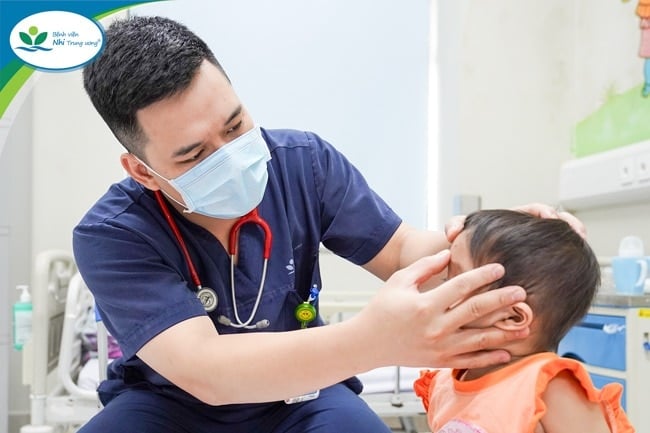 |
| Over the past two weeks, the National Children's Hospital has admitted and treated four children who were stung by wasps, two of whom were hospitalized in very serious condition. |
After being burned, the family quickly took the child to the local hospital for emergency treatment. The child was diagnosed with elevated liver enzymes and acute rhabdomyolysis and was transferred to the National Children's Hospital for further treatment.
At the Emergency and Toxicology Department, the child was treated for acute rhabdomyolysis, using forced diuresis to prevent acute renal failure. Currently, after 4 days of treatment, the child's health has stabilized and they have been discharged from the hospital.
Notably, on the same day, doctors at the Emergency and Toxicology Department of the National Children's Hospital also admitted patient HT (11 years old, from Hanoi ) who was in anaphylactic shock due to a wasp sting.
According to the child's family, while playing ball with friends in front of their house, the child was unexpectedly stung by two wasps on the back and shoulder area.
Following the cauterization, the child developed generalized skin redness and itching. After about 10 minutes, the child sweated profusely, fainted, and was taken to Ha Dong General Hospital by family members in an unconscious state, unresponsive to questioning, with a rapid, weak pulse of 130 beats/minute, unmeasurable blood pressure, rapid heartbeat, and SpO2 of 94-96%.
Here, the child was treated according to the anaphylactic shock protocol. After treatment, the child became more alert and was transferred to the National Children's Hospital. After initial admission and examination at the Emergency and Toxicology Department, the child was diagnosed with anaphylactic shock due to a wasp sting.
The child continued to receive adrenaline, oxygen support, and medications according to the protocol for managing anaphylactic shock and preventing complications from the bee sting. After 4 days of treatment, the child's health stabilized and they were discharged from the hospital.
According to Dr. Nguyen Tan Hung, Deputy Head of the Emergency and Toxicology Department at the National Children's Hospital, wasp venom is a mixture of peptides and inflammatory mediators such as histamine, phospholipase A2, and amino acids, with about 40 components that can cause anaphylactic shock, hemolysis, red blood cell rupture, coagulation disorders, rhabdomyolysis, acute renal failure, etc.
The severity of the venom dose depends on the type of bee, the number of stings, and the location of the sting. For adults, a severe sting is considered serious if there are more than 30 stings, while for children it is considered serious if there are more than 10 stings. If not treated promptly, the victim's life is in great danger.
People are often stung by bees due to accidents at work, in daily life, while hiking in the forest, or while raising bees for honey or harvesting wild honey. In children, it's usually due to teasing, playing with, or destroying beehives (usually yellow wasps or hornets) or being accidentally stung while playing.
To prevent bee stings, Dr. Nguyen Tan Hung, a specialist in internal medicine, advises that young children should be accompanied by a guardian when playing outdoors. If beehives are found near residential areas, it is necessary to seek the help of an experienced person to remove them; children should be instructed not to poke, throw objects at, or disturb the beehives.
Families going on picnics should avoid wearing brightly colored clothing or clothing with floral prints, and refrain from consuming sweet foods and drinks that could attract bees.
If you are unlucky enough to be surrounded by wasps, stay calm, take deep, steady breaths, do not run, and do not swat the wasps. When the wasps realize it is a person, they will fly away.
If a child is unfortunately stung by a wasp, parents should remove the stinger (if present) by gently scraping it out with tweezers, avoiding squeezing it with their hands as this may spread the venom. Wash the stung area thoroughly with soap or clean water and take the child to the nearest medical facility for examination and timely treatment.
Source: https://baodautu.vn/tre-soc-phan-ve-do-ong-dot-bac-sy-huong-dan-cach-so-cuu-d221907.html


![[Photo] Prime Minister Pham Minh Chinh presides over a meeting on private sector economic development.](/_next/image?url=https%3A%2F%2Fvphoto.vietnam.vn%2Fthumb%2F1200x675%2Fvietnam%2Fresource%2FIMAGE%2F2025%2F12%2F20%2F1766237501876_thiet-ke-chua-co-ten-40-png.webp&w=3840&q=75)

![[Photo] Prime Minister Pham Minh Chinh presides over the conference announcing the establishment of the International Finance Centre in Vietnam.](/_next/image?url=https%3A%2F%2Fvphoto.vietnam.vn%2Fthumb%2F1200x675%2Fvietnam%2Fresource%2FIMAGE%2F2025%2F12%2F21%2F1766309817714_ndo_br_dsc-3400-jpg.webp&w=3840&q=75)



















































































Comment (0)