

Pham Than Duyat and Ton That Thuyet had a close relationship. In 1875, when Ton That Thuyet was the Acting Governor-General of Ninh-Thai, overseeing military affairs in the four provinces of Bac Ninh , Thai Nguyen, Lang Son, and Cao Bang, Pham Than Duyat was the Governor of Bac Ninh. When Ton That Thuyet was promoted to Acting Governor-General of Ninh-Thai, Pham Than Duyat served as the Acting Governor-General. In mid-1882, Ton That Thuyet was summoned back to the capital, and Pham Than Duyat, along with Lam Hoanh, submitted a petition to Emperor Tu Duc requesting that Ton That Thuyet relinquish his position as Grand Minister of the Privy Council, but it was not accepted.
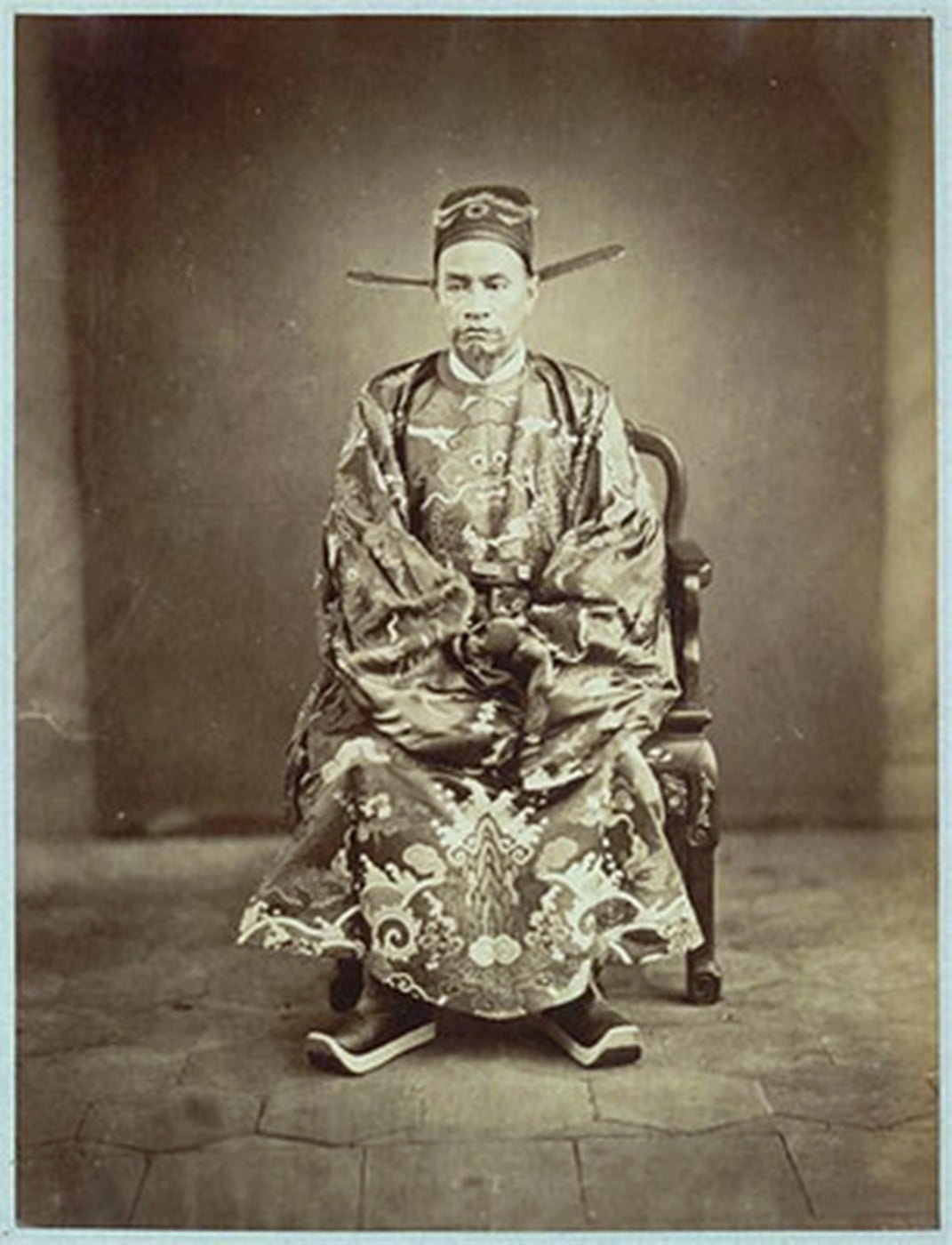
Regent Nguyen Van Tuong (1824 - 1886)
PHOTO: LE NGUYEN ARCHIVES
There was also a family connection between these two pro-war figures: Ton That Thuyet's eldest son, Ton That Dam, was betrothed to Pham Than Duyat's daughter, Pham Thi Thu. The marriage failed because Ton That Dam committed suicide after King Ham Nghi was captured in 1888. Pham Than Duyat, while serving as Minister of the Board of Revenue, also held the position of Deputy Minister of Public Works to directly oversee the construction of Tan So and the mountain defense offices.
King Kiến Phúc's ascension to the throne was also the wish of King Tự Đức. It was during the reigns of Kiến Phúc and Hàm Nghi that the Huế court prepared for the Cần Vương movement to resist the French for a long time. It was precisely because of this that the French constantly obstructed it, ultimately leading to the fall of the Huế citadel.
BUILDING MOUNTAINS AND Trenches, CONSTRUCTING MANSIONS AND ARMOR DEPOSIT CENTERS
Immediately after Hiep Hoa was deposed and King Kien Phuc ascended the throne, the Hue court ordered the construction of Tan So citadel and Duong Yen mountain stronghold (Quang Nam), and the repair of mountain strongholds and the main road. "The mountain stronghold of Quang Tri can serve as a rear route for the capital..." They then authorized the construction of ramparts and moats, the building of government offices, gun depots, barracks, and various watchtowers and fortresses... and chose a location to relocate the Lao Bao garrison. They established residences and workplaces for civil and military officials, set up medicine depots, barracks, and elephant workshops.
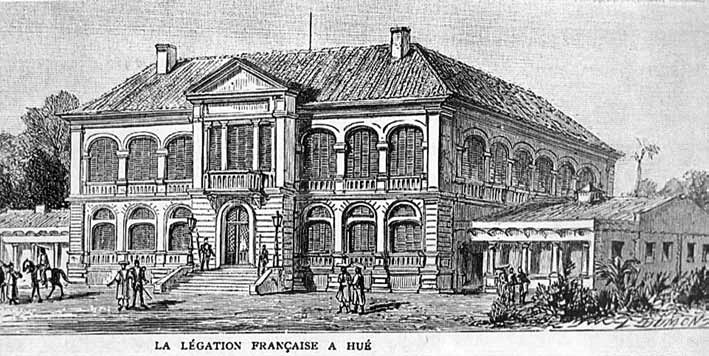
Apostolic Nunciature (Hue)
PHOTO: ARCHIVE
The Tân Sở citadel in Quảng Trị served as a rear route to the capital, or a reserve capital for the provinces. When the Cần Vương movement in Quảng Nam retreated from La Qua (Điện Bàn), they moved to the Dương Yên mountain stronghold. After Dương Yên fell, Trung Lộc was built and renamed Tân Tỉnh. This was part of a long-term resistance plan devised by the Kiến Phúc court and the pro-war group.
We know that, besides the capital Hue, Hanoi, Gia Dinh, and other provinces and cities throughout the country were built on riverbanks to facilitate the transportation of supplies and food by boat. However, this was an insurmountable disadvantage when fighting against the French invaders, whose main force was the navy.
"Copper ships and large guns" were the advantage of the invading army. To resist the French colonialists for the long term, the court of Kiến Phúc, and subsequently Hàm Nghi, realized the need to move the court and the king away from the capital, which was controlled by the French on three sides: Thuận An, the Residency across the Hương River, and especially Trấn Bình Đài (Mang Cá).
All three locations were strategic. Two places the court could temporarily relocate to when leaving the capital of Hue were Tan So in the north and the Duong Yen mountain stronghold in the south. And in the long term, the court could establish a base in Binh Dinh, backing onto the Central Highlands, or in the mountainous region of Thanh Hoa.
The imperial court ordered the transfer of salt, rice, gold, and silver to Tan So and Duong Yen. Ninety loads of gold and silver were transported to the Duong Yen mountain stronghold (Quang Nam). Meanwhile, provinces and cities such as La Qua, Quang Ngai, Binh Dinh, Phu Yen... (in the south) or Quang Binh, Ha Tinh, Nghe An, Thanh Hoa... (in the north) would retreat to their mountain strongholds. The main road along the Truong Son mountain range would become the vital artery, connecting the provinces and the imperial court, replacing the coastal highway which the French could easily control and cut off.
According to reports from Bishops Camelbeck in Quy Nhon, Caspar in Hue, and Puginier in Hanoi, France was well aware of the imperial court's plans. Three months before the signing of the Treaty of Giap Than (June 6, 1884), Admiral Courbet sent a proposal to General Millot suggesting the immediate capture of Hue to thwart this plan . (to be continued)
(Excerpt from the book "Gathering Insights into Vietnamese History" by researcher Tran Viet Ngac, published by Ho Chi Minh City General Publishing House)
Source: https://thanhnien.vn/trieu-vua-kien-phuc-khang-phap-185260313221404489.htm

![[Photo] Prime Minister Pham Minh Chinh presides over meetings of the Government Standing Committee to discuss several important issues.](https://vphoto.vietnam.vn/thumb/1200x675/vietnam/resource/IMAGE/2026/03/16/1773674631996_ndo_br_img-5789-jpg.webp)
![[Photo] The General Secretary works with the Executive Committee of the Hai Phong City Party Committee.](https://vphoto.vietnam.vn/thumb/1200x675/vietnam/resource/IMAGE/2026/03/16/1773629925474_vna-potal-tong-bi-thu-lam-viec-voi-ban-chap-hanh-dang-bo-thanh-pho-hai-phong-8644445-332-jpg.webp)

![[Photo] Prime Minister Pham Minh Chinh receives the Ministers of Foreign Affairs, Defense, and Public Security of China.](https://vphoto.vietnam.vn/thumb/1200x675/vietnam/resource/IMAGE/2026/03/16/1773659638054_ndo_br_dsc-4386-6157-jpg.webp)



![[Image] National Assembly through the terms](https://vphoto.vietnam.vn/thumb/402x226/vietnam/resource/IMAGE/2026/03/15/1773534202709_1-jpg.webp)






























































Comment (0)